Opinion: Journalism, being a journalist is an act of resistance we must lean into
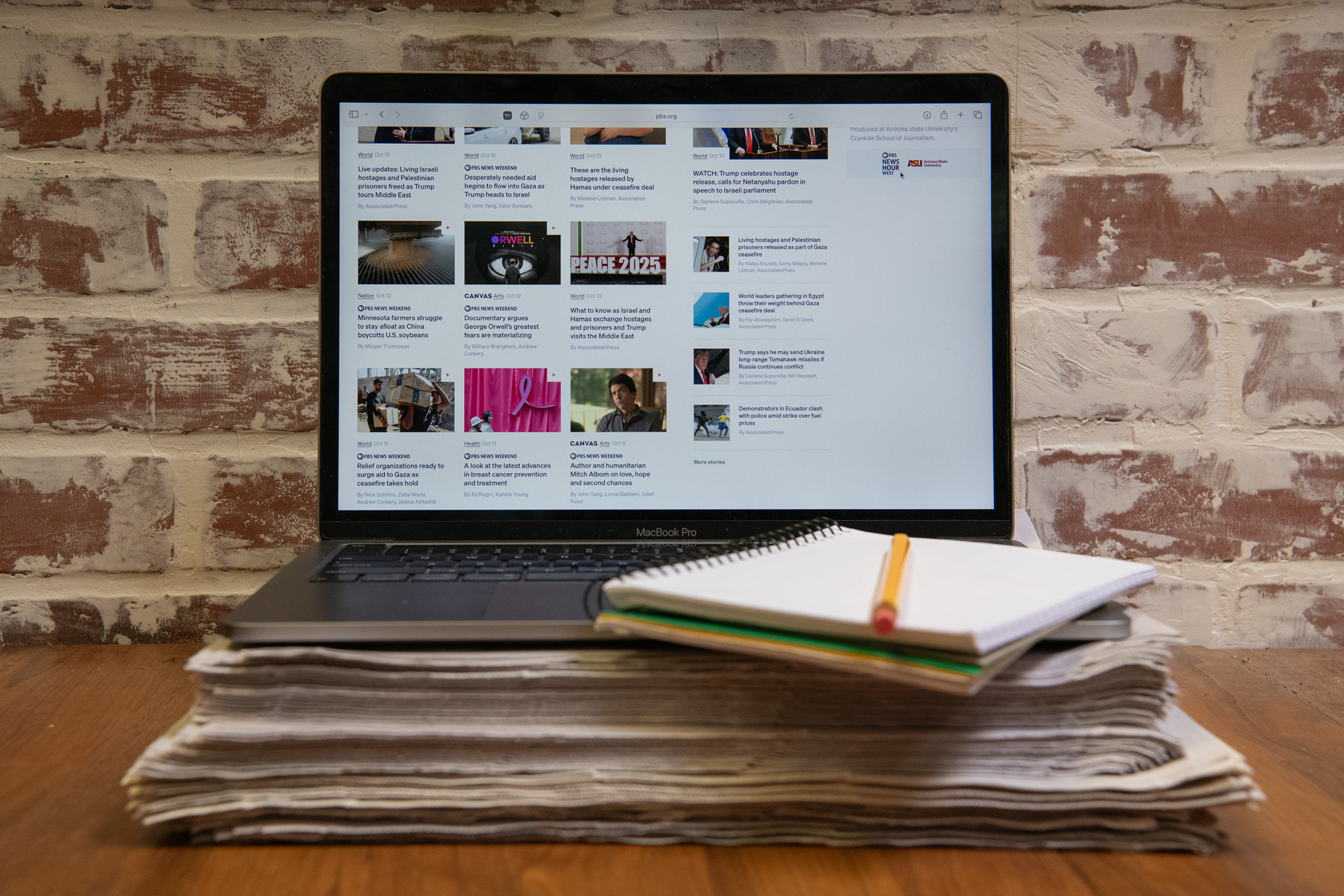
A journal and laptop displaying news stories are pictured. Columnist Ruby Galbraith argues that we all need to adopt journalistic practices in our everyday lives. (Ruby Galbraith/Daily Bruin)

By Ruby Galbraith
Oct. 13, 2025 8:05 p.m.
This post was updated Oct. 14 at 8:05 p.m.
At times, I question whether I can really call myself a journalist.
I am not planning on going to graduate school for journalism, pursuing a career with a major news organization, dedicating my life to writing or any of the other numerous things people tend to assume when I tell them I am a writer for the Daily Bruin.
Even my column pieces feel too infrequent to justify adding “journalist” to my list of identities.
But as I continue to witness my country suppress free speech and spread misinformation, it becomes clear that being a journalist is one of my greatest assets.
With funding cuts to NPR and PBS and the president threatening to take talk show hosts off the air, the Trump administration has ushered in a new era of attacks on free speech.
Student journalism has similarly experienced a worrying trend of budget cuts and censorship. Many universities are facing suspension of federal funding, and international students at some schools are facing difficulty working for their campus newspapers because of visa restrictions.
The whole situation has consistently made me feel overwhelmed and powerless. I struggled to find ways to resist the attacks on free speech while being a full-time student.
However, the most vital form of resistance is to engage in the very behavior that the Trump administration wants to restrict: the act of being a journalist.
But what does being a “journalist” even mean?
Calling myself a journalist painted a picture of a future that I don’t plan to pursue. But what I have come to realize – and what I want other students to embrace – is that journalism is not just a profession but a dedication toward a method of observing and thinking about the world.
Even if they do not write for a newspaper, there are concrete ways students can apply the lessons of journalism to their daily lives and uphold the ideals of free speech and free press.
First: sourcing.
In order to share information, one must first attain that information. This can be harder than it looks. In a world where humans are correct in identifying human versus AI-generated images only 50% of the time per a 2024 study, the “truth” can seem elusive. Knowing where and how to source reputable, diverse information is a skill that is immensely applicable outside of the newsroom.
Second: communication.
Having the information from sourcing is one thing, but being able to communicate it to other people is a necessary step. Communicating clearly and concisely – while staying committed to accuracy – is vital when sharing both news and opinions.
Third: integrity.
This is the most broad and important category, encompassing a variety of ethical obligations. Through all the steps of the journalistic process, it is essential to stay committed to transparency, accountability and accuracy. While you will make mistakes, commitment to these values is what truly defines a journalist.
By applying these tenets of journalism to our lives, we give ourselves the opportunity to keep the Trump administration accountable and advocate for our needs.
Through reaffirming our commitment to the free, accurate spread of information, we will do our part to resist censorship and misinformation.
There is a long legacy of journalists creating concrete change in American society.
In 1892, Ida B. Wells’ investigation and subsequent pamphlet publication about lynchings helped catalyze the anti-lynching movement.
In 1954, Edward R. Murrow risked his job as a CBS news journalist to speak out against the actions of Sen. Joseph McCarthy, leading to increased public awareness about McCarthy’s unfounded claims of the Communist allegiances of government employees.
In 2023, Northwestern University released its head football coach after student journalists published reports of the coach’s alleged participation in hazing and racist behavior.
Now, it is our turn. We must embrace the journalistic method to fight back against the trends of misinformation and censorship that are affecting our campus and the country.
Despite my original hesitancy, I realized my future plans have no bearing on my identity as a journalist.
The commitment, not the career, is what counts.
I am now proud to call myself a journalist.
I challenge the UCLA student body to consider using ethical journalism methods as a way of fostering critical thinking, educating others and advocating for institutional change. The Trump administration has brought seemingly insurmountable challenges to the country, but our community has enormous potential.
By educating ourselves, we refuse to give in to ignorance and hatred. By sourcing and communicating with integrity, we commit to the truth.
By becoming journalists, we resist.