UCLA Jewish researchers criticize funding cuts, response to antisemitism claims
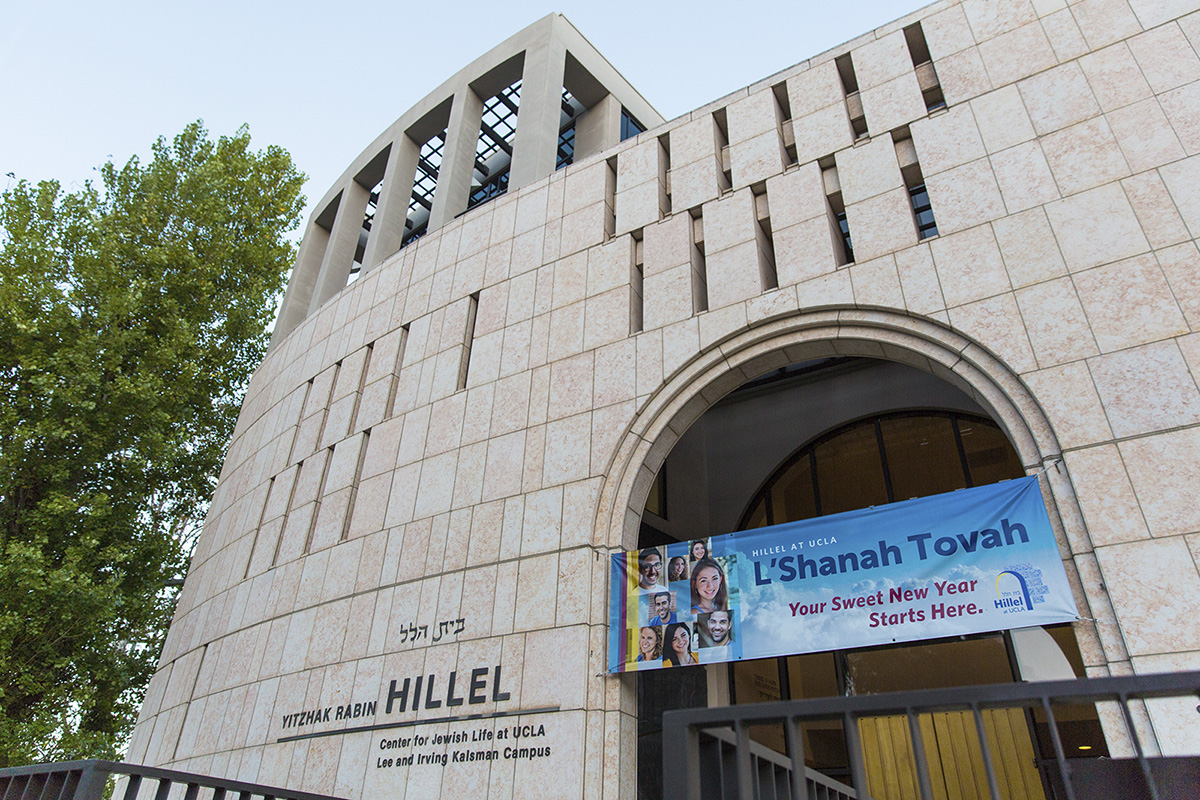
Hillel at UCLA building is pictured. UCLA’s Hillel chapter, along with the Jewish Faculty Resilience Group, are forming a Jewish faculty working group to advocate for the restoration of UCLA’s research funding. (Daily Bruin file photo)

By Izzy Greig
Sept. 18, 2025 8:00 p.m.
This post was updated Sept. 24 at 11:17 p.m.
Jewish community members criticized the federal government’s citation of “antisemitism and bias” as justification for suspending university funding.
The National Institutes of Health, National Science Foundation and U.S. Department of Energy suspended about $584 million in funding to UCLA on July 30 and 31. Some Jewish students and faculty said the move – despite being defended as combatting antisemitism – has harmed their community.
While a federal judge temporarily restored about 300 NSF grants Aug. 12, the NIH and DOE grants are still on hold. The same judge will consider Thursday whether or not to temporarily reinstate NIH grants while the merits of the case are decided.
[Related: District court judge to hear arguments on restoring suspended NIH grants to UCLA]
UCLA has faced antisemitism allegations since pro-Palestine protests erupted on campus in the fall of 2023. The protests – which continued throughout the 2023-2024 and 2024-2025 academic years – opposed Israel’s military offensive in the Gaza strip, which has killed over 60,000 people, according to the Gaza Health Ministry, and came in response to Palestinian political party and militant group Hamas’ Oct. 7, 2023 attacks on Israel that killed 1,200 people.
Protest activity peaked in the spring of 2024 when pro-Palestine protesters set up the Palestine solidarity encampment in Dickson Plaza to demand that the UC divest from companies associated with the Israeli military. Counter-protesters attacked the encampment the night of April 30, 2024, and police swept the area May 2, 2024 with flash bangs, batons and less-than-lethal weapons, arresting over 200 protesters.
The funding freeze followed the Department of Justice’s July 29 letter to then-UC President Michael Drake, which alleged that UCLA allowed antisemitism on campus following Oct. 7, 2023 – particularly during the Palestine solidarity encampment.
The UC agreed to pay $6.45 million the same day to settle a lawsuit brought by four Jewish UCLA community members who alleged that members of the Palestine solidarity encampment blocked them from accessing certain parts of campus based on their religion. Over $2 million of the settlement will be allocated to organizations that combat antisemitism – including on UCLA’s campus – according to the UC Office of the President.
[Related: FEDERAL FUNDING CUTS TO UCLA]
Noa Pinter-Wollman, a professor of ecology and evolutionary biology who identifies as Jewish, said two of her NSF grants were frozen, leaving her unable to renew one of her postdoctoral researcher’s contracts and forcing her to suspend her lab’s work.
Pinter-Wollman said she sees the administration’s justification behind the funding cuts as “hypocritical” and that the suspension is largely harmful toward the Jewish community.
“It’s more of the hypocrisy that bugs me more than any direct impact,” she said. “The hypocrisy of saying that this is to benefit people who were harmed, but we’re going to harm those same people.”
The Tel Aviv University graduate said she was not heavily involved in Jewish life on campus before the funding freeze. However, after she saw the DOJ pinning the funding suspension on antisemitism, she began seeking out ways to advocate against the cuts, including signing a letter addressed to the Trump administration, entitled “Jews in Defense of UC,” she added.
The letter received over 600 signatures from Jewish UC faculty, students, alumni and staff as of Sept. 18.
“We urge the Trump Administration to cease its attempts to deprive institutions such as ours of vital research funds intended to save and improve lives,” Jewish faculty members said in the letter. “We ask that it cease its misplaced efforts to withhold funds in the name of combating antisemitism.”
But not all Jewish faculty members see eye-to-eye on the funding suspension. Some – especially those in the Jewish Faculty Resilience Group, which identifies as Zionist – chose not to sign the letter.
Judea Pearl, a professor of computer science and a member of JFRG, said he does not believe the letter sufficiently addresses alleged antisemitism on UCLA’s campus.
“As a scientist, I’m joining the National Academy of Sciences, National Academy of Engineering in criticizing the administration for cutting down funds … and as a Jewish professor at UCLA, I cannot just ignore a problem that has surfaced,” he said.
Pearl – whose NSF grant was temporarily suspended – said he believes the federal government’s approach to handling claims of antisemitism at UCLA was too heavy-handed and has alienated people rather than allowing for a constructive conversation.
He added that he believes the university should adopt a concrete definition of antisemitism – such as the International Holocaust Remembrance Alliance’s working definition, which the Trump administration adopted – as a show of “goodwill” to ease tensions with the federal government.
Open dialogue could allow for a resolution to antisemitism on campus, Pearl said.
“Unfortunately, it split people apart because now we are as if there are two groups,” he said. “One encourages us to go with Gov. Newsom’s attack on Trump and head-on collision with Trump, with no collaboration with the federal agencies whatsoever… There’s another group that’s saying, ‘Let’s hear what they want us to do. Maybe what they want us to do is exactly what we want to do.’ This second voice has been muffled.”
Pearl and Pinter-Wollman agreed, though, that they believe the university has not been transparent and communicative enough about its plans to respond to the funding freeze.
“There’s no communication to us of how the university will respond,” Pinter-Wollman said. “Maybe there is some task force that is working on a response, but the fact is faculty are not being kept in the loop.”
Max Levenson, a doctoral student in environmental and molecular toxicology who signed the “Jews in Defense of UC” letter, said he believes the funding freeze has denied Jewish students research opportunities and disrupted their academic progress under the guise of combating antisemitism, he said.
Levenson said the suspension of his lab’s grant created difficult budgeting decisions for equipment and research personnel as well as uncertainty about his graduation timeline.
“In the fight to stop antisemitism, what they’re essentially doing is disenfranchising every student on school, including the Jewish students and every other student at pretty much every level of their education,” Levenson said.
In response to the federal funding freezes, UCLA’s Hillel chapter, along with the JFRG, are forming a Jewish faculty working group to advocate for the restoration of UCLA’s research funding, said Daniel Gold, Hillel’s executive director, in an Aug. 19 email to Hillel members.
Pinter-Wollman said the funding suspension has motivated her and other Jewish researchers to engage more actively with the public – both by highlighting the importance of funding scientific research and using their identities to advocate for the grants’ restoration.
“People are – even more than before – energized to reach out to the public and communicate science and its importance,” she said. “I really would like to help make a difference here, and if this is a place where I can assist because of my identity, I’m happy to do that.”