






UCLA, USC rivalry defined by mutual respect rather than hatred

USC women’s basketball guard JuJu Watkins dribbles the ball and looks to find an open teammate (left). The rising junior earned the Ann Meyers Drysdale Shooting Guard of the Year Award last season. UCLA men’s basketball guard Skyy Clark jumps to the rim and attempts a layup (right). The Los Angeles, local transferred from Louisville before the 2024-2025 season, which marked his inaugural campaign with the Bruins. (Design by Katie Azuma/Assistant Design director)

By Grant Walters
Aug. 20, 2025 7:51 p.m.
This post was updated Sept. 1 at 3:33 p.m.
Rivalries often breed hatred.
Take Michigan and Ohio State – a rivalry so fierce that both teams brawled at midfield when Michigan attempted to plant its team flag on Ohio State’s logo – a testament to the rivalry’s fortitude.
Hate is a word that has long seeped into various strifes, even one-sided ones. The mantra “good old-fashioned hate” defines the Georgia-Georgia Tech bout.
Contempt even drives the most storied rivalries. A curse sparked the historic Yankees-Red Sox feud, with Babe Ruth igniting mutual disdain. Ruth’s move from Boston to New York even coined the term “Curse of the Bambino.”
“I see some of those other rivalries when I go around the country, and there’s real hatred,” said UCLA men’s tennis coach Billy Martin.
Many consider the UCLA and USC rivalry – dubbed the Battle of Los Angeles – to reflect a conflict fueled by hatred, with the “Victory Bell” marking the winner’s yearlong superiority over the vanquished.
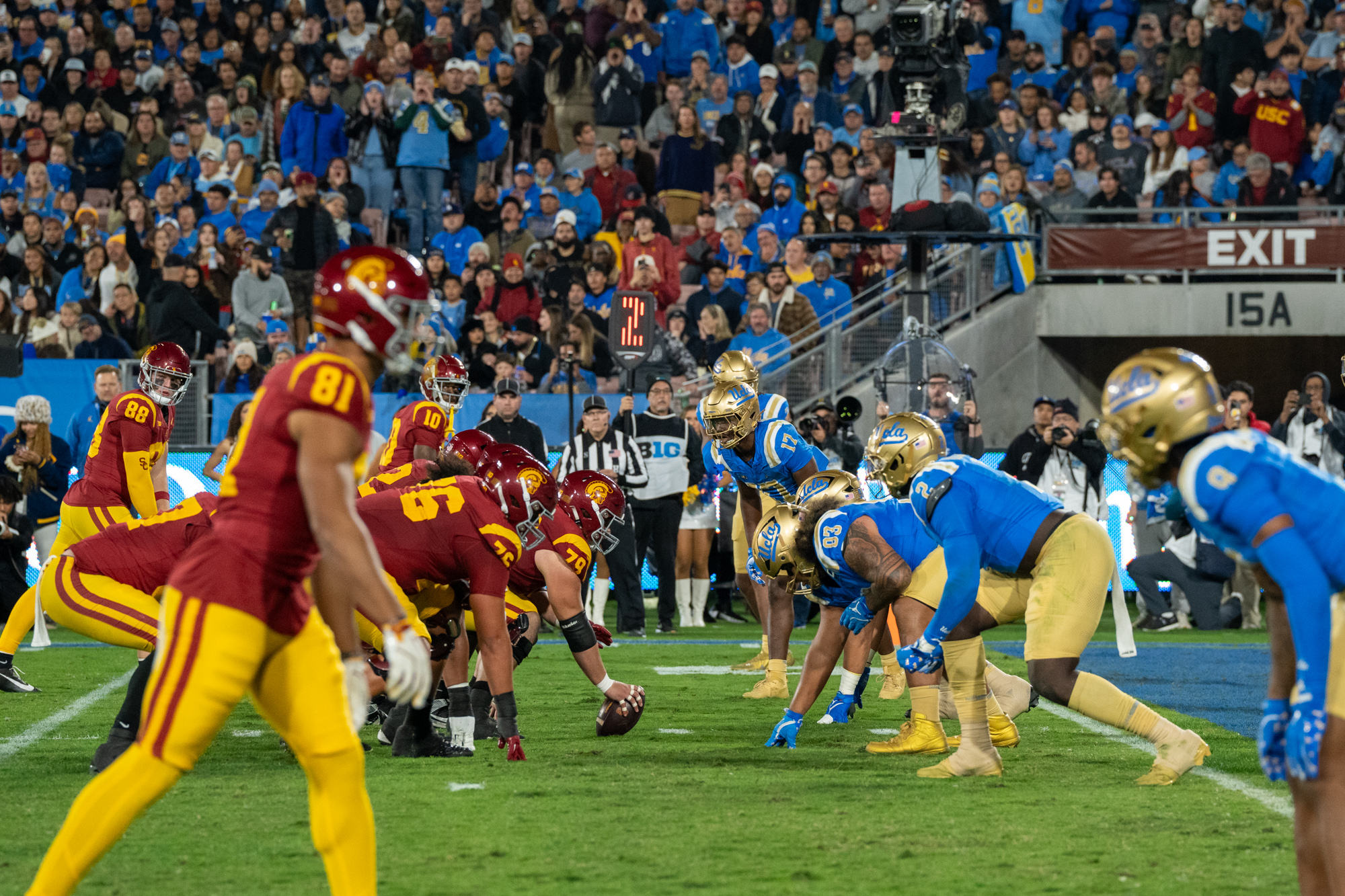
The Den and the Legion – representing UCLA and USC’s respective student sections – embrace the rivalry’s heated nature, spearheading the annual “Hate Week” to elevate school spirit leading up to the schools’ annual football matchup.
A scuffle impacted the recent football battle between UCLA and USC on Nov. 25, with both squads exchanging taunts after the first half concluded. Physical altercations erupted across the gridiron, and numerous penalty flags sprawled across the damp grass.
But that’s just the surface.
Underneath the hood, a layer of reverence helps define the rivalry.
“When I was a player, I really wanted to beat USC because I didn’t like them,” said UCLA women’s golf coach Alicia Um Holmes. “Now, as a coach, I think it’s a great rivalry because it’s more of a friendly matter. We push each other to be better.”
And mutual respect is warranted. UCLA has captured 124 NCAA team championships while USC boasts 115 titles – the second and third-most collegiate trophies, respectively.
It may help that both universities represent the LA community, with their campuses sitting less than 15 miles apart.
While regional disputes have caused the rise of many rivalries – often sparked between neighbors – UCLA and USC find pride in the area they call home without allowing geography to alienate them.
“I’ve always had a lot of respect for the Trojans,” Martin said. “We’re fortunate to have the rivalry at two great universities in our great city.”
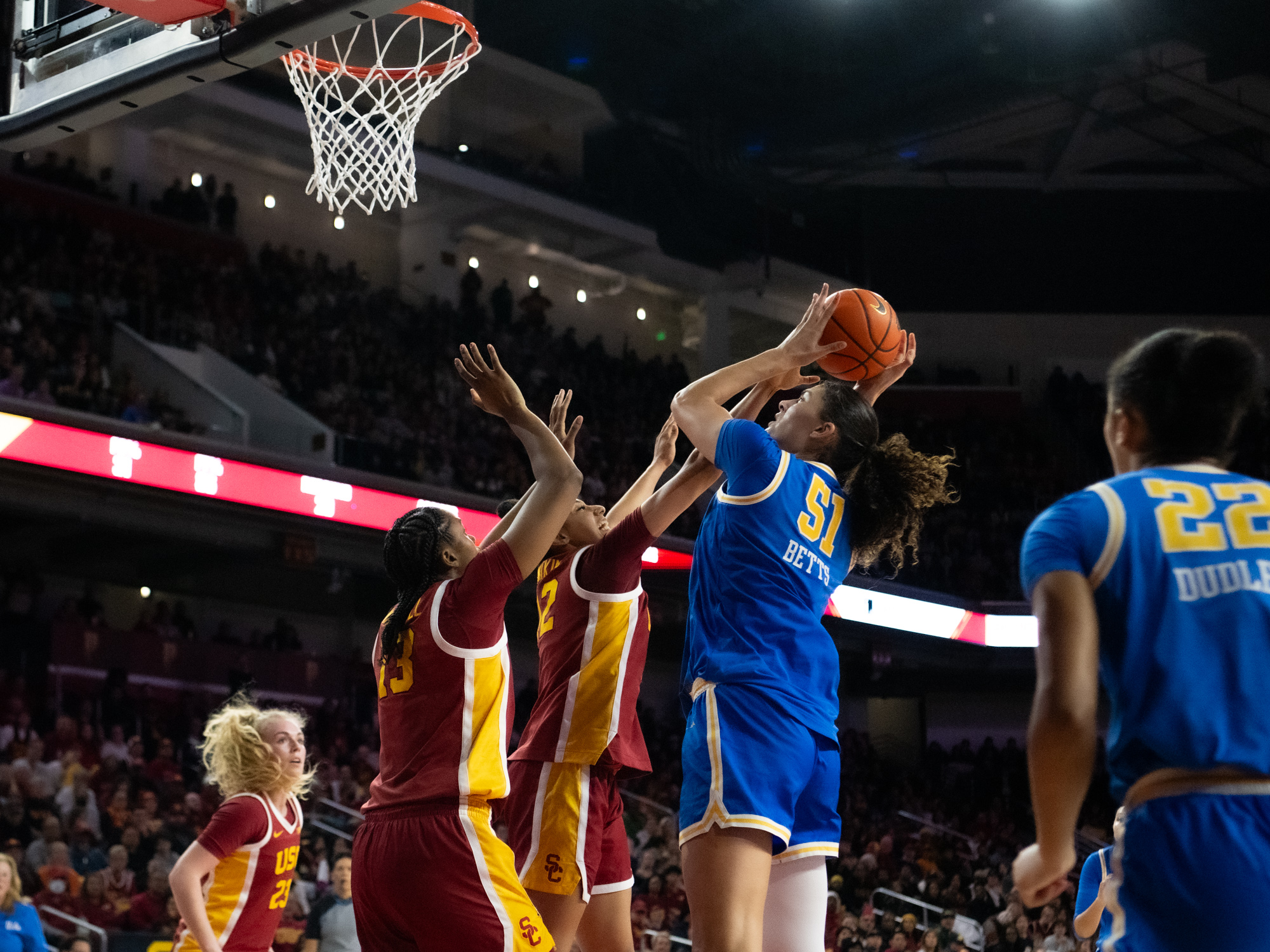
Many rivalries boast defining characteristics – the Bruin-Trojan feud relies on each program’s renowned colors to mark its prominence. The NCAA has sanctioned that the UCLA-USC is the only bout where the respective teams can wear their home jerseys at the same time, painting a blue, gold and red canvas.
“We all have pride in our colors,” said UCLA athletic director Martin Jarmond. “Those colors tell you there’s a healthy level of respect for LA and this rivalry.”
But the competitive drive that establishes the Battle of LA is what many coaches say is the rivalry’s strongest attribute.
Heightened competition can devolve into violent conflict, with battles extending beyond the field and into a mentality that incites brawls to boast a rival’s physical superiority.
Yet, the Bruin-Trojan rivalry has generally maintained good health.
“We’ve always had great matches that are very respectful and competitive,” said Stella Sampras Webster, UCLA women’s tennis coach. “It’s always exciting because it means so much to compete against them.”
Still, both programs take pride in beating their rival. The will to defeat the Bruins or the Trojans is one of each squad’s biggest goals heading into every season.
Victory’s sweetness and defeat’s bitterness don’t just last for a day – they linger until the pair battle once again.
“You take a lot of pride in winning that meet, and we’ve had such a rich rivalry for so long in every sport,” said UCLA track and field assistant coach Tate Curran. “It doesn’t change from being an athlete, or a spectator or a Bruin or a Trojan. It’s all the same – you want to beat SC, and they want to beat UCLA.”
And for some sports, the match between UCLA and USC has national championship implications.
Since beach volleyball’s NCAA inception in 2016, the Bruins and Trojans have captured all but one of the nine championship trophies.
“No matter where our teams are ranked, it’s always going to be a competitive match,” said UCLA beach volleyball coach Jenny Johnson Jordan.
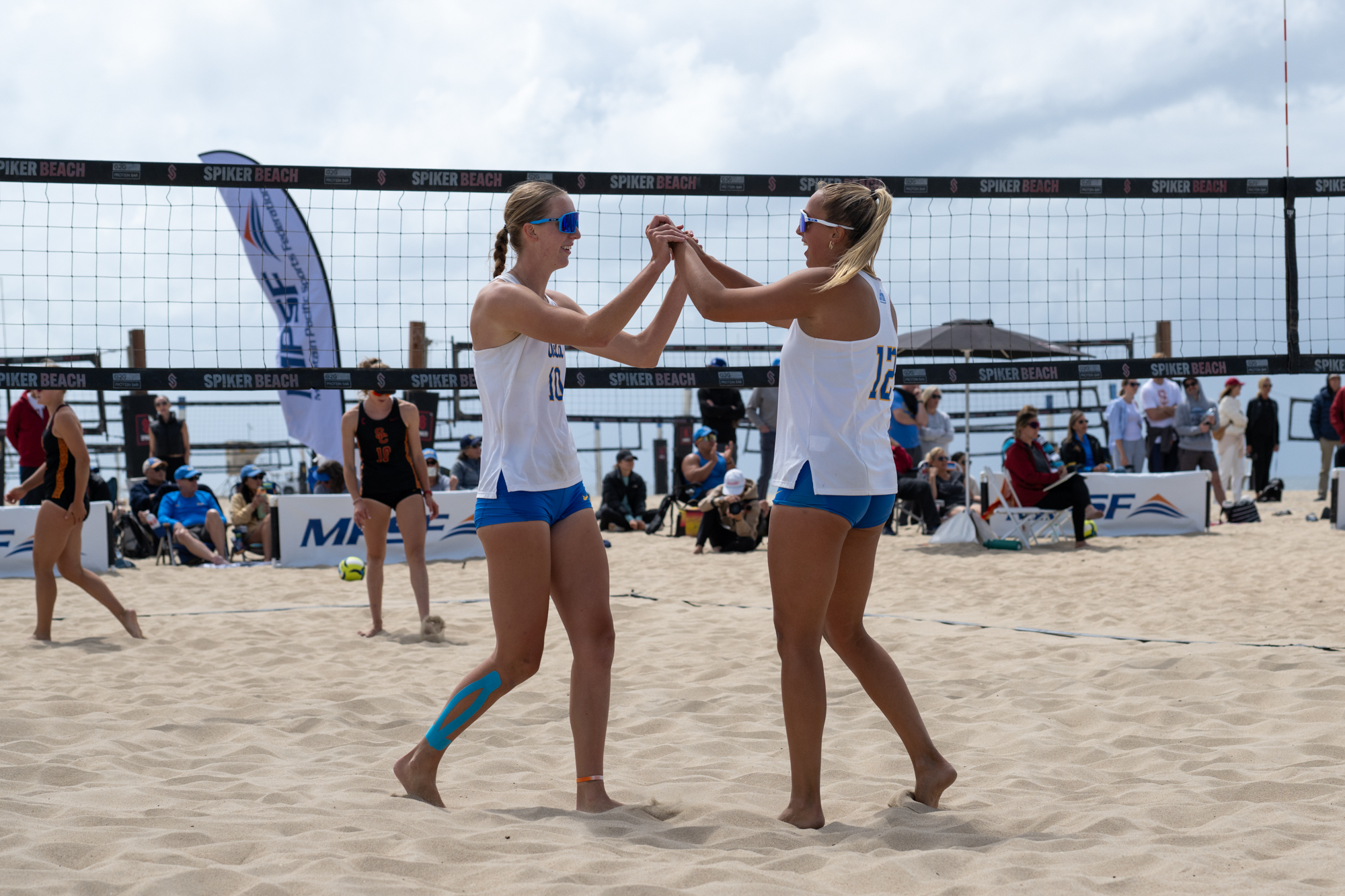
With UCLA and USC setting the standard across collegiate athletics, the rivalry is bound to foster continued excellence, pushing each squad beyond its perceived limits.
The Bruins and Trojans seem to rely on each other to thrive, and the feud may represent the motor spurring the programs’ historic feats.
“Sometimes it takes others to bring out the best thing, and we do that for each other,” Jarmond said. “It’s a special rivalry.”
And that is where the rivalry’s beauty is most apparent – the Bruins and the Trojans don’t seek to put each other down, instead opting to embrace room for individual growth while flashing a product that showcases competition at its highest – and classiest – level.


