David Lefkowitz goes back to Bach in Baroque-inspired preludes, fugues collection

The cover of “Preludes & Fugues for Piano.” The UCLA professor’s most recent project was released June 20, featuring 52 pieces. (Courtesy of Bridge Records)

By Maile Smith
Aug. 8, 2025 4:59 p.m.
This post was updated Oct. 12 at 8:35 p.m.
UCLA professor David S. Lefkowitz is stretching the bounds of classical composition, taking piano music to new scales.
What first started as a pandemic project, “Preludes and Fugues for Piano” by David S. Lefkowitz, a professor of composition at the UCLA Herb Alpert School of Music, has expanded into a sweeping two-book collection. Released June 20 with Bridge Records, the work features 52 pieces and runs nearly three hours in total. The two books have distinctive differences, Lefkowitz said, but are composed entirely of preludes and fugues – compositions first defined by renowned composer Johann Sebastian Bach.
“The prelude sort of sets the mood, or at least says ‘Hey, here’s the key that we are in. Get used to it,’” Lefkowitz said. “And then the fugue comes along – and it’s complicated, and you say ‘Well, at least I know where I am, because I’ve heard the prelude before.’”
Lefkowitz originally began with a single book of 13 pieces, he said, but later extended the project to 26 works, eventually pairing each prelude with a fugue to double it to 52 pieces.
Lefkowitz added that he distinguishes between the two books – or collections of pieces – by noting that the first is written exclusively for solo piano. Exploring across various keys, Lefkowitz said he challenged traditional harmonic expectations, resulting in unexpected sounds.
“I took the idea of prelude and fugue for solo piano in multiple keys, and I questioned each of those things,” Leftkowitz said. “I’ve got fugues that maybe you don’t think is a fugue. I’ve got keys that are strange and different and unusual.”
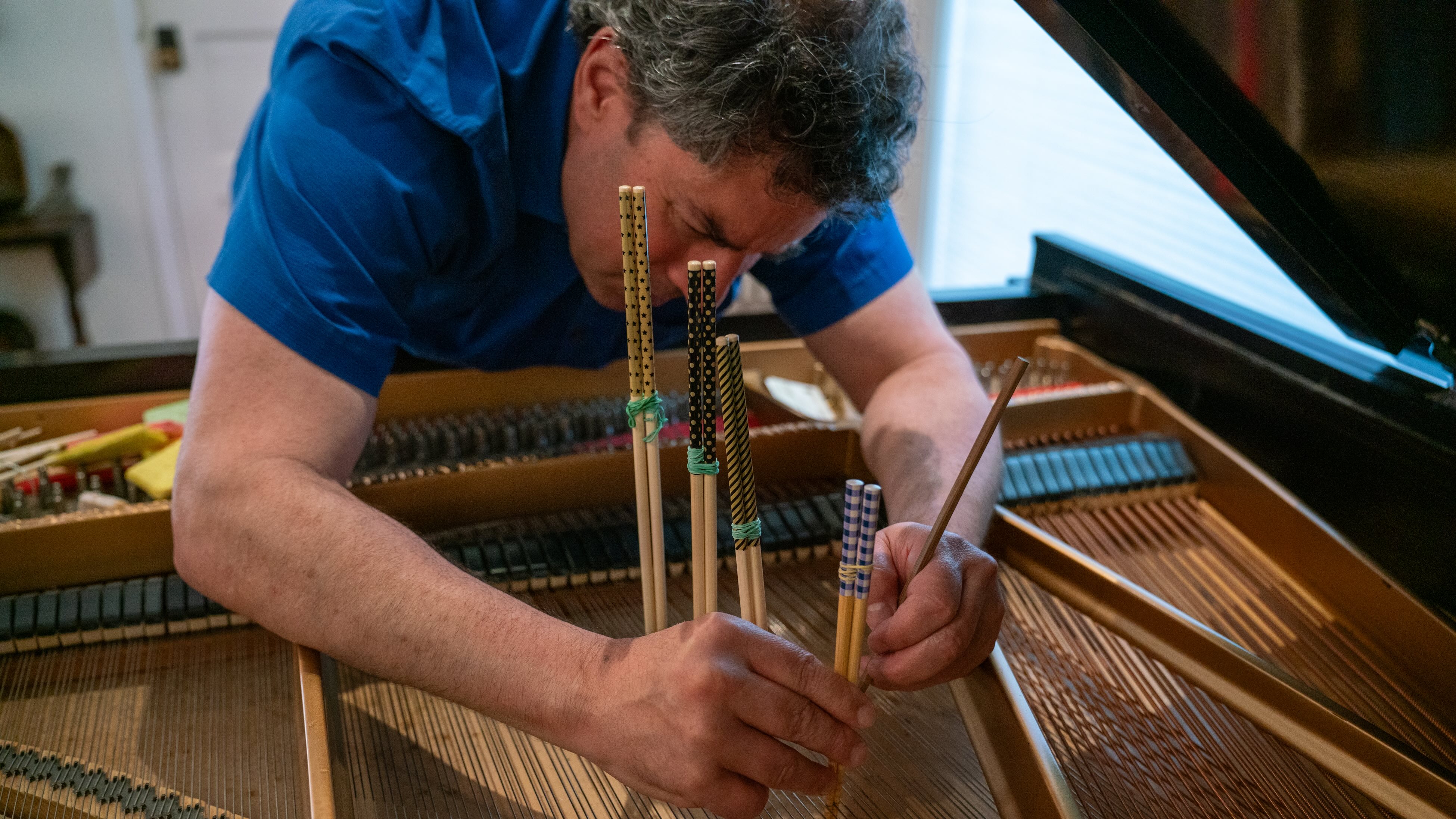
The second book, however, further challenges the elements of solo piano, Lefkowitz said. With time to explore his art during lockdown, Lefkowitz said he spent six months experimenting with his piano, putting objects such as chopsticks, screws, erasers, tambourine jangles and clothespins on or into the strings of his piano in order to create different sounds. The items, known in this musical context as preparations, were often challenging to stick in the strings, Lefkowitz added. Wherever he moved them, it created a new sound. Lefkowitz said this book was especially challenging because he was essentially experimenting with a new instrument.
“Sticking chopsticks into the strings, I found different chopsticks produce different sounds,” Lefkowitz said. “So I had to go to all the Japanese restaurants and all the Chinese restaurants and all the Korean restaurants … in West LA or in Westwood. We all have to suffer for our art, and I suffered very greatly going to all these restaurants.”
Kay Rhie, assistant professor of composition at the School of Music and a colleague of Lefkowitz’s, said Lefkowitz was one of her first composition mentors during her time as an undergraduate student at UCLA. Rhie then joined him as his junior colleague eight years ago. Professor Rhie said she believes Lefkowitz is the first person to truly push the boundaries of the keys and scales within preludes and fugues. He was able to create new keys out of detuned or ultratuned pianos from the materials he used, she added.
Rhie said she knew this collection was something exciting when Lefkowitz showed her the different materials he was experimenting with, but she did not realize the scale and scope of the project until it was produced. She said the ideas of composers often live in their heads, because it takes time to find performers to actually bring them to life – let alone record an album in its entirety. She added that this album is a monumental accomplishment for the genre.
“David is one of those very remarkable individuals, because he had been teaching at UCLA for decades – but he’s so young at heart, and he never really stops questioning and exploring,” Rhie said. “So he’s one of those composers that does not repeat himself ever.”
[Related: African American Music Ensemble, Old-Time String Band put on spring show]
Lefkowitz said the album was inspired when Richard Danielpour – a distinguished professor of composition – began a project for the UCLA composition students and faculty to work with Italian pianist and Bach specialist Stefano Greco to play newly-composed preludes and fugues. Danielpour said during the COVID-19 lockdown, many of the composition faculty went into a “spiritual retreat,” a time where they worked to create their best music – something Danielpour himself was able to accomplish as well.
Sharing a love of Bach, Danielpour said Lefkowitz and the rest of the composition faculty at the School of Music are a tight-knit group of colleagues and friends who inspire each other. He added that when Lefkowitz first presented some pieces for the project, he encouraged Lefkowitz to keep going and to make sure he recorded his work. With this album, Lefkowitz was able to merge his intuitive process with his knowledge of composition, Danielpour said.
“And I think that is really one of the things that all composers are striving for, that is, to create a marriage between one’s intuition and one’s cognitive ability and knowledge,” Danielpour said.
[Related: Coauthors Rob and Bob shed light on movie magic, creative leadership in new book]
Some pieces in the album are meant to just be fun, such as the prelude “Funk” from Book II, which sounds like a bass, xylophone, drums and jazz quartet due to the preparations in the piano, Lefkowitz said. Others, he added, are meant to sound like you are “spinning off slowly into space.” No two pieces are the same, Lefkowitz said.
Some aspects of the album, however, might be difficult for listeners, such as metal clanging, Lefkowitz said. He urges people to step back from the sounds and listen to the notes of the music. In words of encouragement to anyone intimidated by a large, instrumental album such as his, Lefkowitz added that listeners can learn how to enjoy any music.
“Go along for the ride, and see where it takes you,” Lefkowitz said. “I think that you’ll find something lovely to listen to in, if not all of the pieces, then most of them.”