

UCLA must prioritize students’ safety, help fund crosswalk at Gayley and Landfair
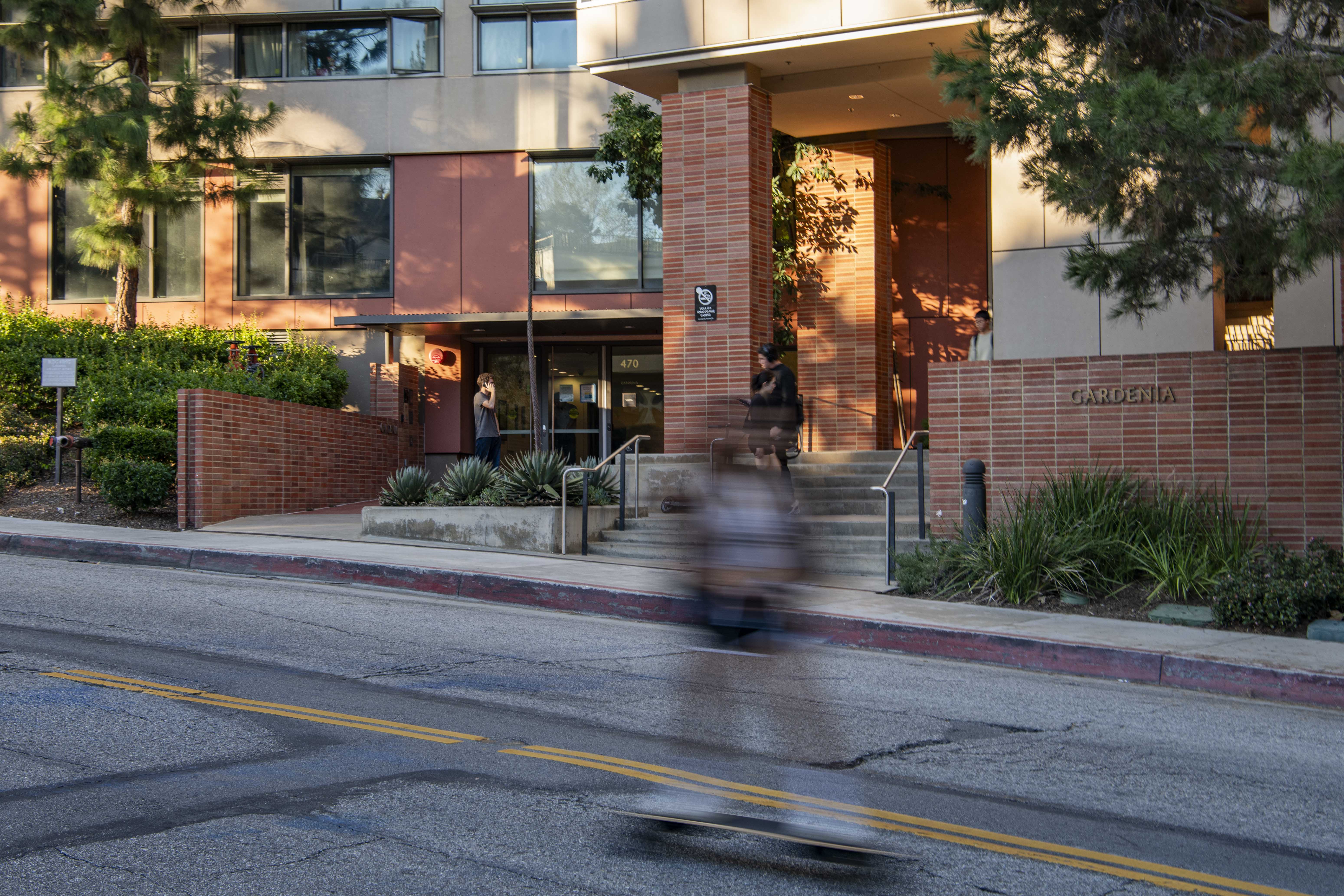
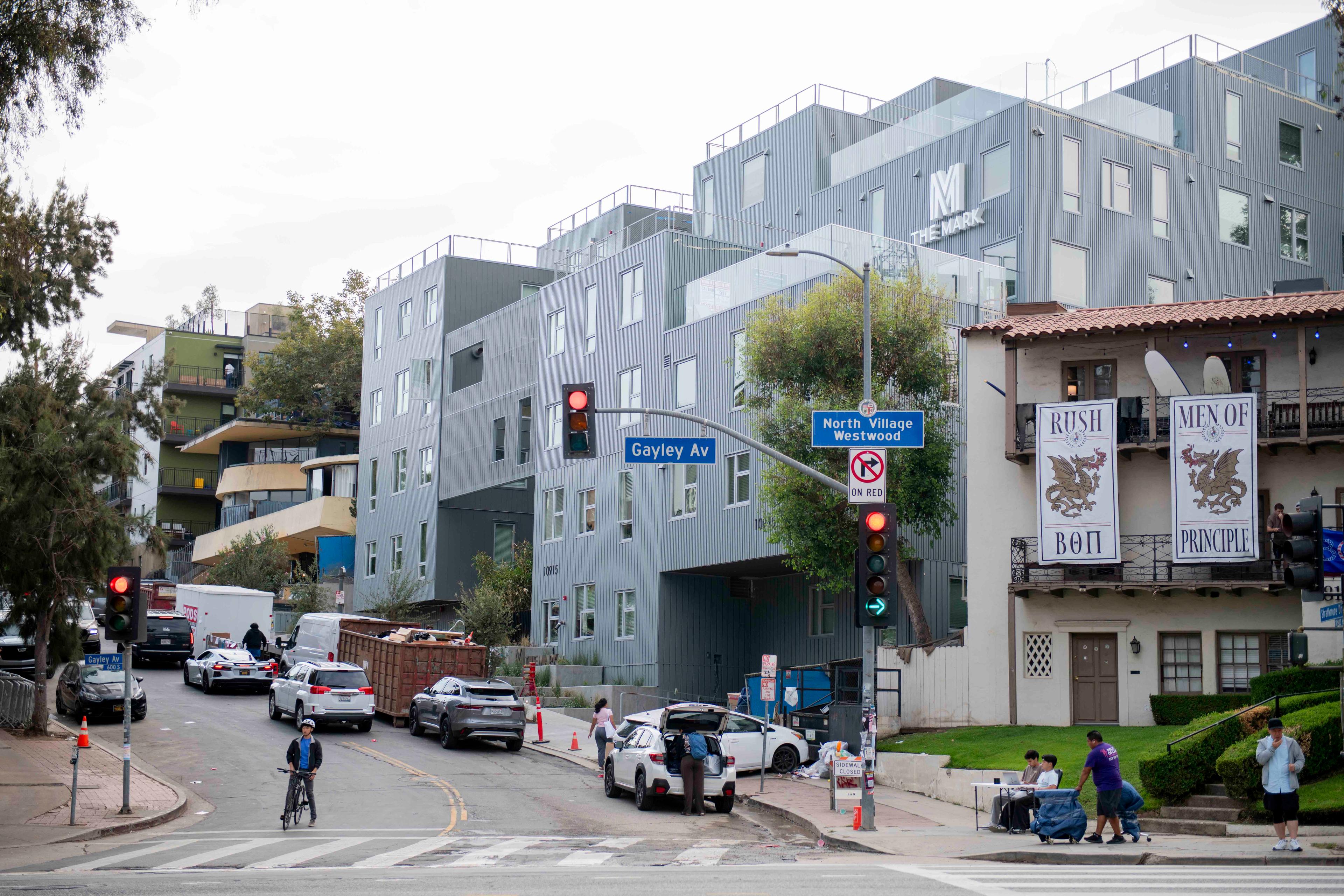
Gayley Avenue and a UCLA residential dorm are pictured. Columnist Brady Mullan argues that UCLA must advocate for a crosswalk near Gayley and Landfair Avenues to protect students. (Edward Ho/Daily Bruin)

By Brady Mullan
Nov. 24, 2026 11:51 a.m.
At the north intersection of Landfair Avenue and Gayley Avenue, students choose between an inconvenient detour and a real-life game of Crossy Road.
This path for students walking from apartments to De Neve Holly is one of few connection points between the North Westwood Village and campus. Yet it lacks a marked pedestrian crossing – the nearest is about a two-minute walk down the road. With blind curves, racing cars and rogue Bird scooters, crossing the road can feel like an inevitable risk.
Concerns about pedestrian safety at this intersection are not new. The North Westwood Neighborhood Council pushed for new pedestrian infrastructure throughout Westwood, including this intersection, said Connor Webb, the chair of the NWWNC’s Transportation, Environment, and Public Space Committee. Their efforts were unsuccessful, however, due to logistical challenges and the city of Los Angeles’ budgetary constraints, he added. But that doesn’t mean people should give up.
UCLA must partner with the city of LA to fund a pedestrian crosswalk with a signal at the north end of Landfair Avenue.
For students who regularly take this leap of faith, the lack of crossing options is more than an inconvenience. The low visibility and high speeds mean it may only be a matter of time before tragedy strikes. Students feel this tension.
“People love to fly around this corner,” said Daniel Bason, a fourth-year economics and political science student. “It’s a little scary sometimes.”
One of the most effective ways to create a safe crosswalk at the intersection is to add a half signal – where a standard traffic light faces the major street and a stop sign and pedestrian signals service the minor one – Webb said. Some are already on campus, Webb added, including where the path through De Neve Plaza ends at the Westwood Palm Apartments, or the HAWK beacon at the UCLA Hilgard Terminal crossing.
There is, of course, a trade-off between safety and cost.
“The safest of all is the controlled intersection where you have a traffic light,” said Anastasia Loukaitou-Sideris, the dean of the Luskin School of Public Affairs and a distinguished professor of urban planning. “But it’s the most expensive.”
Webb added that curb ramp construction – an Americans with Disabilities Act requirement – can easily cost $250,000 for an intersection, and signals themselves could be $500,000.
These high costs, combined with the number of unsafe sidewalks and crossings in LA, can make it extremely difficult to get the city to focus on improvements in one area.
But the city’s financial constraints do not give UCLA an excuse to wait for LA to change its priorities. UCLA has a responsibility to consider the safety of students beyond the boundaries of its campus – especially when they are crossing into it.
“If they funded it, I think it would definitely happen,” Webb said. “But even if it was just partial funding and strong advocacy by UCLA and UCLA Transportation, I think there would be a good chance that it could happen even then.”
Students should not have to wait for a devastating accident for someone to recognize the dangers of this intersection. The university must prioritize student safety and commit resources to constructing a signalized crosswalk in partnership with the city.
Getting to campus shouldn’t feel like a game of Crossy Road with Bruins’ lives on the line.