Opinion: Loneliness takes a village as college students need support, community
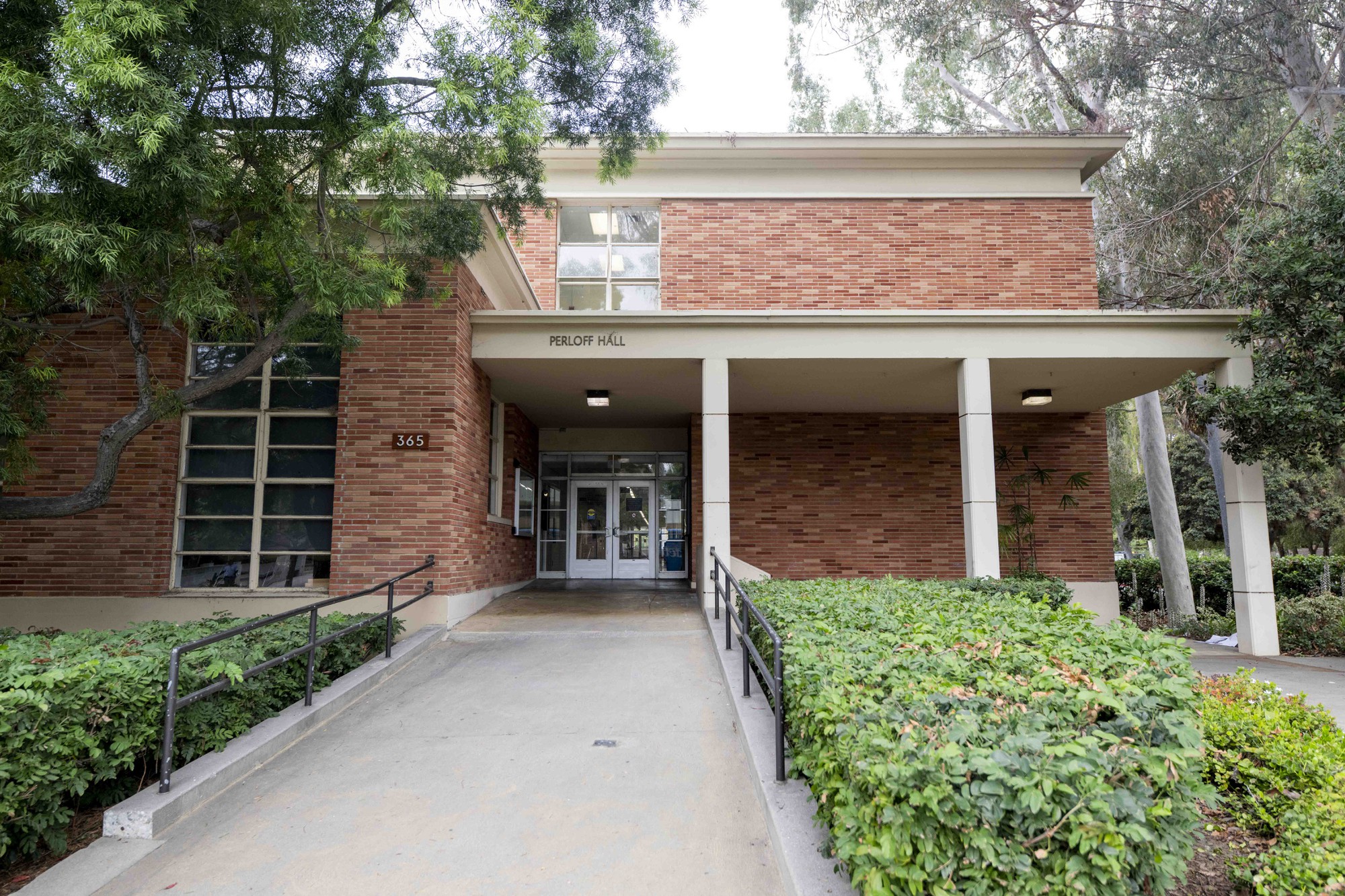
Perloff Hall is pictured. Columnist Bockman Cheung argues loneliness is more than an individual responsibility; it is something all students must work to combat. (Gabby Yang/Daily Bruin)

By Bockman Cheung
May 17, 2026 12:34 p.m.
This post was updated May 27 at 8:44 p.m.
Turning down an offer to grab lunch. Skipping classes. Working on a group project alone. Deciding not to go out on the weekend.
We think of loneliness as a series of shaky individual choices that make us wince at our unrealized potential connections.
But when everyone suffers from loneliness, it becomes more than an individual responsibility. Loneliness is an epidemic that we all must acknowledge and work together to address through rethinking social spaces.
The average American’s time spent out of the house fell from about 360 minutes per week in 2003 to under 280 minutes in 2023, according to research co-conducted by Brian Taylor, an urban planning and public policy professor.
Active Minds, a nonprofit organization centered on providing mental health services, reported that nearly two-thirds of college students report feelings of loneliness. Key aspects include feeling social isolation, being left out and lacking companionship.
But to truly address our loneliness epidemic, we have to look at the structural level. One aspect to explore is how changing our social spaces shapes our interactions and how UCLA provides space for its students to feel more valued.
The common response of dealing with loneliness is often on the individual: They should be more emotionally ambitious and go out.
This may be valid advice, as the direct way to feel more connected to society is to socialize. Yet this is a vast oversimplification of the multidimensional challenges UCLA students face socially.
Spaces that used to be social have become individualized.
Cafes have become increasingly popular as a study spot. But during midterm seasons, when the majority of students study in Kerckhoff Coffeehouse or Jimmy’s Coffeehouse in Lu Valle Commons, the original intention of meeting friends is undermined, blurring the boundaries between work and relaxation.
Food trucks, which once made up 18% of dining swipes used on the Hill, are reducing in number and may be gone next year. Waiting in line for hours was a memorable moment for many undergraduate students because it was an important social venue and allowed connections to form.
Social gatherings outside the classroom such as parties – which are often an integral part of the college experience – are ending earlier and waning in size.
In-person interactions that connect the community have also become rarer in class and workplace environments.
“I began my career as a faculty member here 32 years ago, and pretty much every faculty office and every building was filled every day,” Taylor said. “Now it’s maybe 25% of it.”
Taylor added that his research also found Americans are changing their working habits post pandemic.
“A lot of those functions for university students, researchers, staff, faculty, that used to happen in person – or at least somewhere out of your living space – no longer have to,” said Samuel Speroni, a doctoral candidate in the urban planning department. “That has a lot of second-level negative effects, particularly around social isolation.”
The stakes of social isolation are incredibly high. Loneliness is linked to an estimated 100 deaths per hour or more than 871,000 deaths annually, according to the World Health Organization. Good social connections are essential to better health and longevity.
The UCLA Department of Architecture and Urban Design associated research center cityLAB UCLA tackles the loneliness crisis through micro urban interventions and designing architectural solutions for public spaces.
Researchers in the center started brainstorming how sidewalk turfs could be converted to small, programmable spaces, said Yang Yang, the co-director of cityLAB UCLA.
“We had focus groups, workshops, students – we shared tons of precedents about what could happen in public space, like punching bags, seatings, hammocks,” Yang said.
CityLAB UCLA realized that projects like this can actually function and make real impacts beyond the already defined rules, Yang said. Yang added that the team also spearheaded other campus projects such as activating Fowler Museum as a public space.
CityLAB’s project invites new narratives on the meaning of socializing, beyond spaces that require lots of social energy like parties.
“Because you stand there, you walk through, you sit there – then it turns into a public space,” Yang said.
Clearly, engineering social opportunities is only a facet of this multilayered problem.
“It will require reimagining the structures, policies and programs that shape a community to best support the development of healthy relationships,” former United States Surgeon General Vivek Murthy said in his 2023 advisory on the healing effects of social connection and community.
As I reflect on my college life, the fondest memories are more than my GPA or resume.
They come from the quality relationships I have formed through quick lunch hangouts, reassuring long conversations or midnight In-N-Out Burger meals. Those shared adventures painted eternity into the ordinary passage of time.
To build a community where everyone is included, we must facilitate campuswide conversations about how we may explore opportunities to connect with others.