UCLA faculty discusses impact of Artemis II mission on human spaceflight, research
(By Yejee Kim/Cartoons director)

By Darren Tran
May 11, 2026 8:34 p.m.
This post was updated May 12 at 10:18 p.m.
UCLA faculty said the success of NASA’s April Artemis II mission was a pivotal moment for human spaceflight.
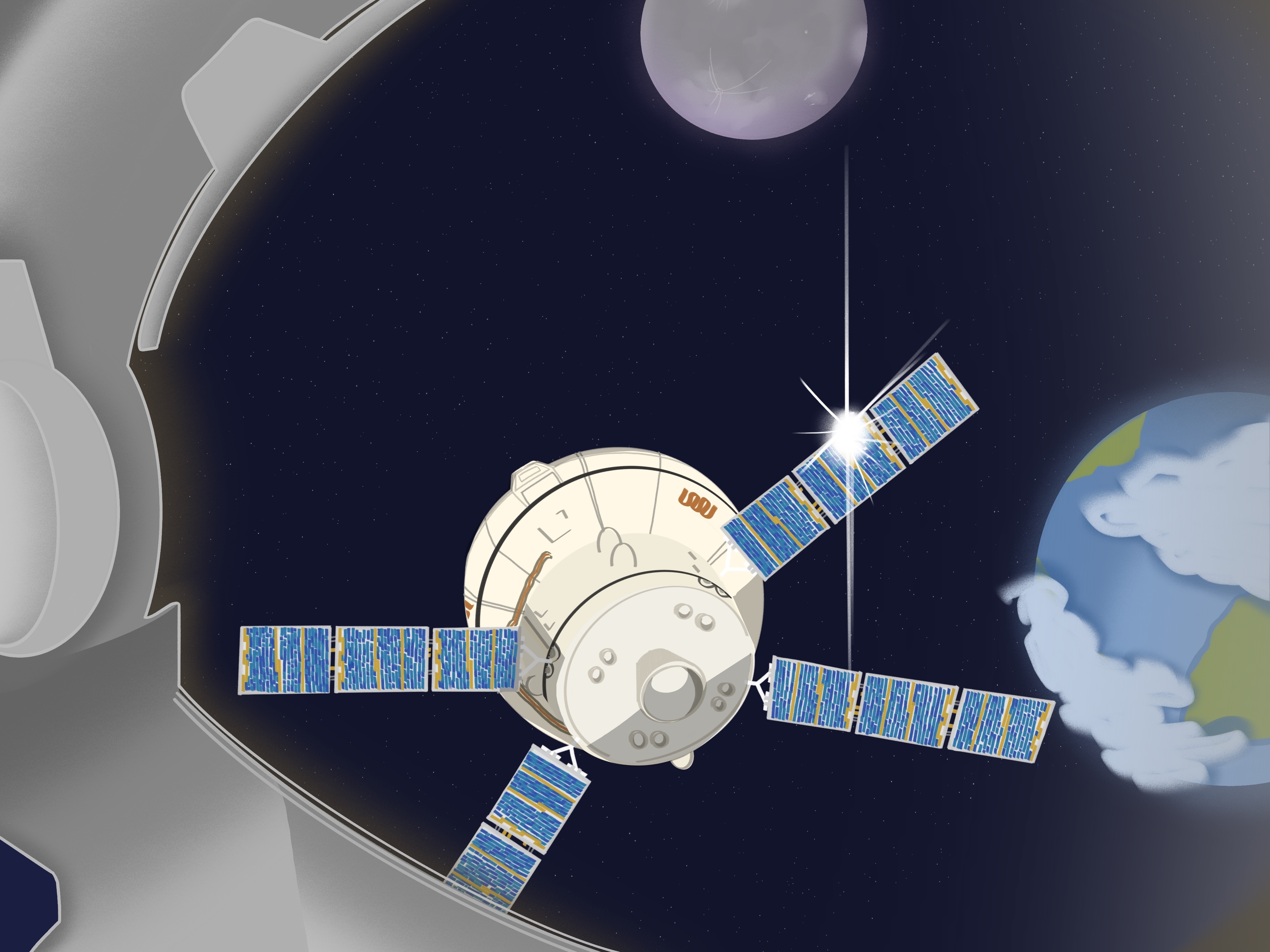
A team of four astronauts flew around the moon during the nine-day mission, which spanned April 1-10. The astronauts tested spacecraft systems that would support the future Artemis IV mission, in which NASA will attempt to send humans back to the moon’s surface.
“After 54 years, we’ve gone back to the moon,” said Dr. Ranga Chary, the executive director of the UCLA SPACE Institute. “From that point of view, it’s a huge breakthrough for crewed deep space exploration, both for the country and for humanity.”
David Paige – a principal investigator of the Diviner Lunar Radiometer Experiment, which created infrared radiometers that measure surface temperatures on the moon – said the Artemis mission demonstrates scientists’ new capabilities.
“It’s demonstrating we have the capability to send astronauts into deep space and bring them back safely,” said Paige, a professor in the Department of Earth, Planetary, and Space Sciences.
The Artemis II astronauts brought a wide range of backgrounds and disciplines to the mission compared to the Apollo 8 mission – the first crewed mission to travel to the moon and back, Paige said.
Multiple members of the Artemis II crew made history, including Victor Glover, who became the first person of color to travel beyond low-Earth orbit, according to NASA’s website. Christina Koch also became the first woman to travel beyond low-Earth orbit, and Jeremy Hansen became the first non-American to do so.
“The NASA administrator, when they came back, described them as almost poets,” Paige said. “The human program is opening people’s eyes to the fact that we are actually living in space, and we’re on a planet and all around us is pretty much empty.”
Jacob Bortnik, a professor in the Department of Atmospheric and Oceanic Sciences, said the mission reflects a shift in the goals of human spaceflight.
“It marks a real turning point because it’s not just about being first anymore,” Bortnik said. “It’s not about planting a flag and being on TV. It’s about a much more sustained presence in space, … learning how to actually live in space.”
Chary said the moon’s far side, which never faces Earth, serves as a valuable site for radio astronomy because it is shielded from Earth’s electromagnetic noise, offering astronomers a clearer window into the origins of the universe and the formation of its earliest galaxies.
Bortnik said the moon also presents opportunities in his own field of space weather. Without an atmosphere or significant magnetic field, the lunar surface is directly exposed to solar wind conditions that could yield data relevant to future deep space travel, he added.
The technological gap between Apollo and Artemis is wide, Chary said, because even modern smartphones dwarf the computing power of Apollo-era spacecraft. Mission planners now use artificial intelligence to scout landing sites for spacecraft and new chemical processes to extract oxygen from water, Chary added.
While astronauts depended on panels with switches and toggles in years past, astronauts now use devices resembling iPads, Chary said.
NASA has framed Artemis as a stepping stone to Mars. However, Paige said he believes space travel to Mars is not currently feasible because of technical barriers.
Bortnik said, while he acknowledges the difficulties in traveling to Mars, the Artemis mission seemed equally out of reach for scientists decades ago.
“If going to the moon is like climbing Mount Everest, going to Mars is like crossing the Atlantic Ocean,” he said. “It’s aspirational, but so was the moon in the 1960s.”
The mission will also lead to new career opportunities such as research projects for UCLA students interested in science and engineering, Bortnik said.
The Artemis mission is filling a gap left by the Apollo era by ushering a new generation of scientists and engineers into space missions, Chary said.
“The intellectual capital which is responsible for the successes of the Apollo program have retired or passed away,” he said. “We are training a whole new generation of scientists and engineers to do deep space exploration.”