Ep. 2 – Curious Clubs: Bruin Beekeepers


By William Gauvin
April 30, 2026 4:08 p.m.
Listen to another episode of Curious Clubs as we interview the Bruin Beekeepers and learn all about bees, hives, honey and more.
William Gauvin: I’m William Gauvin, and this is Curious Clubs, a Daily Bruin podcast that explores the many different and unique clubs here at UCLA. Today I am with the executive directors of the Bruin Beekeepers Club, Barenya Das, a fourth-year cognitive science major, and Nora Wang, a third-year human biology & society and sociology double major.
WG: Welcome to Curious Clubs! Today I am with the…
Barenya Das: Bruin Beekeepers.
WG: We are so happy to have you here. First off, if you could just give us a quick little introduction of your club and what the day-to-day of the Bruin Beekeepers is like?
Nora Wang: Yeah, so we’re pretty much exactly as the name suggests – we’re the Bruin Beekeepers, meaning we keep bees. We keep them here on campus – shoutout the Life Sciences Building – and we keep them also on our satellite campus that’s in Ventura, but we do also do a range of activities outside of just obviously keeping bees itself. We also support awareness of native pollinators here in California. We table at all sorts of events with UCLA clubs talking about this sort of thing. We also do a little fun social stuff at our general meetings.
BD: We do a lot of educational events if you want to become a certified beekeeper as well.
WG: And so I’m curious, what’s the process to become a certified beekeeper, as you mentioned?
BD: Okay, so for more information, you could definitely look on the California Master Beekeeper site. That’s like CAMBP. That’s run by, I believe it’s UC Davis. But in California, there are different levels of certification to become a beekeeper, and at the most basic, it’s the ambassador level, and for that, you follow a study guide, take a test. It’s pretty simple, and…
NW: You earn volunteer hours by participating in bee-related events, and you can do that with us.
BD: Oh, yes, this is true. You can forgo the fee to actually go through the first level of certification by getting involved with Bruin Beekeepers.
WG: And how many hives do you manage just here on campus?
BD: It ranges. Sometimes if there are swarms found on campus, you can actually reach out to us, and we will temporarily home them on the roof. So it can be anywhere between like 14 to 20.
WG: And do you often receive reports of swarms, and what do you do when someone calls you and says, “Hey, we’ve caught a swarm over here?”
NW: Yeah, so our operations managers, Liz (Director of Ethical Labor and Sustainability for UCLA Trademarks & Licensing Liz Kennedy) and Bonny (Deputy Chief Sustainability Officer Bonnie Bentzin) – shoutout Liz and Bonny, they’re great – and they’re also faculty here at UCLA, and usually people will reach out to us. Sometimes people DM us on Instagram or they’ll join our Slack or Discord and message us, and we have a specific channel for like swarm lookout because obviously they can get dangerous or be scary and alarm people.
And as soon as I receive a notice of that, I send it to Bonny, and I’m like, “Hey, someone spotted this on campus. Do you think you can deal with it? If you can’t deal with it, let’s call the professionals, obviously,” but if she has the time and we have the window, sometimes we let students come help out if they’re a little more experienced, and yeah.
WG: How do you take care of the swarm, so to speak?
BD: That would definitely be more of a Bonny question. She’s way more well-versed in the actual process of like removing the swarm safely and then kind of relocating them into a hive, but sometimes there’s a process of trying to match them with a queen. Fun fact: You can actually buy queens, but I’m not sure.
NW: It also depends on why they might have swarmed because sometimes within colonies – we like to say that there’s tea and drama and there’s beef – because there are times where bees will rebel against their queen, and so they’ll literally choose to be queenless and leave the hive themselves, or like there was a new queen, and she left, and she took a bunch of bees with her or something like that.
So if they have a queen, the easiest way is to like pick up the queen because they all follow her and then like you just mostly spend your time being like, “Where’s the queen at? Let me find her. Let me get her.” You put her in, and then they’ll usually work with you following that. But if they’re just on their own, it’s a way more unique like, I don’t even know, process.
WG: Are bee stings common? Do you have protective equipment? How does that work?
BD: In my three years here, I’ve been stung twice, but when you do work with bees, you are suited up. So there’s a beekeeping suit. It’s all white. You’ve got a netted covering. It covers everything from your head to your ankles, but we stress that it’s really important to wear thick socks or boots, even, to cover every part of your body, and you’re also wearing gloves.
NW: The only, also, the first time I ever got a bee sting was through Bruin Beekeepers, but I’ve only ever been stung twice also – once on the chin, though.
WG: And what’s your relationship with the faculty that you mentioned?
BD: Yeah, so we’ve got Bonny Bentzin, who is the deputy chief sustainability officer at UCLA, so she’s super involved. April is a busy month for her. And then there’s Liz Kennedy – she works in licensing with ASUCLA, I believe.
NW: They’re just awesome and cool, and we like them a lot. Yeah, we have a group chat.
BD: They are technically our faculty advisors, so they help us with a lot of club decisions, and then they’re the ones at the forefront of any operations on the roof or in Santa Paula.
NW: And they help like train all of our new members and every important thing like that.
WG: And what does a typical meeting of Bruin Beekeepers look like?
NW: So we have a classroom. Yeah, we actually have a classroom, and most of our stuff actually just takes place in a classroom. We tend to bring the work to students in the classroom rather than have them directly on the roof just because not everyone who joins the club is interested in really actually digging their hands into a hive or even getting their certification.
A lot of the time and the way I first started was like, just to hang out, meet people. I like bees. I think they’re cute, right? Like and so for that reason, if we have something that’s roof-related, we bring it to the students, and that might mean like they help us build the boxes for new hives or help us paint them, scrape wax, a lot of menial labor. A lot of free labor, but sometimes we also just do–– like we did letter-writing.
BD: And wax seals.
NW: Yeah, and we watched the “Bee Movie.”
WG: And with these hives, do you produce any honey?
BD: Yeah, we actually have a honey extraction coming up. The date is to be determined, but we do get honey.
NW: Yeah, we do.
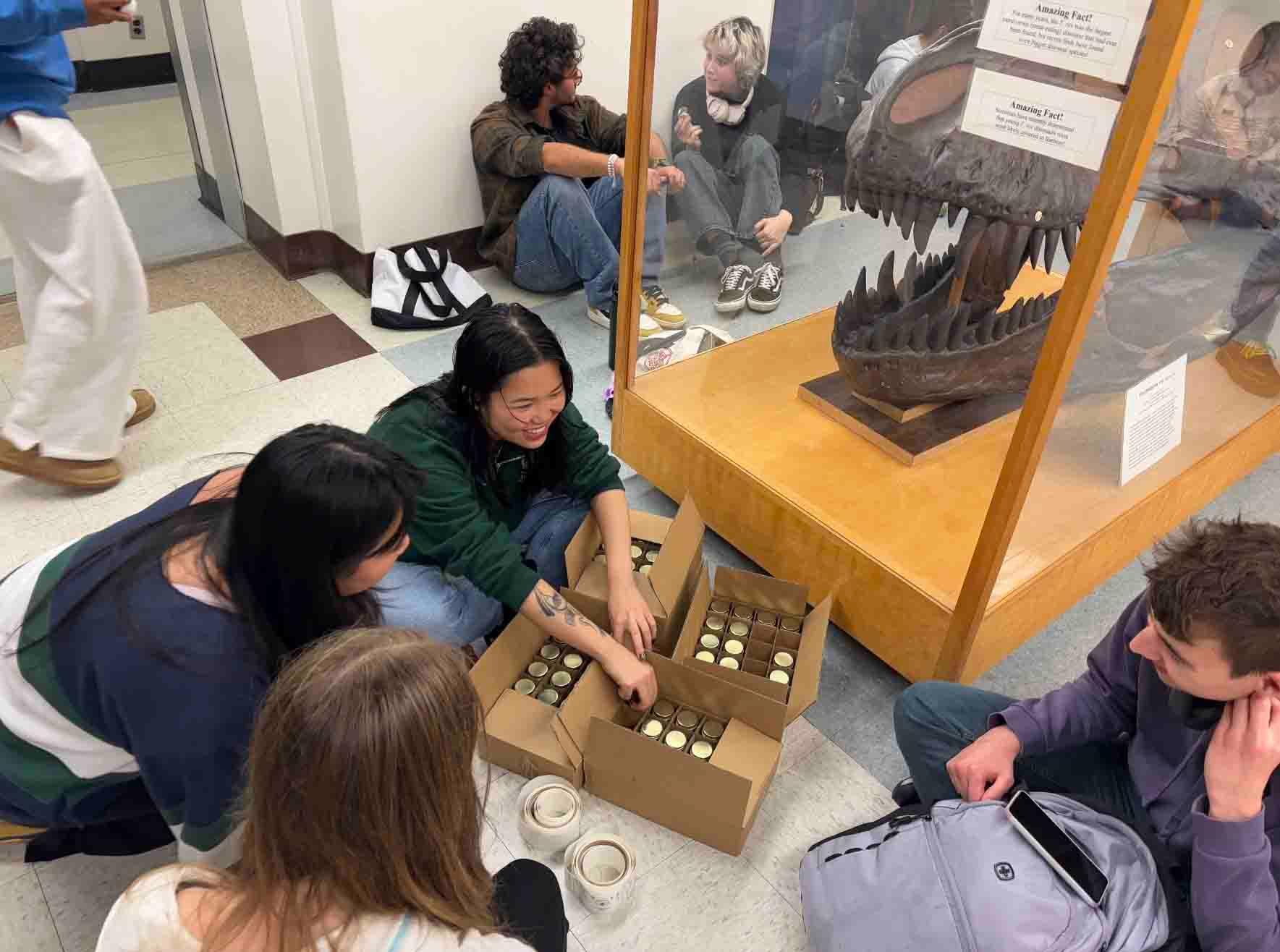
BD: We have lots of jars of it, actually, on the roof. We actually used to have a partnership with the CPO (Community Programs Office) food closet where we would give them our honey.
WG: And out of personal curiosity, can you taste the difference between this localized honey and say, the honey that you buy at a grocery store, for example?
BD: Oh, definitely. I think there’s like, there are a lot of misconceptions with honey. I think one thing is like, honey shouldn’t be stored in plastic, like real honey should be in glass jars. And so there’s a big difference between real honey and what a lot of stores put out.
NW: I don’t know if my palate’s that refined, I’m going to be honest.
BD: We actually, we have a honey wheel – like that’s something that exists, where you can kind of be like a little honey connoisseur and like get different flavor profiles based on like what flowers are being used to, or that the bees are pollinating. Yeah.
WG: Interesting. And what are students’ initial reaction to when they learned that there is a beekeeping club on campus because especially UCLA – it’s very urban. When I think of, say, a more outdoorsy campus, I think perhaps UC Santa Cruz, UC Davis…
NW: The most common reaction I get is, “There’s actually no way. I had zero idea,” which I go, “Yeah, most people didn’t.” The other top reaction is, “Oh, I think I heard about you guys once.”
BD: Oh, I get a lot. For some reason, the chancellor, I believe, always tells people about us, right? Yeah, at like orientation or like commencement or something, he always drops Bruin Beekeepers. I’ve yet to see him, but he always is like, “Oh yeah, there’s a beekeeping club.” And so at EAF (Enormous Activities Fair), people will come up and be like, “Oh yeah, you were brought up in the speech.”
NW: At my freshman orientation, and I’m like, “Like, wait, why? What?” I guess we’re just on the radar.
BD: I don’t know. It’s fun.
WG: Do you get a lot of your new members from word to mouth, or do you do a lot of social media recruitment?
BD: For sure, word to mouth or people will come up to us at tabling events where it’s mostly environmental clubs, so it’s students interested in sustainability to some extent.
NW: Yeah, I think we get a lot of crossover with a lot of really amazing clubs like birding and like other people that are very interested, especially like ecology, evolution, behavioral majors – they love us. We’re pretty cool. Yeah, definitely a very environmentally-oriented crowd tends to naturally get our way there and otherwise, people who just like to talk.
WG: And how long have you been around for as a club?
BD: The club has a pretty extensive history. It was initially part of an engineering club on campus, and then it kind of broke off and became its own. I believe that was in 2019.
NW: Yeah no, we’ve been around for a long time. I think that’s what I kind of like about it, though, since I feel like it takes on a real big life of its own and like has become its own big thing and splitting off from an engineering club into this, I mean, partnering with UC Davis and all the fun stuff we do. I don’t know. I’m, I’m proud of the club. I like us.
WG: And what are some fun events you’ve had in the past, you’ve held in the past year or so, maybe past quarter, some, some things that just pop up to mind?
BD: Oh, OK, Liz hosted a, it was initially called Meet the Bees, but it’s kind of like a beekeeping 101 where if you’ve never suited up before or seen hives, you can kind of just shadow what a typical beekeeping hive inspection would look like. So you can go up on the roof,we take about like six members and it’s usually their first time doing something like this. Sometimes the students are maybe afraid of bees, so it’s a cool thing to see people get, take a step forward and just experience that kind of educational moment with Liz because she’s really knowledgeable.
NW: I think my personal favorite and I think one of our more popular events is called Leap Lab, and so I might have mentioned before that we have a satellite campus in Santa Paula. And Leap Lab, we get to invite the students out. We drive all the way to Ventura, and it’s a very beautiful, relaxing, very nature campus. We’ve got our own set of hives out there, and like Bonny bakes cookies or makes guac sometimes, which is delicious. So we have snacks, and you just sort of get out there and enjoy the bees in a different environment and like take a step away from school and stress and get a breather.
BD: You definitely get to touch grass, which is so nice, and the campus also has like baby goats sometimes – lots of fun little surprises.
WG: And you mentioned this campus. Is it a farm of some sort? Is it a plot of land? How does it like–– if you could describe it to our audience members?
BD: It’s an outdoor educational center. I know the owners are currently trying to build some kind of outdoor science museum-type experience, specifically for children in the Santa Paula area, but it’s a large plot of land. I’m not sure how many acres, and there’s a lot of room for things like the apiary, and even they’ve got some dinosaur replicas. It’s really cool.
NW: No, they fully have like dinosaur bones. Last time I was there, the owner, he was like, “You want some?” and he just gave me little pieces of dinosaur bone.
WG: Do you often go to the satellite campus?
NW: We try to make it out there once every quarter, weather permitting. Weather is like a very sensitive thing for bees. Obviously, if it’s too hot, it’s not good to have people out there. If it’s too cold, not good for the bees. So we do try to do it every quarter, but I would say on average, when we get out there, guaranteed twice a year.
WG: And you mentioned weather. In the offseason, say during the fall and the winter, I know California has a relatively temperate climate, but still bees probably temper down their activity. How does that look like?
BD: Bees get cold, and when you’re inspecting hives, you are essentially taking off the roof of their home and pulling them out and bringing them into the cold. They’re slower, and they also are really locking into those food stores that they’ve created in the warmer weather. So when it is, let’s say it dips below 65 degrees and it’s not sunny, we wouldn’t want to go midday and do an inspection.
WG: And how often do you conduct these hive inspections?
NW: They occur pretty much on a weekly basis. It depends sort of what’s going on with the hives, like sometimes we have hives that need a little more extra attention – we might get in there a little more frequently.But generally, they take care of themselves for the most part, and it’s better to leave them alone than to bother them a bunch. So really, it’s like a casual once a week, an alternating schedule for the hives too. We don’t check on all of them every single week because that would take hours and hours, but it’s more like a couple here and there, you know.
WG: Well then, maybe you can take us through what a typical hive inspection looks like?
BD: Yeah, so there are a lot of different things that you can look for. One of our faculty beekeepers, Kristen, she created this really cool data sheet system, and we look into things like: Do the bees seem aggressive? Are they laying eggs? If so, how many? Like, is it a normal laying pattern? And we’re also taking note of the weather, whether we’ve seen a queen – that’s a big deal. Because if they do have irregular behavior, maybe we can say it’s because of that.
NW: Yeah, we have a very fun, extensive little checklist with all those little factors. We count drones, whether the queen has been marked with a color, because then we’ll know if she’s one of ours as in like, we’ve seen her before. And we also look for signs of any pests, pointedly, like we get varroa mites or wax moths, and those are pretty damaging. Perhaps, we look for any signs of that and then otherwise general health like brood and et cetera.
WG: And so what happens when there’s a pest invasion? How do you deal with that?
NW: We are constantly trying new and different ways, and we’ve, we don’t really have a standard dealing because, I mean, luckily for us, the beekeeping community is constantly on the innovation, and I feel like Bonny’s always like, “We’re going to try something new.”
I think our recent varroa mite attempt was using alcohol washes, which if you haven’t tried that, maybe you should for your hive at home. No, but I don’t think we really have a standard since it really all changes with maybe how severe the infestation is, whether or not it’s been around for a while, what other things we’ve tried, so yeah.
BD: Yeah, I would say varroa mites are really important to look out for because there’s something called deformed wing virus for bees, and so that’s the whole reason we look for them.
The alcohol wash is a way to just like do a little sample test of some of the bees in the hive, and you can spot the mites that way because it’s hard to just pinpoint them. They’re really, really small. There’s also a sugar roll method that we’ve done in the past, but we have decided not to do it anymore just because it consists of putting like a cup of bees into a jar and then rolling them around in sugar, which makes them really nauseous, and they like throw up and stuff. So it’s just like, it’s not the best move, so we don’t do that anymore,
NW: Even if it is for their benefit.
BD: Yes.
WG: And with climate change, have you seen any impacts on the bees? I know it’s a rather short frame to observe it in person, or…
NW: I would say it’s not really our bees that we’re concerned about because we deal with honeybees, which is like the most popular, the most prolific and also farmed for the most part. And so for that reason, they are hardy as ever. They’re great. But it’s always native pollinators and native bees in particular that have very specialized relationships that we’re concerned about. And you can see the impact of those numbers following like the recent wildfires that took out a bunch of habitat. And you can see those numbers going down slowly, and we’re sort of losing out more and more on unique bee species. But at the same time, there’s not a lot of awareness about this in the first place, and not that many people maybe even care about all the unique little bees we’re losing out on, and so we may not even know.
BD: But I do have some good news that one of our members is working with our faculty advisors. Her name is Michelle, and she is spearheading a native pollinator project at UCLA. So a big threat is that because of a lack of awareness, the plants that these native pollinators really love aren’t necessarily as like fruitful as they should be or like they aren’t planted as often. So some of her project works, work entails collaborating with the botanical garden to better inform gardening practices.
NW: Yeah, and I’m really excited because she’s talking about, OK, a lot of native bees actually live underground – fun fact, a lot of them, and a lot of them are like solitary. They’re not in hives and big masses. They’re just on their own. And so one of the big things we’re trying to get back into is making homes for these little bees and then instructing the groundskeepers on how to watch out for them and, you know, to be careful of them. And so I’m really excited about where Michelle’s going to take this.
WG: Pretty soon we could see little underground bee burrows around campus.
BD: Bee burrows…
NW: Yeah, that’s, that’s, that might actually be what they’re called.
BD: Yeah, I guess so, that’s the goal for sure.
WG: And how do you navigate funding for the club?
NW: Oh yeah, definitely. Well, first off, I want to shout out Julia, our finance director. Thank you, Julia, for all your hard work. And thanks to her we usually apply for funding through TGIF, The Green Initiative Fund here at UCLA, through ASUCLA, and it’s a team of really great students that put in a lot of effort to make sure that the projects they fund are very like impactful and better for the environment.
WG: And then do you have any plans for the future of, say, expansion or collaborating with more clubs?
NW: Yeah, I think I’m really hopeful that we’ll get to do more collaborations with other organizations on campus. I just really hope our native project keeps getting its momentum, we keep going with that and it goes really well. I have so much fun stuff I hope for.
BD: I mean, I’m really excited about the future of like the education program here. So far, we’ve been mostly taking care of the ambassador level, which is the first level of certification, but we do have the means in the future to move a little forward with the next levels, which include things like a CPR certification and things like more hands-on assessments that our faculty advisors can provide.
WG: Interesting. And if you could resume, kind of as we close off, one word to just describe Bruin Beekeepers?
BD: Fruitful, because of pollinators and also there’s a lot to offer. I don’t know.
WG: Well, thank you very much for your time. It was a great pleasure to have you, and next time I’ll walk around campus and see a little bee, I’ll think of you.
NW: Thank you for having us.
BD: Yes, thank you so much. This was so fun.
WG: Thank you. This episode of Curious Clubs was brought to you by the Daily Bruin Podcasts, and you can listen to this episode and all other Daily Bruin podcasts on Spotify, Apple Podcasts and SoundCloud. The audio and transcript of today’s interview are available at dailybruin.com. I’m William Gauvin. Thank you for listening.