UCLA law professor Kimberlé Crenshaw speaks on critical race theory, ‘backtalking’
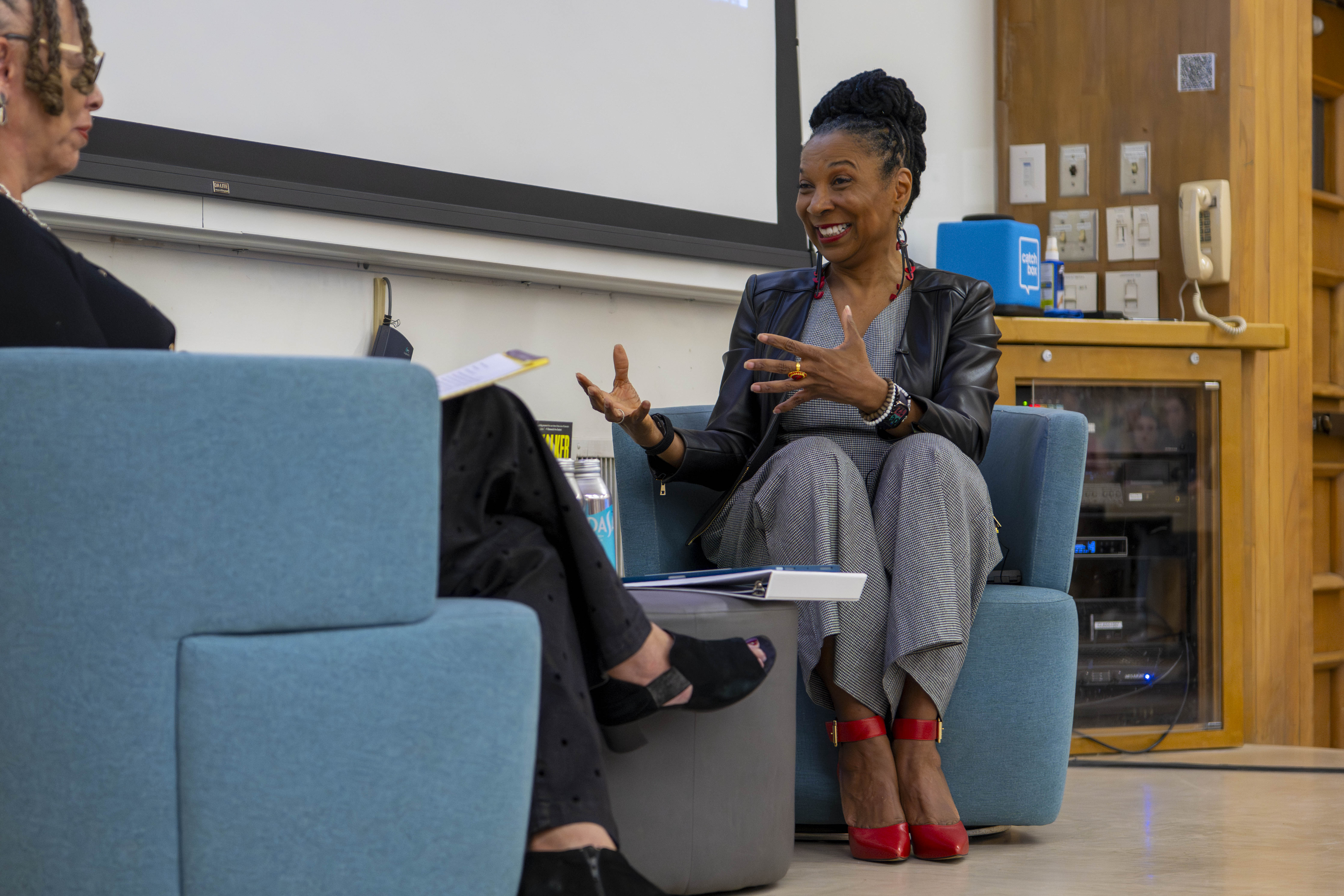
Critical race theory scholar Kimberlé Crenshaw speaks at a Thursday event promoting her memoir. Crenshaw emphasized the importance of standing up to oppressive systems. (Elle Smith/Daily Bruin)


Critical race theory scholar Kimberlé Crenshaw emphasized the importance of standing up to oppressive systems at a Thursday event promoting her memoir.
Crenshaw, a distinguished law professor at UCLA, shared anecdotes from her upcoming book “Backtalker” at the event. The event was organized by the UCLA Law Review and co-sponsored by UCLA’s Critical Race Studies Program, which Crenshaw co-founded.
Critical race theory, which Crenshaw developed, argues race is not natural, but a social construct meant to maintain inequality. Crenshaw also contributed to popularizing the concept of intersectionality, a framework for understanding how different social identities come together to impact privilege or discrimination.
“It (CRT and intersectionality) is basically saying that the knowledge that comes from the lived reality of being a racialized person, of being gendered in this society, is knowledge that matters,” Crenshaw said during her talk.
Cheryl Harris, a UCLA law professor, said she believes Crenshaw’s book is important at a time when at least 35 states have passed or considered legislation restricting teaching of CRT, according to ABC News, and the Trump administration has cracked down on diversity, equity and inclusion programs.
President Donald Trump signed an executive order mandating the removal of DEI initiatives across all federal contractors in January 2025. The United States Department of Justice sent a letter in August demanding UCLA end diversity initiatives, including race and ethnicity-based scholarships, and make other concessions to reinstate $584 million in federal research grants.
UCLA attorneys advised staff to remove website language that may have implied preferential treatment for certain groups in response to the Trump administration’s anti-DEI directives, a former equity advisor told the Daily Bruin in March.
Related: [UCLA staff advised to remove targeted website language amid Trump’s DEI crackdown]
Crenshaw said in a speech that she wrote the memoir to defend CRT’s credibility and prevent it from being portrayed as a form of identity politics or an ideology imported from Europe. She added that she believes people with left-leaning views – including her colleagues in critical legal studies, who follow the belief that the law is inherently political – have been afraid to speak out about race.
“Critical race theory has barely gotten to the front door with our allies – much less with the rest of society,” Crenshaw said during the talk.
Backtalking – the core concept of her latest book – is about resisting systems that exclude and suppress people, Crenshaw said in an interview.
Crenshaw said during the talk that she experienced gender discrimination in her all-Black study group at Harvard Law School, adding that she was expected to show solidarity as a Black person while also being excluded for her gender. She inherited her willingness to stand up to injustice from her mother and grandparents who defied racism, she added.
“Sometimes the things that come at you are not because you’re underperforming. It’s because you’re overperforming,” Crenshaw said during the talk. “There are assumptions that are attached to your life and performance.”
The memoir takes place in her home town of Canton, Ohio, a small industrial town where segregation was widely accepted, Crenshaw said during the talk. A private corporation bought homes in the area – including her own – and demolished them to build an industrial park, which she said she believes hindered families’ abilities to build intergenerational wealth.
Crenshaw added that she believes it is important for people from marginalized backgrounds to tell their stories.
“The MAGA (Make America Great Again) people are not the majority,” Crenshaw said in an interview. “The only way they’re able to exercise power is when we don’t talk back. When we don’t realize that we are the majority. When we don’t realize how important and valuable our history is.”
Crenshaw said in the talk that she was always conscious about gender inequalities within the Black community, but Anita Hill’s testimony in front of the Senate Judiciary Committee that Supreme Court Justice Clarence Thomas sexually assaulted her marked a turning point. Thomas denied the allegations, and the Senate confirmed him in a 52-48 vote following her testimony.
Crenshaw said she felt betrayed when she joined a prayer group that opposed Hill’s testimony.
“To the extent we can trace this moment of authoritarian collapse to those decisions, not believing a black woman didn’t just harm us – it harmed the nation,” Crenshaw said during the talk.
Kyshia Hearns, a third-year education and social transformation student who attended the event, said she related to Crenshaw’s testimony about being stereotyped as a talkative Black woman. Seeing Crenshaw embrace backtalking was inspiring, she added.
Austin Piatt, who was a research assistant for Crenshaw and attended the talk, said he believes the Trump administration is attacking people of color. He added that conversations which humanize critical race theorists – especially amid conservatives’ CRT scrutiny – are especially important.
“We have to be able to resist those who would want us to believe that there’s nothing that we can do,” Crenshaw said.