It’s day one for UCLA football. Here’s how things are looking.
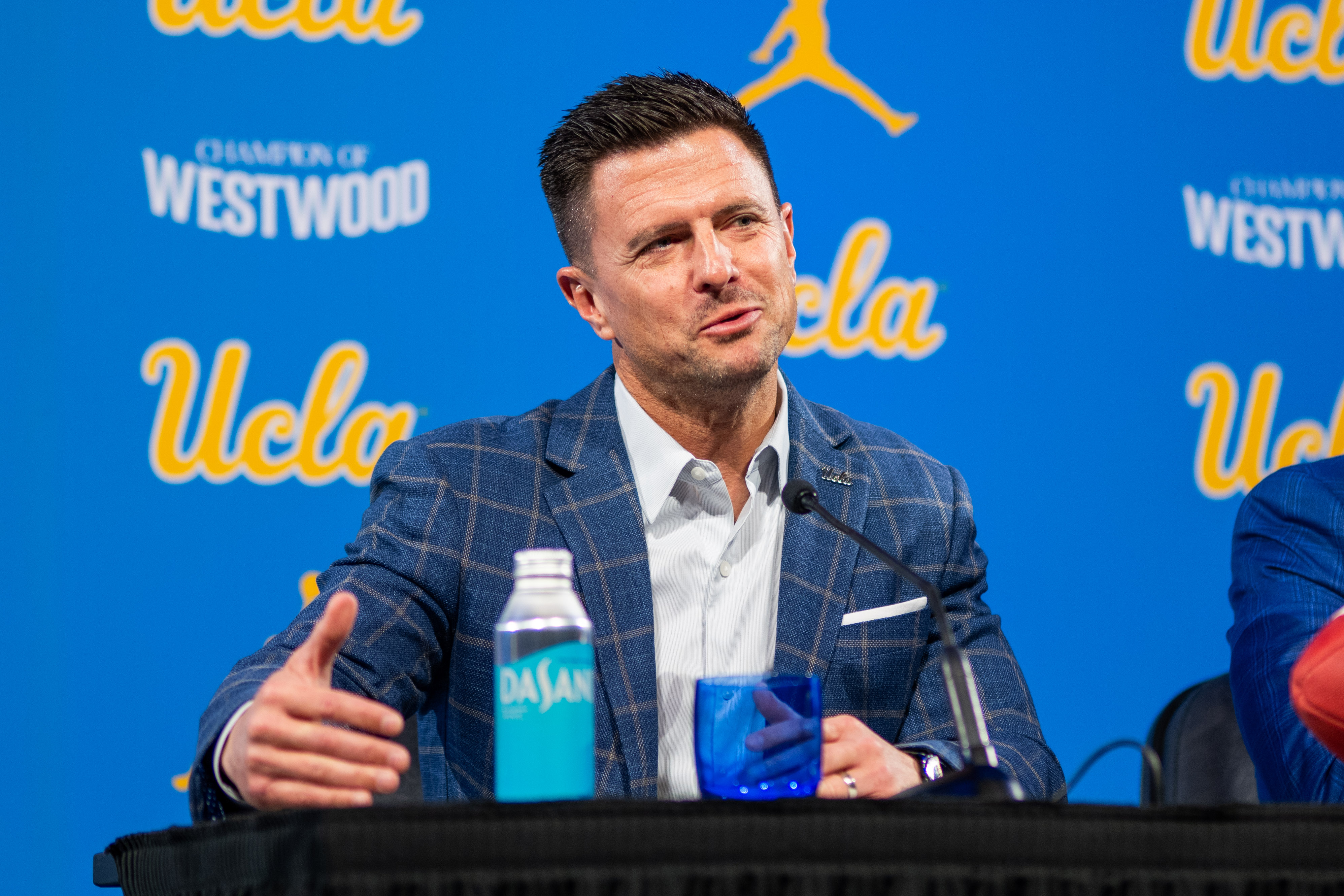
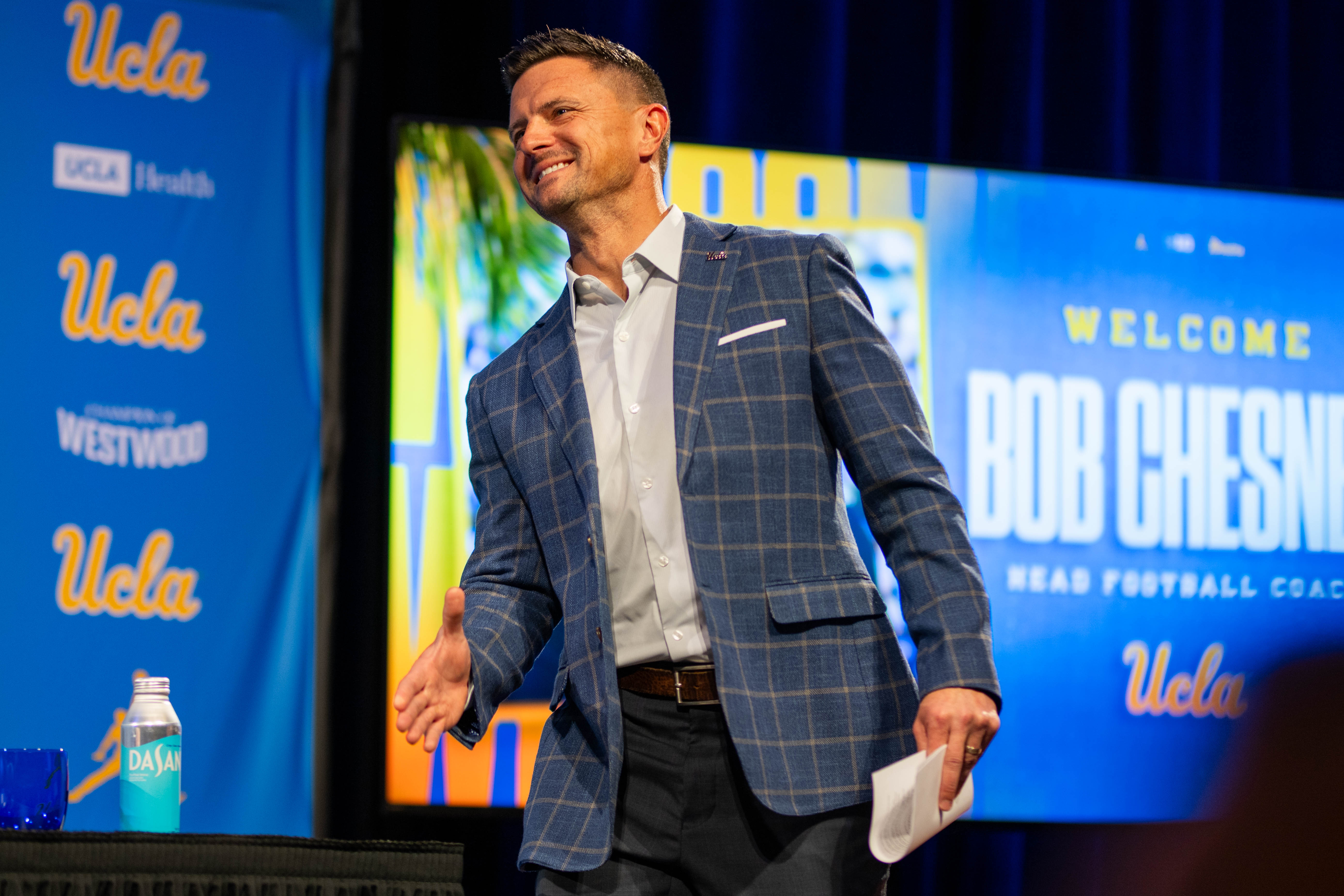
UCLA football coach Bob Chesney talks
to the media. (Aidan Sun/Assistant Photo editor)

By Connor Dullinger
April 2, 2026 11:30 p.m.
An unfamiliar feeling emanated from Spaulding Field.
One that has rarely been synonymous with UCLA football over the last several seasons.
And a feeling that everyone in attendance seemed to share at the Bruins’ first Spring practice Thursday morning.
Music that could be heard around campus boomed from the speakers surrounding the Wasserman Football Center. The yelling of coaches and chants from players cut through the early morning air as students walked to class. And herds of recruits surrounded the field, eyes glued to the performance in front of them.
Most, if not all, felt the seemingly tangible feeling in the air.
Excitement.
The 2026 UCLA football roster – composed of 57 returning athletes and 55 newcomers – with 43 transfers and 12 freshmen making up the novel bunch – cultivated the buzz that teemed across the turf.
But coach Bob Chesney was focused on everything else. Chiefly, ensuring that the team’s culture, pillars and the collective attitude and effort the program built in the months leading up to padded practice continued on day one.
“You leave day one, and there’s going to be intensity and excitement around it, but the question is, was it clean? Did the fundamentals that we worked on all throughout the winter carry over or not?” Chesney said. “And while I watch it out here, the things that don’t take skill, the things that don’t take great genetics, were the things I wanted to focus on today – more than anything, was the effort.”
With a frenzy taking over the football practice field Thursday, it seemed Chesney had his toe in every pond – offense, defense, special teams, recruits, media and everything in between.
But the first-year head honcho said one thing remained evident throughout the team’s first spring practice.
Effort.
“Unbelievable,” Chesney said of his new players’ attitude Thursday. “We’ve been going for January, February, March – three months basically – before we’re really playing football, and I thought they were just hungry to be out here. It’s day one, so you expect that.”
But like the coach said, excitement on day one is expected.
But progression from one practice to the next and the mitigation of dips in performance and effort are imperative to the beginning days of the 2026 season. Avoiding dips, though, does not mean failure is absent.
Setbacks are expected, Chesney said.
But it is the response to the failure that determines the trajectory of a player’s and a team’s success.
“As those failures show up, remove your emotion from the motion,” Chesney said. “Let’s focus on what you did that was incorrect, and let’s fix it. Because ultimately, dwelling on the past, if it was bad, is not going to get you anywhere. Getting too high in the successful moments isn’t going to get you anywhere. Don’t put any limits on yourself. Don’t wonder, ‘Can I do this? Can I do that?’ You can.”
This mindset that Chesney is establishing eventually builds trust.
And once there’s trust, the standards and expectations are set.
And when there are standards and expectations, accountability – among the players, the coaches and everyone in the program – comes to the forefront, the coach said.
Achieving this culture is Chesney’s ultimate goal, and establishing that foundation comes from building upon what was learned from January to March throughout UCLA football’s spring practices.
“This is sort of the bedrock that we’ll build upon,” Chesney said. “Ultimately, what you allow to happen out there is going to carry over every single day moving forward. So if you didn’t break whatever habits were out there that were not good, and if you didn’t celebrate the good things that you liked, you’re probably not going to see the repeat of the good things, and you’ll probably see a whole lot of bad things.”
Although games are not won and lost in the spring, championship-level mindsets and habits are built.
What did Chesney see from his position groups?
It’s day one.
The starting offense and defense won’t be concrete until UCLA takes the field against California on Sept. 5 for the team’s first game.
But Chesney still highlighted what he liked from his position groups Thursday morning.
While Chesney sparingly spotlighted individuals, he acknowledged the strength, depth and versatility of the Bruins’ running backs.
“Not to name names, but they are all physical,” Chesney said. “They’re downhill players. They protect the football well. What their bodies look like is phenomenal, and that they are probably, just on mass alone in the weight room, are stronger than most, but that running back room, they’re stronger than the linebackers. They might be stronger than the (defensive) ends, there’s some stuff in that room that’s just a little bit different right now.”
The Bruins retained starting running backs redshirt junior Anthony Woods and junior Jaivian Thomas from last season, but they also added James Madison’s Wayne Knight – an AP Second Team All-American all-purpose player – and Iowa State’s Dylan Lee, while also keeping former four-star recruit Karson Cox.
Another group that did not face much turnover was the quarterback room, which includes starting signal-caller Nico Iamaleava, alongside his brother and former four-star recruit Madden Iamaleava.
And, again, while Chesney did not point out individuals, the first-year Bruin head coach liked what he saw from the team’s game managers.
“I thought they (the quarterbacks) did a good job,” Chesney said. “It’s the first time they’re out here, really seeing it, with different colored jerseys and helmets on and an O-line in front of them. Everybody stood in the pocket well, and nobody was looking to run or scared to stay in there. They did a nice job keeping their eyes downfield … And when they had to scramble, they did a (good) job to get downfield and put the ball away.”
Chesney noted that the Bruins’ offensive line will undergo a lot of rotations in the upcoming season.
Chesney said a deep offensive line is integral for a team to gel while ensuring the squad does not skip a beat if someone on the starting line goes down.