Scouting report: UCLA men’s basketball vs. UConn
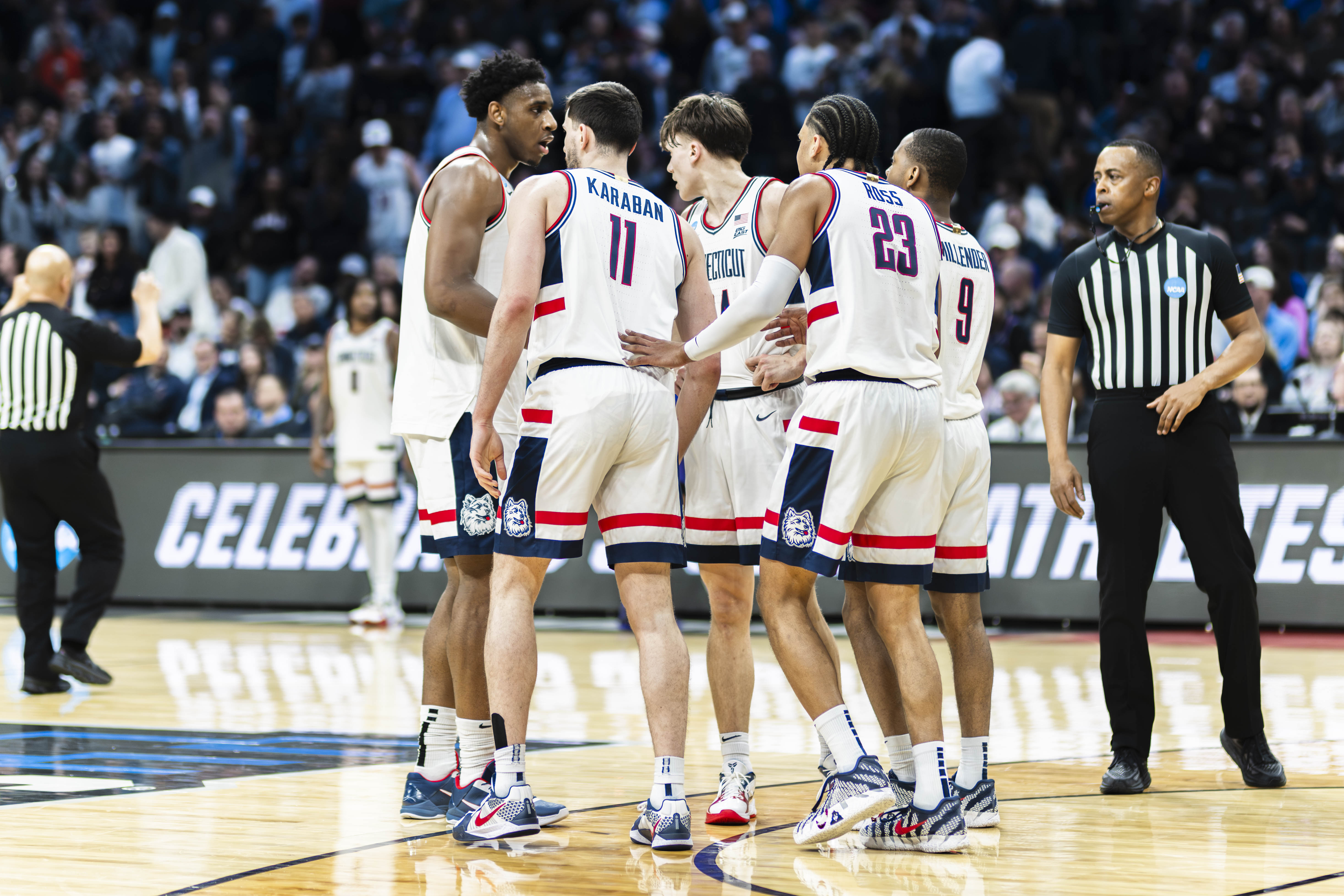
Players for No. 2 seed UConn huddle together on the court in Philadelphia. (Aidan Sun/Assistant Photo editor)

By Connor Dullinger
March 21, 2026 4:56 p.m.
The second round of the NCAA tournament is here, and the Bruins have the chance to advance to their first Sweet Sixteen in three years when No. 7 seed UCLA men’s basketball (24-11, 13-7 Big Ten) faces No. 2 seed UConn (30-5, 17-3 Big East) on Sunday night at the Xfinity Mobile Arena in Philadelphia. Daily Bruin Sports editor Connor Dullinger breaks down the Huskies’ strengths and weaknesses ahead of the Round of 32 matchup.
Personnel:
Coach: Dan Hurley
Starting lineup: Guard Solo Ball, Guard Silas Demary Jr., G Braylon Mullins, F Alex Karaban, C Tarris Reed Jr.
Best player: Tarris Reed Jr.
X-factor: Silas Demary Jr.
KenPom ranking: No. 11
Adjusted offensive rating: 122.2 (No. 30)
Adjusted defensive rating: 94.7 (No. 14)
Adjusted tempo: 64.6 (No. 322)
PHILADELPHIA – Tarris Reed Jr. is probably the first name on coach Mick Cronin’s scouting report – and rightfully so.
The center is coming off a historic night, where he knocked in 31 points and grabbed 27 rebounds against No. 15 seed Furman in the Round of 64 matchup Friday night.
With senior forward Tyler Bilodeau as questionable for the Bruins’ second-round affair, Reed could be on the verge of back-to-back monster games to propel the Huskies to the Sweet Sixteen.
Junior forward/center Xavier Booker, redshirt senior forward/center Steven Jamerson II and redshirt sophomore guard/forward Brandon Williams will have their hands full limiting Reed if Bilodeau is absent from Sunday night’s contest.
Reed is a ferocious rebounder. He averages 8.7 boards per game, including 3.1 per contest on the offensive glass. He uses his massive 6-foot-11 and 265-pound frame to dominate the interior, clearing out space and using his game sense and athleticism to grab opportunities for the UConn offense.
The former Michigan transfer’s offensive prowess also stems from his high motor around the rim. Reed paces the Huskies in scoring, averaging 14.3 points per game on 63.5% shooting from the field. He almost exclusively scores in the paint, and has taken just six 3-pointers across his four-year collegiate career.
If Bilodeau does return Sunday night, he will be met with a tall task of defending and attacking Reed. This means the Bruins’ frontcourt depth may be imperative to mitigate Reed.
Joining Reed in the frontcourt is forward Alex Karaban – UConn’s program leader in games played and 3-pointers made.
Karaban paces the team in scoring behind Reed, averaging 12.9 points per game on 47.8% shooting from the field and 38.9% shooting from beyond the arc.
The forward does not play like a typical power or small forward, with long-range shots comprising 48.5% of his shot diet. Karaban makes his money from deep. Coach Dan Hurley designs offensive sets to have the forward work around multiple screens to free him up on the perimeter.
The UConn forward could be critical to the Round of 32 – giving the Huskies a lethal option from deep that may steal the game from the Bruins if they let him get hot.
He is a veteran player, having won two NCAA championships while in Storrs and making the NCAA Tournament in each of his five season’s at UConn. Karaban has started in 145 of the 146 games he has appeared in as a Husky, and his seasoned leadership could give the Huskies the upper hand Sunday.
UConn’s backcourt is headlined by guards Silas Demary Jr., Solo Ball and Braylon Mullins.
Demary, who injured his ankle in the Big East championship against St. John’s, did not play in his team’s first-round matchup against Furman, and is questionable to play against UCLA on Sunday.
The injury status of Demary is as important to UConn as Bilodeau’s to UCLA.
The guard affects all aspects of the Huskies’ game. He leads the team in assists and steals, averaging 6.2 and 1.6, respectively. He also contribues 10.9 points and 4.5 rebounds per game – marks which rank fifth and third on the team, respectively.
Demary excelled as a catch-and-shoot threat, netting 37.4% of his 3-pointers on 4.7 attempts per game last season at Georgia. Since his transfer to UConn, however, he has become the squad’s primary point guard, focusing on distributing the ball and getting downhill.
His assist tally has increased from 3.1 to 6.2 over the last year, and while he only takes 2.3 3-pointers per game this season, he is still efficient on his reduced volume, shooting 41.6% from downtown.
If Demary plays, he will be a pesky one-on-one defender who will most likely take any one of UCLA’s starting guards. He could be most effective guarding senior guard Donovan Dent if his ankle injury is fully healed, else he will likely take sophomore guard Trent Perry.
Joining Demary in the frontcourt is Ball, who plays more as the Huskies’ two-guard.
Operating as an off-ball guard, Ball works primarily as UConn’s backcourt shooter. He excels on the catch and shoot – taking 6.7 of his 10.9 shots per game from beyond the arc. Despite being a bigger guard at 6-foot-4, he is not a particularly dangerous slashing threat, but could catch fire if he finds his rhythm shooting the ball.
Ball is also not afraid to work in isolation or use his dribble pull-up to throw defenders off and create separation in the midrange.
The third-year UConn guard has struggled as of late, failing to score at least double-digits across his last three outings and shooting 7-for-26 from the field. But as Cronin would say, the law of averages says he is destined to return to form sooner rather than later.
Rounding out the starting five is guard Braylon Mullins.
The projected first-round pick in the 2026 NBA Draft is an elite catch-and-shoot guard who has a quick release and is not afraid to take shots off balance while coming around the screen or off the cut. Mullins averages 12 points per game and shoots 33% from beyond the arc.
Mullins is also not afraid to dribble into his pull-up, using his game sense and feel combined with his proficient ball-handling to manipulate defenses and create space for shots.
What sets him apart – and could be the difference Sunday night – is his off-the-ball movement and zero hesitation shooting the ball, making him a dangerous player in March.