USAC IVP office sanctioned for early campaigning on Bruin Success Referendum
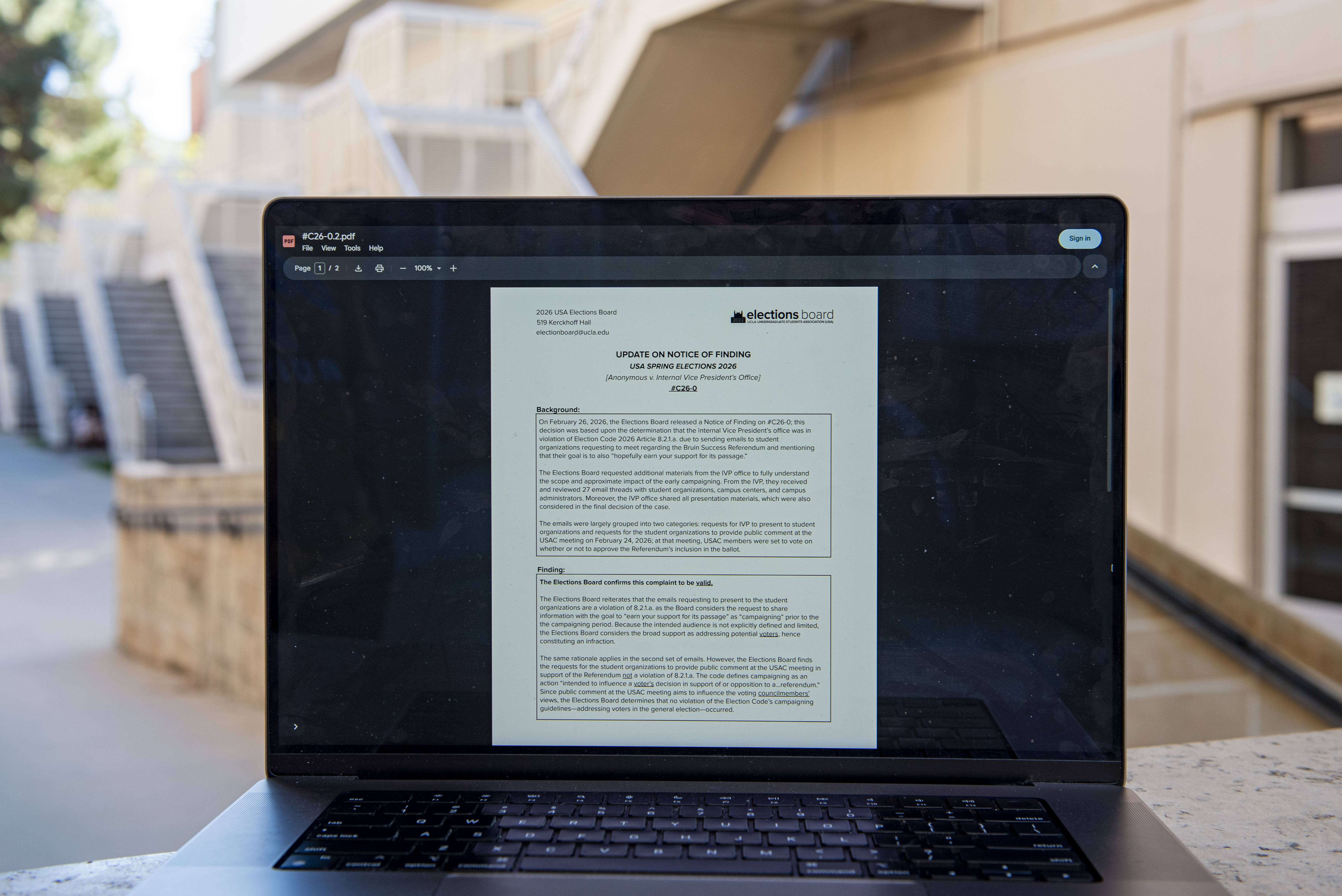
A USA Elections Board sanction is pictured on a computer. The sanction said the Undergraduate Students Association Council Internal Vice President’s office cannot campaign for a referendum sponsored by the office until two weeks after the campaigning period begins. (Leydi Cris Cobo Cordon/Daily Bruin senior staff)

By Shiv Patel
March 5, 2026 7:19 p.m.
This post was updated March 5 at 10:00 p.m.
The Undergraduate Students Association Council internal vice president will be unable to campaign for a referendum he proposed until two weeks into the May USAC election’s designated campaigning period.
The USA Elections Board issued a sanction Wednesday barring USAC IVP Tommy Contreras’ office from campaigning for the Bruin Success Referendum’s approval until April 22. The elections board determined that members of the office sent emails requesting to give student organizations and campus centers presentations about the referendum and asking members of the organizations to advocate for the referendum’s approval at a Feb. 24 USAC meeting.
USAC unanimously voted Feb. 24 to place the referendum on undergraduate students’ ballots in May after multiple students urged the council during public comment to approve the referendum.
The Bruin Success Referendum, if passed, would levy an additional $55 quarterly fee on undergraduate students – the biggest single-year increase to USAC fees in the student association’s history. It would fund 10 identity- and community-based centers and programs, including the Academic Advancement Program, the Black Bruin Resource Center and the Transfer Student Center.
Each undergraduate student currently already pays more than $100 in USAC fees every quarter.
The elections board found that emails asking for groups’ support for the ballot measure fall under the USA Election Code’s definition of campaigning, since the emails requested student groups’ support for the referendum. Campaigning is not allowed until April 8 – one month before voting opens.
The elections board also determined, however, that the emails requesting students to speak in favor of the referendum at public comment did not constitute campaigning.
The sanction came a week after the elections board indefinitely barred the IVP office from campaigning for the referendum. The board received a complaint alleging that the IVP office had sent the Muslim Student Association multiple emails in January and February about the referendum, including one that said the office wanted to secure the group’s support for the proposition.
“Our goal for a potential meeting is to take time to share specifics regarding the Referendum, answer any questions you may have, and hopefully earn your support for its passage,” a member of the IVP office said in a Jan. 22 email, according to the elections board.
Sofia Gevorgian, the elections board’s director of investigations, said the initial complaint came from the MSA. The MSA did not respond to a request for comment on the complaint.
The board also requested last week for the IVP office to turn over a list of organizations it had reached out to and any materials from presentations the office had given on the referendum within 48 hours.
Gevorgian said the decision to reduce the IVP office’s campaigning time was based on the extent and volume of the emails.
“We decided … to limit the campaign period for the referendum for two weeks since they spent about a month campaigning beforehand,” said Gevorgian, a fourth-year Middle Eastern studies and political science student.
She added that further violations by supporters of the Bruin Success Referendum would likely be met with a harsher punishment. The election code says a ballot proposition can be disqualified if a proponent of the proposition violates election rules.
Contreras, who proposed the referendum to USAC, said he was unaware of the specific language used in his office’s outreach emails.
“If I probably would have seen that word ‘support,’ (I) would have flagged it,” said Contreras, a fourth-year political science and public affairs student.
Contreras said, however, that he believes the two-week suspension is excessive, adding that he is considering appealing the decision to the USA Judicial Board.
Elections board decisions may be appealed to the judicial board, though the appeal must be filed within 24 hours of the elections board’s decision – which was issued 4:09 p.m. Wednesday.
The UC Office of the President and Chancellor Julio Frenk must approve the referendum’s language before it appears on students’ ballots.
If it makes it to the May ballot, at least 20% of undergraduate students would need to vote in the referendum, with a majority of those voting selecting “Yes.” Per UC policy, if the referendum is passed, 25% of the fees collected would be returned to student aid.
Contreras also introduced a proposal to add the BruinFresh Referendum to the spring ballot. That referendum, if passed, would have levied an additional $9 quarterly fee to create a food benefit program for undocumented and international students experiencing food insecurity, but USAC declined to place the proposition on the ballot, with some council members calling the referendum’s text too vague during the Feb. 24 meeting.
He also previously campaigned for the successful Resources First Referendum in 2025, which increased the #UCLAWellness quarterly student fee by $4.
[Related: Bruins renew Bruin U-Pass, vote in new council in 2025 USAC election]
Despite his office having a shortened campaigning period, Contreras said he does not think the sanction will hurt the referendum’s chances of passing.
“I’m confident that we are able to get through any obstacle that comes our way, including this sanction,” he said.