UCLA engineers discover metal with potential to enhance AI chip performance
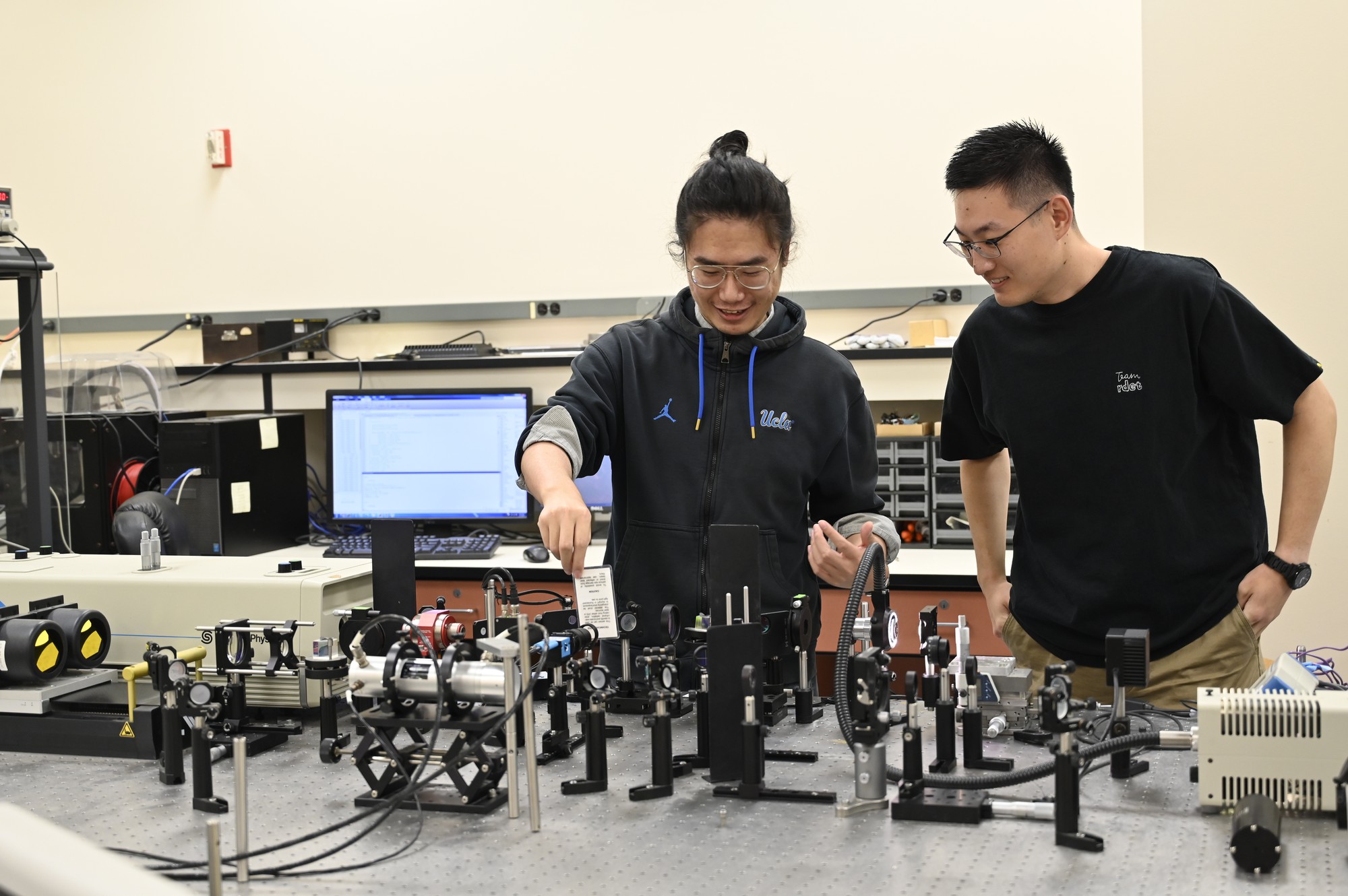
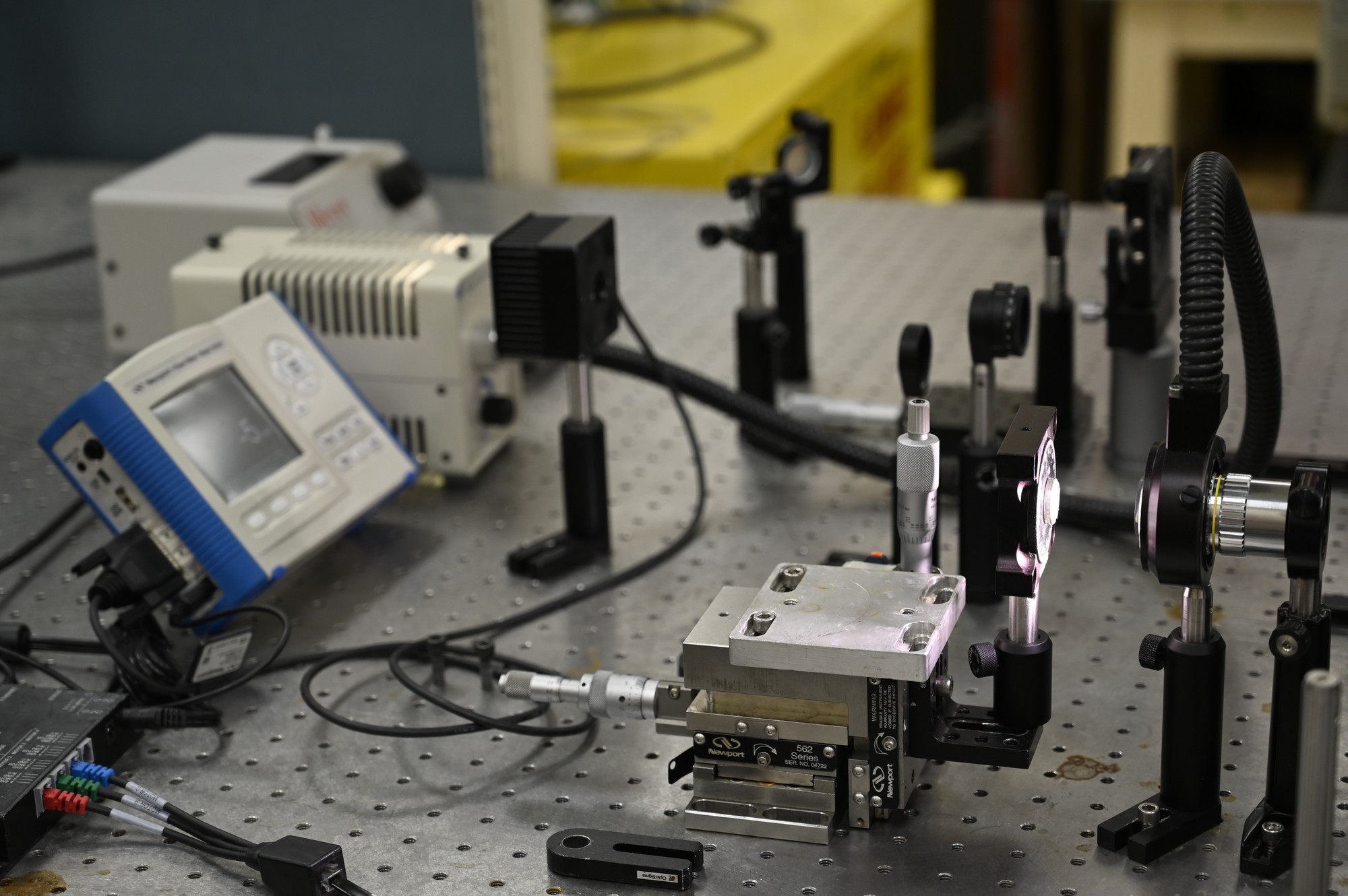
Li (left) works with the lab’s spectroscopy setup as part of his experimentation work, and Su (right) assists with theoretical work. (Hannah Morgan/Daily Bruin senior staff)

By Hannah Morgan
Feb. 20, 2026 1:25 p.m.
This post was updated Feb. 22 at 10:33 p.m.
Researchers in the UCLA Henry Samueli School of Engineering and Applied Science discovered a metallic material with nearly three times the thermal conductivity of copper, which could make some electronic devices – including AI chips – more effective.
Yongjie Hu, a professor in the department of mechanical and aerospace engineering, uncovered the metastable transition metal, called theta-phase tantalum nitride, with his research lab in July 2024. The team – which discovered the material using an advanced laser spectroscopy setup – published its findings in scientific journal Science on Jan. 15 and Feb. 12.
Hu said the team’s findings show that theta-phase tantalum nitride contains properties which make it more effective than copper at heat dissipation and thermal conductivity, which can improve the performance of electronic hardware.
Replacing copper hardware with theta-phase tantalum nitride could increase performance in AI chips and electronic devices, affecting companies like NVIDIA, a leading producer of AI hardware, said Suixuan Li, a postdoctoral researcher in Hu’s lab.
The publication was the culmination of a multiyear effort to expand on the lab’s previous breakthroughs concerning thermal conductivity properties, Hu said. The lab previously discovered boron arsenide, the compound with the highest thermal conductivity among semiconductors, in 2018, Hu added.
“We were excited (about) how we can move (to the) next state, to push it forward,” Hu said.
Engineers began incorporating boron arsenide into electronic chips after the 2018 discovery. The chips performed better with boron arsenide compared to previous thermal design components, Hu said.
Li said since both boron arsenide and theta-phase nitrate share the same physics, the team could use the same discovery strategy as 2018 – just shifting from semiconductor to metal.
Hu’s team had to not only research phonons but also interactions between electrons and phonons, which are key for heat transport, Hu said.
The discovery of theta-phase tantalum nitride has industrial applications, Hu said.
Copper and silver are the most commonly used materials in electronic hardware technology, Hu added. According to Hu’s paper, copper’s thermal conductivity is about 400 W/mK, whereas theta-phase tantalum nitride has one of roughly 1100 Watts per meter-Kelvin, meaning a chip utilizing theta-phase tantalum nitride would be more effective at enhancing chip capabilities.
Chuanjin Su, a doctoral student in Hu’s lab, said heat transfer – which theta-phase tantalum nitrate bolsters – dictates the size of AI chips.
“The size of the nanostructure seen in chips is (going to) keep shrinking over a few decades, and right now it’s more likely to reach a limit,” Su said. “This limit is not governed by the chip design, but actually it’s governed by the thermal dissipation – thermal design.”
Li said he believes the discovery will have significant implications for the future of AI.
“For this newer generation or the future generation of, say AI accelerators like (those) from Amadeus and others, copper may not be sufficient to dissipate the heat,” Hu said. “We … experimentally discovered new metallic material, which has three times the thermal conductivity of copper, essentially breaking the record set by (copper) for the last 100 years.”