Opinion: Grades must be deemphasized to promote real learning, reduce pressure
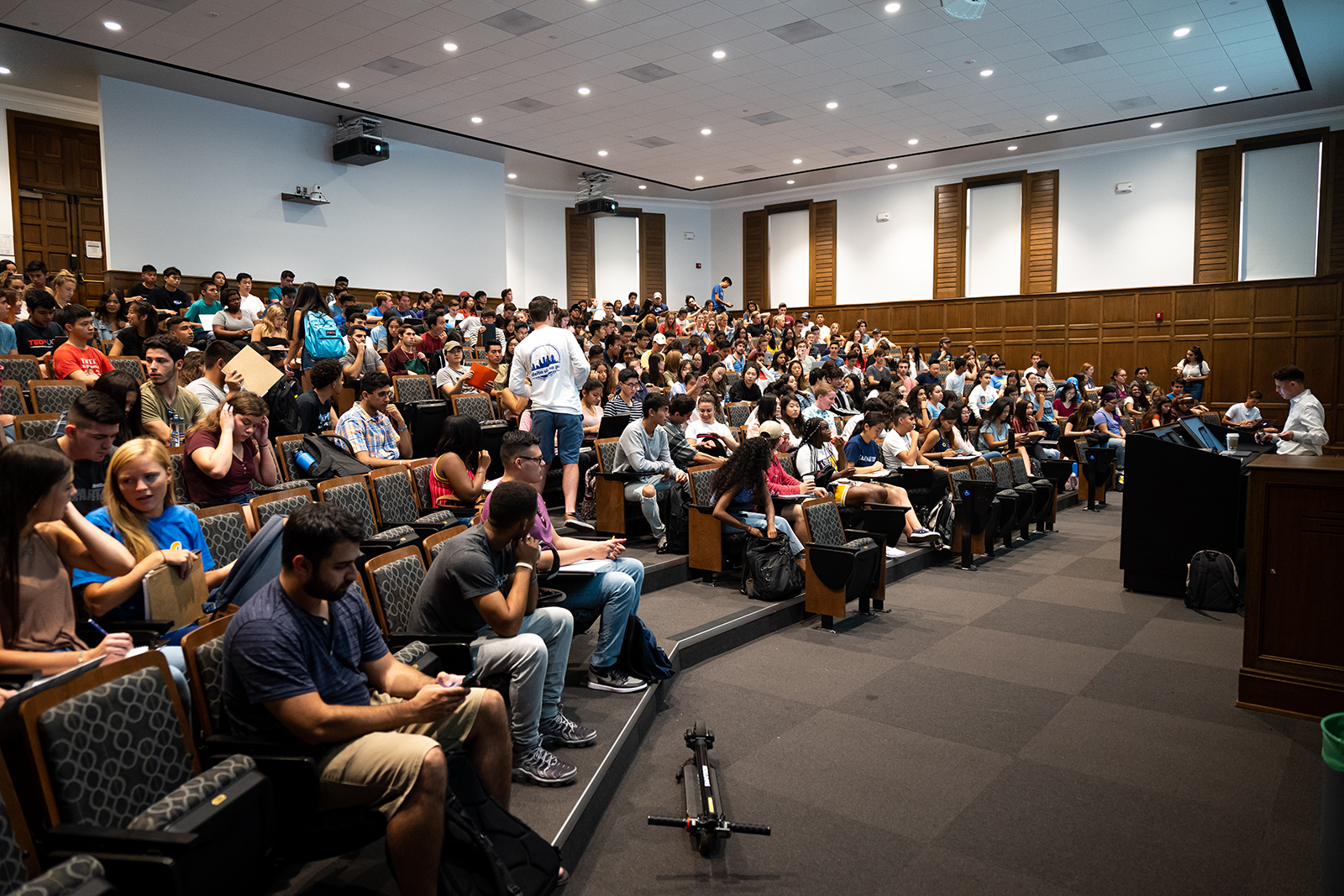
A crowded lecture hall is pictured. Columnist Mia Kennedy argues grades should not be central to the learning process. (Daily Bruin file photo)

By Mia Kennedy
Jan. 29, 2026 4:52 p.m.
This post was updated Feb. 18 at 7:40 p.m.
Life is all about making mistakes.
When children learn how to ride a bike, they fall. When they spill a glass of milk, they clean it up.
But in college, a mistake means more than just a scraped knee or a mess on the kitchen floor. Instead, it could result in long-term consequences.
This is because of the grading system.
In theory, the grades one receives should reflect what they have learned. But in practice, this is not always the case.
Grades need to be deemphasized in the classroom to better support students. Whether that be through explicit actions – such as opportunities for ungraded practice assignments – or simply being more aware of academic struggles, professors need to mitigate the pressure placed on students to navigate the balance of grades and mastering content.
Without any support, students will inevitably face ramifications in not just their academic success but also their mental health and overall well-being.
There has always been academic pressure placed on students.
In a 2022 study, more than half of the interviewees described achieving A’s as more stressful than keeping up with a college workload.
There’s pressure to be the best student and strive for the best grades in a class, even if that results in sacrificing other physical and mental responsibilities.
UCLA alumnus Alyssa Dehaven said she believes UCLA only adds to this perfectionist mindset.
“UCLA is so renowned, and then it’s so competitive, and you feel like you need to live up to this really big expectation of yourself and the people around you,” Dehaven added.
When you attend such a prestigious university, there is a norm where the priority shifts from learning to aiming for a good grade. People don’t want to say they failed, and people especially don’t want to say they failed at UCLA.
One thing to note is that the decision between mastery of content or excelling in terms of grades can depend on a wide range of factors – most commonly the type of class taken.
“For my GEs, I’m just trying to get the grade,” said Kobe Geyer, a first-year English student. “But in my major, … I want to go through those errors and failures to an extent.”
The need to prioritize getting good grades, especially when it comes to core major classes, can significantly affect what a student gets out of a particular course.
“I don’t want to mess up my class or my future, but I want to have that rough essay or that rough process, because you learn how to build off that,” Geyer added.
With the pressure for students to achieve high marks, there is no way for them to experience and overcome the failures associated with learning. This creates a cycle where students are forced to pick between grades and learning, a lose-lose situation that is constantly repeating itself.
In an ideal world, students would be able to strike a balance.
“The way that courses are meant to be designed, if you learn the material, you should do well on the assessments and get a good grade,” said Tyler Andres-Bray, an assistant professor of teaching in the Department of Ecology and Evolutionary Biology.
But in subjects where the only way to learn is through trial and error, there is no room for both cases to be true.
“There are situations where it can be more frustrating for students than intended, and then students have to make this decision sometimes between whether they should be trying to learn the material or whether they should be trying to get a grade,” Andres-Bray added.
This frustration is why support for students is so necessary, as there should not be a world where students are forced to make sacrifices in their educations.
Support for students can come in a multitude of ways. Professors can give more opportunities for ungraded practice or allow essay drafts to be turned in for review before a final version.
“A policy that I’ve usually done in the past is, if you perform better on the final than your lowest course exam, I will replace that exam with your final,” said Patrick Wilson, a chemistry and biochemistry assistant teaching professor.
Whether it be through direct or indirect support, professors need to be more understanding of the competing demands of achieving good grades and learning the material for students when it comes to classes.
Granted, some professors may say these policies undermine the freedom that comes with being the instructor of a class. They may argue it is a student’s responsibility to manage their workload.
But students are not machines. Guidance and support from professors can be the difference between a positive and negative experience for those attending UCLA.
College has so much to offer, but the full extent is inaccessible when students feel they can’t mess up without serious repercussions.
And ultimately, if falling off a bike is how children learn, college should not be the place where mistakes suddenly stop being allowed.