Exploring the UCLA housing guarantee 4 years after its implementation
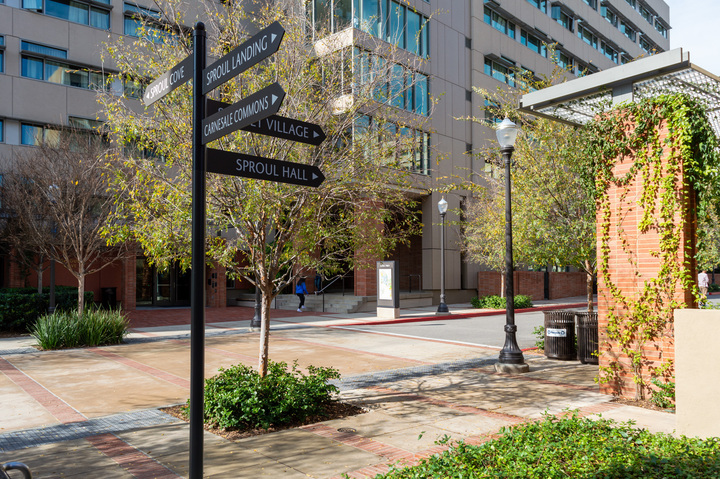
The Hill is pictured. UCLA Housing has offered four years of guaranteed housing for every incoming class since April 2022. (Daily Bruin file photo)

By Owen Mazzola
Jan. 23, 2026 10:09 a.m.
This post was updated Jan. 29 at 7:35 p.m.
The class of 2026 – the first to benefit from UCLA’s four-year housing guarantee in its entirety – is set to graduate this year.
In April 2022, UCLA Housing announced that the class of 2026 and those that were to follow would be guaranteed four-year housing on the Hill or in university apartments. Third-year transfer students would also be guaranteed two years of housing. This arrangement aimed to address the issue of the cost of living in Los Angeles, especially in areas such as Westwood.
A UCLA Housing spokesperson said in an emailed statement that student reactions and feedback have been positive to the four-year housing guarantee.
“Students and families appreciated the peace of mind that comes with knowing they can stay on campus for their full UCLA journey if they choose,” the spokesperson said in the statement.
The UCLA spokesperson also said the plan will continue to incentivize students to choose dorm life instead of commuting, ensuring the community stays intact.
“This guarantee has been part of UCLA’s long-term plan to move from a commuter campus to a residential campus,” the spokesperson said in the statement. “We want every student to have access to the full on-campus experience – living close to classes, access to study and social spaces, dining, and student life.”
UCLA’s push to establish a residential campus began in 1959 with the creation of Dykstra Hall. Sproul Hall, Rieber Hall and Hedrick Hall followed in 1960, 1963 and 1964, respectively. The most recent developments on the Hill include new residential halls Olympic Hall and Centennial Hall, which opened to students in the fall of 2021.
Living on campus has been proven to boost academic performance, according to a 2022 University of Connecticut study that analyzed data from 2010 to 2018 to find a correlation between on-campus living, GPA and four-year graduation rate. Students who resided on campus received better grades and graduated faster compared to their off-campus counterparts.
Jake Alvarez, a fourth-year communication and economics student, said he lived in university housing for his first three years of school, and recently relocated to a nearby apartment complex not affiliated with UCLA.
“I had a great experience living in the dorms,” Alvarez said. “Socially it was great, the amenities, the food – just a really nice community on the Hill.”
Despite not staying for his fourth year, Alvarez cited positive experiences in the on-campus dormitories, and decided to make the shift to follow friends and get a taste of independence.
“I wouldn’t say there’s anything about the Hill that forced me to move off, aside from feeling like I’ve outgrown it,” Alvarez said.
Given the program is aimed to support those who will use it all four years, if a student chooses to move out of university-owned housing, they will lose the guarantee and would need to enter a lottery to earn a spot back on the Hill or in university apartments.
According to UCLA Housing, 1,600 fourth-year students and 1,500 second-year transfer students lived in university housing during the 2024-2025 school year. Around 10,000 undergraduate students graduated from UCLA at the end of that year, according to UCLA Newsroom. These figures suggest more than 30% of that year’s graduating class were living in university housing.
Others choose to leave university-owned housing. Gwen Chenoweth, a first-year public health student, said she may choose to forgo her guarantee early in her UCLA experience.
“I decided to join a sorority because I felt like it was a great opportunity to make friends within such a large school,” Chenoweth said.
Like many in her position, Chenoweth said she plans to move into her sorority’s house her sophomore year, then shift to other off-campus accommodations with friends for her remaining two years.
Despite her impending departure from the Hill, Chenoweth said she is already looking forward to her sophomore year.
“I’ll definitely miss the dining halls when living on the Hill,” she said. “Living in the house, it’ll be nice to be surrounded by all my friends and be closer to campus.”
However, some students criticized what they saw as a decline in the quality of housing options offered. In January 2025, to ensure each student had a place on the Hill, the university switched a majority of its double occupancy rooms to triples.
“That change enables us to accommodate more students while keeping costs lower than off-campus housing,” UCLA Housing said in an emailed statement.
[Related: UCLA Housing to transition most on-campus dorms to triple occupancy]
Chenoweth said she was initially worried about her switch from home to dorm life, especially in sharing a space with two other students in such close proximity.
“The transition for me was definitely challenging, but nowhere near as hard as I expected,” Chenoweth said.
UCLA is still the only UC school offering housing all four years. The guarantee also helps to battle housing insecurity among students, given a 2023 report by the Bipartisan Policy Center found that only 18% of undergraduate students lived on their college campus, with the rest relying on local housing markets to dictate the cost of their rents.
“I have a lot of friends at schools like UC Berkeley that have maybe one, maybe two years of guaranteed housing, then they have to fend for themselves,” Alvarez said.
The school plans to continue and expand the guarantee through the addition of more beds in the coming years, given its initial success.
“This guarantee is about more than a place to live – it’s about belonging,” the UCLA spokesperson said in the statement. “UCLA is proud to be one of the few public universities in the nation offering this level of housing security, and we’re committed to maintaining it for years to come.”