Student tour guides voice concern over reduced operations, hiring amid budget cuts
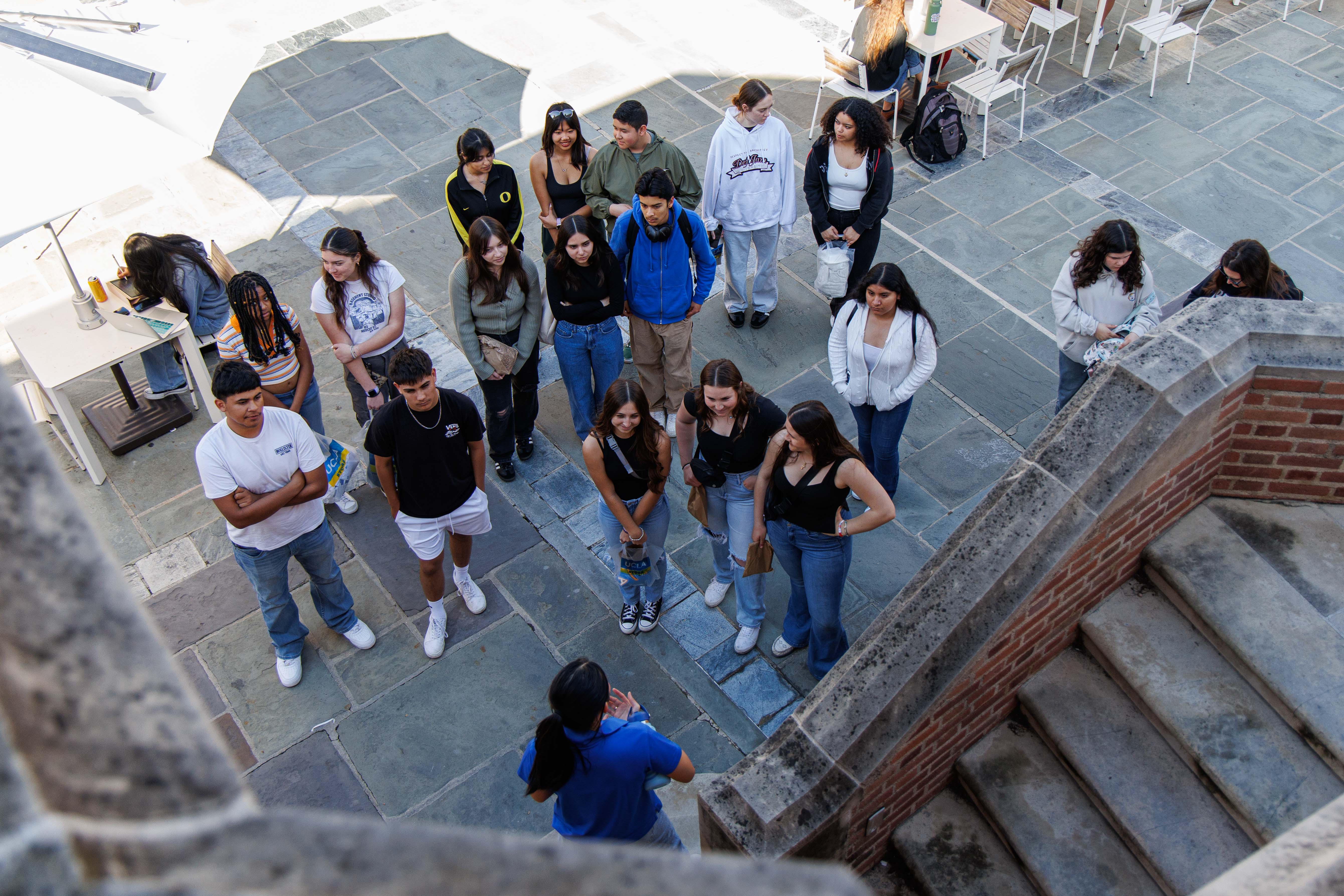
A UCLA tour guide talks to students in Kerckhoff patio. Students said tour guide organizations under UCLA Enrollment Management were forced to reduce their budget by 10%. (Daily Bruin file photo)

By Jennifer Michel
Oct. 27, 2025 8:01 p.m.
This post was updated Oct. 28 at 10:53 p.m.
UCLA budget cuts have forced student-led tour organizations to reduce the frequency of their tours and limit working hours, student employees said.
Frank Hobson, an executive coordinator for UCLA Cub Tours, said organizations that fall under UCLA Enrollment Management – including student tour guide organizations – were forced to reduce their budget by 10% due to a deferral of state funding. While Gov. Gavin Newsom and the California State Legislature reached a final state budget agreement June 24 that did not reduce the UC’s funding for the 2025-26 fiscal year, the agreed upon budget deferred a payment of about $130 million to the UC until July 1, 2026.
[Related: Gov. Gavin Newsom, California State Legislature reach final state budget agreement]
The university instituted a 10% budget cut for administrative units, implemented a new hiring review process and limited travel expenditures in March to reduce operational costs, two vice chancellors announced in an Aug. 20 email sent to faculty and staff.
[Related: UCLA pauses new faculty hiring, will consolidate IT teams following funding cuts]
Hobson, a fourth-year mathematics and political science student, said the budget cut to Cub Tours – a volunteer organization that provides tours for students in eighth grade and below – has forced the program to reduce hours for the organization’s student coordinators, who contact schools and schedule tours.
Cub Tours’ annual budget is about $30,000 – most of which goes toward paying its two student coordinators, Hobson said.
“Our budget is a bit less than $30,000,” Hobson said. “Finding 10% is about $3,000 or so, but most of our money goes to the two coordinators … For the other two – Campus Tours and the Bruin Ambassadors Program – they are paid workers, and so they’re committed to not firing anyone … but it does mean that they now have to do more with less.”
Campus Tours gives walking campus tours to prospective students and the Bruin Ambassador Program conducts outreach at high schools across Southern California.
A spokesperson for Undergraduate Admission – a department under Enrollment Management that student tour groups are a part of – said in an emailed statement that the budget cuts to student tour groups come as part of a broader effort to reduce operational costs across the university.
“We’ve reduced non-essential spending while maintaining high-quality campus tours and outreach activities, including high school visits and college fairs,” the spokesperson said in the statement. “Supporting our current student staff remains a top priority.”
Liam Jenny, a guide at Campus Tours who learned of the cuts late September, said Campus Tours is hiring fewer students and guides are receiving less billing hours due to the cuts. Jenny, a fourth-year atmospheric and oceanic sciences and political science student, added that Campus Tours has reduced its number of weekly tour reservations.
Jenny said he believes the reduction in hiring could also decrease diversity within Campus Tours, leading to more prospective students feeling alienated. A fourth-year applied mathematics student and guide for Campus Tours – who was granted anonymity due to fear of retaliation from their manager – said group tours for under-resourced schools, which were held multiple times a day prior to the budget cuts, now only happen a few times a week due to decreased staffing and resources.
“With budget cuts – losing the number of people we can hire – we’re also losing the diversity of our tour guides,” Jenny said. “A lot of our prospective students are coming from a huge array of backgrounds, and without guides that can reflect them – their identity, their background, their interests – then they might not see themselves at UCLA.”
However, Jenny said he believes the changes will not impact the quality of the tours, adding that the guides fought to maintain the tours’ standard duration and content.
The fourth-year applied mathematics student said Campus Tours has also reduced its number of lead guides because of the cuts. Lead guides are responsible for coordinating groups, tracking guides’ attendance, emailing customers and training new guides, they added.
The budget cuts have forced the program to reduce tour guides’ hours and student guides’ ability to bill for training activities such as shadowing tours, the tour guide said. They added that the tour guides’ meetings are now biweekly, rather than weekly.
“A lot of the joys from the job also come from the new hiring class and being able to train these new guides and watching them grow,” they said. “As tour guides get smaller, it becomes a smaller community.”
Andrew Rubalcava, a second-year mechanical engineering student, said his campus tour as a prospective student influenced his decision to commit to UCLA, especially as a first-generation college student. He added that his tour helped him navigate around campus – particularly the Engineering Library, which he now frequents – and the surrounding areas where most of his classes are located.
“My tour guides were great about making me informed. As a first-gen student, I really had no idea what I even wanted in a college,” Rubalcava said. “After seeing the resources – they really broke down the financial resources and first-generation student resources – I felt like I had a sense of belonging at UCLA.”
Hobson said he does not foresee the budget cuts harming enrollment numbers, but added that he is concerned about the quality of future tours.
“When you have a lot of guides, you have these spectacular ones that will show you or that really make an impact on the program, and they can train their fellow guides,” he said. “When you have a lower head count … you will have fewer of them, and there’ll be fewer training and learning opportunities within the program.”
Opportunities for guides to deliver specialized presentations on academic departments have also been reduced, Jenny said. Despite budget constraints, he added that the guides will continue to encourage students to pursue higher education.
“We all believe in higher education and really – at the end of the day – we’re trying to sell UCLA, but we’re also really trying to sell prospective students that an investment in themselves is the most important thing, and higher education is a great way to get there,” Jenny said. “They can achieve anything if they really want to, and regardless of whatever budget cuts, financial obstacles or federal decrees might come down – eager and ambitious students will always seize the day and have a good time.”