Q&A: Ninez Ponce talks Asian American representation, equity in health care
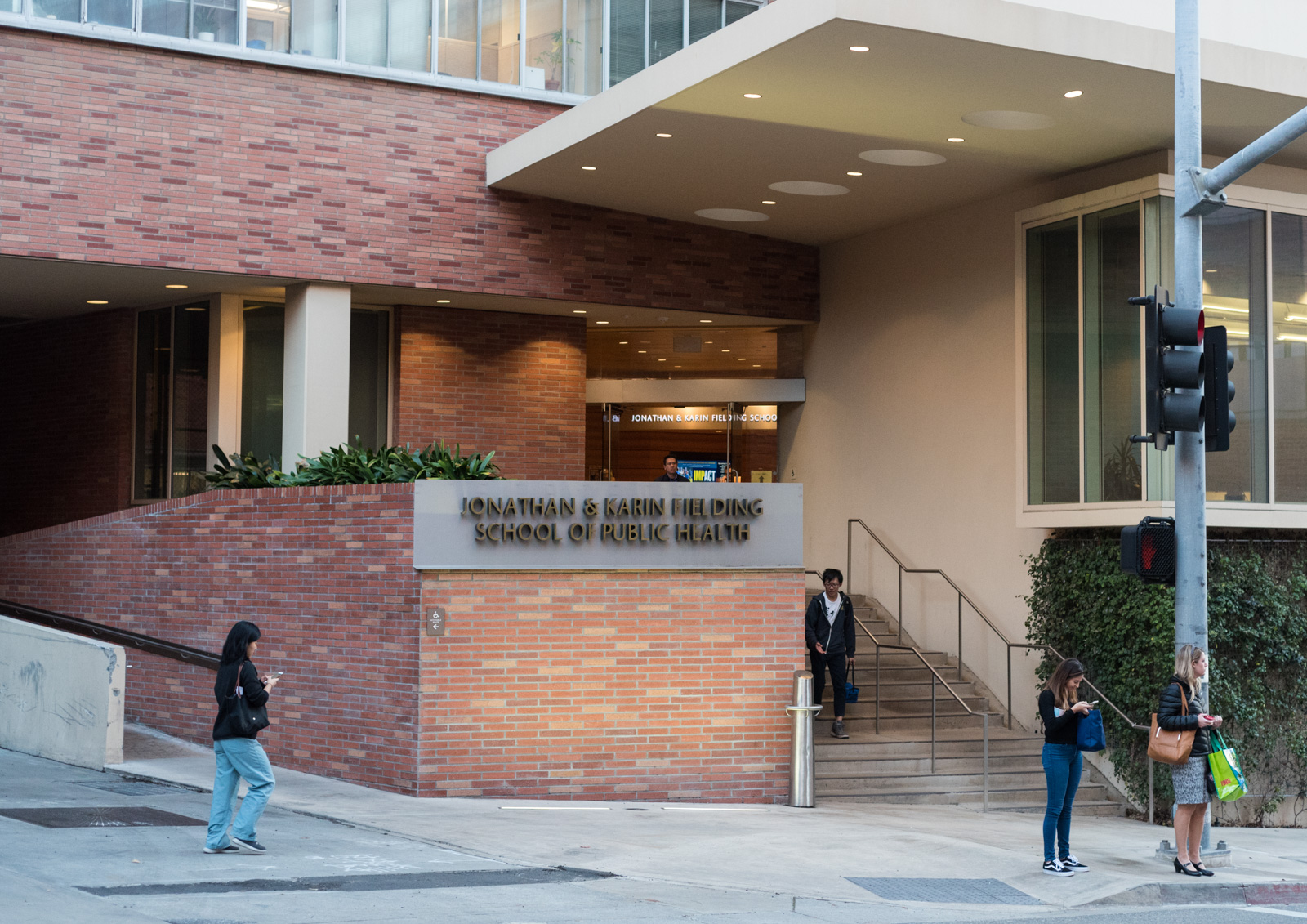
The Fielding School of Public Health is pictured. (Daily Bruin file photo)

By Jiyoon Choi
Jan. 8, 2026 11:42 p.m.
Ninez Ponce, a professor and endowed chair in the UCLA Fielding School of Public Health, sat down with Daily Bruin News contributor Jiyoon Choi to discuss representation in healthcare and the California Health Interview Survey, which she leads.
Ponce was elected to the National Academy of Medicine, one of the highest honors a medical professional can receive, in October. The NAM elected 90 regular members and 10 international members this year.
This interview has been edited for length and clarity.
Daily Bruin: How did you feel when you heard that you were elected? What does that mean to you, personally?
Ninez Ponce: I fell off my chair. I’ve been nominated before, and it was always very disappointing when you don’t get elected. When I found out I was elected, I fell off my chair, because it is truly one of the highest honors for my field. I felt that this academy is finally recognizing my contributions, whereas I thought a decade ago that my contributions may not have been as valued now as they are now. I was ecstatic.
DB: Could you explain more about what you are elected for?
NP: The California Health Interview Survey was one of the first projects I worked on when I first started at UCLA as a faculty member. It’s the nation’s largest population health survey. When I started my faculty position in 1999, we had just started to think about deploying a survey like this, and it was under one of my colleagues and mentors, Dr. E. Richard Brown.
My involvement with representation, particularly in the Asian American population, started way before I became an academic. I was an advocate for what was then called the Asian American Health Forum. It’s now called the Asian Pacific Islander American Health Forum. As an advocate, I was pushing for both representation and disaggregation. I helped start the survey, and that was more than 25 years ago, in 1999. The survey continues to be relevant, valued and salient in representation of not just the Asian American population, but for the entire population of California.
I also started ensuring that the survey wasn’t just done in English or Spanish. If (the survey) truly is going to be representative of California’s diverse linguistic population, it should also be done in Asian languages. We were one of the first surveys that conducted the survey in English and Spanish, of course, but then also Cantonese, Mandarin, Korean and Vietnamese. About a decade later, we started conducting the survey in Tagalog and we’re going to be doing it in Armenian next year, too.
DB: What motivates you to continue enhancing the survey and continue researching it?
NP: Populations change, needs continue, and surveillance has to continue. One of the first roles of public health is surveillance. We can’t just continue to find out what the needs are of a population using 1990s measures or approaches that do not acknowledge that the immigration flows have changed. We never had questions on hate incidents before COVID-19, but when it happened and there was a lot of blame and a spike in hate incidents, particularly against Asian American population, I worked with Asian American Studies Center here at UCLA to come up with questions that got the experience of physical and verbal abuse and of cyber bullying.
DB: Why do you think representation and equity in health is important?
NP: We cannot advance in the wellbeing of everyone … if we just privilege the few who can afford access to care. We need a healthy population to bring up our economy, to be good consumers, to have faith in each other, for a cooperative, supportive community. Health is fundamental. It’s a fundamental human right.
I also think there’s an efficiency argument. I’m a health economist, and if you don’t get at representation, then the tools are blunt that you have in creating public policies. You may be wasteful, you may be creating policies that might be effective for some but not for others. When we talk about the Asian American population, that’s so true. You can’t have a one size fits all policy to, for example, insurance coverage for an Asian language. There is no (one) “Asian language.” There are over 90 Asian languages. You have to have that precision and representation, so that you have informed ways of creating policies that would be tailored, targeted and more effective.
DB: What are some other projects that you have done or are currently working on at UCLA?
NP: Right now, I’m working on scaling up what we’ve learned from the California Health Interview Survey to other states. Especially now, as some federal data infrastructure is on pause or is suppressed, we have a project where we are essentially inviting four to five states that we can work with so that we can provide technical assistance on measuring race and ethnicity … but also working with communities and how to make sure that the insights and the way that you collect information is respectful of the communities that you purport to represent. That’s one of the big projects.
I have some other projects all related to CHIS– a Latino youth health survey. It’s based on a survey from CHIS respondents, and then we follow them up with a survey. There’s another project on Latinos on trust and mistrust. Where do Latinos get information from, what sources of news or influencers?
I also, during COVID-19, helped a group of Native Hawaiians and Pacific Islander students start the Native Hawaiian (and) Pacific Islander Data Policy lab, because there’s the issue of disaggregation in the Asian population. During COVID-19, the NHPI population took an even greater hit because the case and death rates were one of the highest in the state, as well as in other states in the nation. But in some other states, they would aggregate NHPIs with Asians so you would hide the high rates. With that, we started the NHPI Data Policy Lab.
It’s creating dashboards that feature relevant data on social drivers of health for the NHPI population. We’re trying to make sure that the data speaks to different communities, particularly those that are often overlooked because data is power.
DB: Why do you think it’s important for UCLA students to care about the work you do?
NP: The community at UCLA, our students and faculty, all are united by a calling to democratize knowledge and information rights for California’s population. We’re in the business of knowledge sharing and that knowledge sharing comes in many forms. I am just one drop in that bucket of that form of generating evidence.