Pedal to the metal: Investigating metro bike usage at UCLA
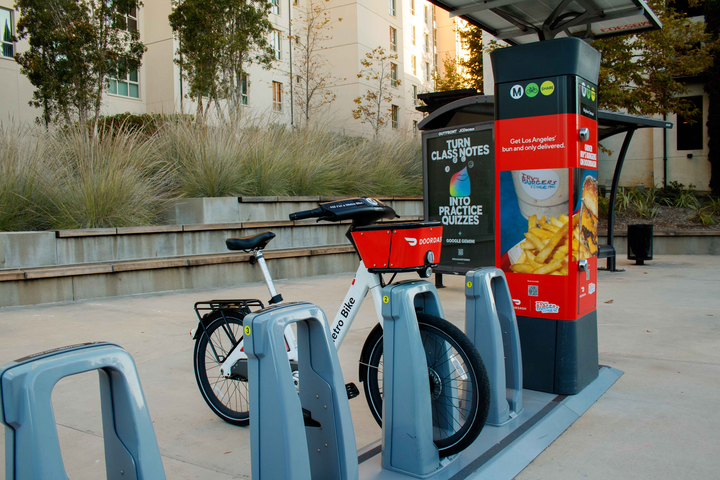
(Crystal Tompkins/Daily Bruin senior staff)



This post was updated Jan. 15 at 10:19 p.m.
Key Takeaways:
- In 2024, roughly 15,000 Metro Bike Share trips were taken by UCLA students and staff.
- Nearly 80% of Metro Bike users in the 2024-25 academic year were monthly pass holders.
- 6,457 trips were taken within UCLA’s campus last year.
Introduction:
When walking around UCLA on any given day, it’s common to see Bird e-scooters, Veo e-bikes and personal micromobility devices parked around campus.
As micromobility has become increasingly accessible across campus, UCPD stepped in early in the quarter, making media posts to encourage traffic law adherence.
The campus has had partnerships with Bird since 2019 and Veo since 2024.
Metro Bike Share came to UCLA in Spring 2022. Ordinarily, riders pay $17 a month for unlimited rides under 30 minutes, and an extra $1.75 is charged per 30 minutes after. However, students at UCLA are eligible for a reduced fare of $5 per month for unlimited rides. Ridership was relatively lower in its first year on campus (2022-23), with 9,036 rides involving UCLA stations. During the 2023-24 academic year, ridership spiked with 22,784 rides and remained around that rate throughout the 2024-25 year, with 23,789 rides. The Stack analyzed Metro Bike Share’s data on and around campus during the 2024-25 academic year to examine bike share usage and convenience levels.
Overview:
Metro Bike Share’s presence in Westwood is spread across six stations. There are three on campus: near Gateway Plaza, Drake Stadium and Perloff Hall. The other three sit in areas in Westwood: at the intersections of Broxton and Weyburn avenues, Glendon and Kinross avenues, as well as one outside Weyburn Terrace. Aiden Yu, a first-year bioengineering student, said his most common routes involved riding from the Hill to Campus.
The following visualizations look at the most common trips taken from the three stations located on campus and measure how much time UCLA students can save by biking instead of walking. These patterns demonstrate how students actually move through Westwood and where biking provides the biggest payoff.
On-Campus Usage
The most common bike trip runs from Gateway Plaza to Broxton and Weyburn avenues, a route between central campus and Westwood’s main commercial block. The second and third most common trips both start on the Hill near Drake Stadium and end on campus. For riders of these routes, bikes may act as a way to leverage the Hill’s natural slopes, helping students arrive to class or club meetings a little quicker. In fact, the return trips back to the Hill are significantly less common, although the ride from Perloff Hall to Drake Stadium does save around 6-7 minutes.
Notably, the routes that save the most time are not always the ones with the most rides. High volume trips like Drake Stadium to Gateway Plaza shave off only a few minutes per trip. Routes involving Weyburn Terrace – graduate housing in Westwood – save by far the most time, cutting an eighteen minute walk to an 8 or 9 minute ride. The split between heavily used and highly efficient routes shows that popularity and efficiency do not always align.
Off-Campus Usage
While the most commonly taken Metro Bike routes cluster around UCLA and Westwood Village, the full map reveals that riders also bike far beyond campus. Dozens of trips stretch miles away into Sawtelle, Santa Monica, Culver City, Hollywood and Koreatown.
A clear pattern emerges when looking at stations connected to the Metro E line. Each of these routes show a steady flow of trips, a far greater number than other off-campus locations at similar distances. These routes suggest that Metro Bikes are a flexible option for riders who want to take the rail part of the way and bike the rest. This same logic likely extends to stations situated near other major rail and bus stops. When bike stations are near stops for other transportation services, they become a natural link in a multimodal commute or trip.
Even stations nearly 10 miles away from campus register occasional Metro Bike trips. Areas like Koreatown, Hollywood and Echo Park appear on the map with small but noticeable ride counts. Their presence underscores just how far the Metro network extends beyond UCLA’s other micromobility options, even if fewer riders use these routes. Still, the low volume on these distant routes suggests that Metro Bikes primarily function as a short-to-medium-range tool for the UCLA community.
These patterns suggest a purpose distinct from the trips taken within campus. Instead of cutting travel times, these off-campus routes appear to connect students to other major transit lines and provide another option for longer-range travel.
Subscription Types
The pie chart above shows the different types of passes riders used for Metro Bike Share rides for the 2024-25 academic year. Metro offers four different types of methods to gain access to bike share stations. An annual pass is $150, a monthly pass is $17, 24-hour access is $5 and a single ride is $1.75 per 30 minutes of usage. For the annual, monthly and daily subscriptions, rides over 30 minutes also incur an extra $1.75 per 30 minutes.
The chart shows that 78.4% of all bike rides during the last academic year were taken by monthly pass holders.
“I only use the Metro Bike, and I do it because it’s pretty cheap – especially for students, it’s only $5 a month,” said Noah Roemer, a second-year statistics and data science student. Yu said he also purchased the $5 monthly pass.
Roemer also stated that his Metro Bike usage mainly consisted of trips to class from the Hill, with roughly 20% of his trips being longer ones going to areas like Westwood and Sawtelle.
Metro Bike Share Maintenance and Expansion
While UCLA Transportation worked closely with Metro to determine the stations’ locations on campus, the overall maintenance of the Bike Share stations are completely overseen by Metro and their contractors.
“Once the location is identified, then it’s our team that provides equipment, and we have a contractor come out and they do all the installation,” said Paula Carvajal, Metro’s Deputy Executive Officer. “They also ensure that the bikes are available and that they’re also being balanced accordingly so there are bikes available at the stations 24/7.”
In terms of bike availability, Metro strives to maintain a two dock to one bike ratio at all stations at all times.
Moving forward, Metro stated that they have plans for continued expansion across Los Angeles, with specific plans to add more stations across West LA in an effort to increase the density and availability of Metro Bike Share in the area. Amid their efforts to increase station availability, Metro is also actively taking public suggestions through their “Suggest a Location” webpage.
“When the program was introduced, it was with the intention of growing the program within the city of LA, but then also to other jurisdictions within the county, and so we’re always looking to grow the program in general,” Carvajal said.
About the Data
The Stack used the Metro’s LA Bike Stations dataset, filtered to remove outlier trips for the 2024-25 academic year. Google Maps Data was also used to compute walking times.