Former Secretary Becerra talks Proposition 50, impacts in collaborative UCLA event
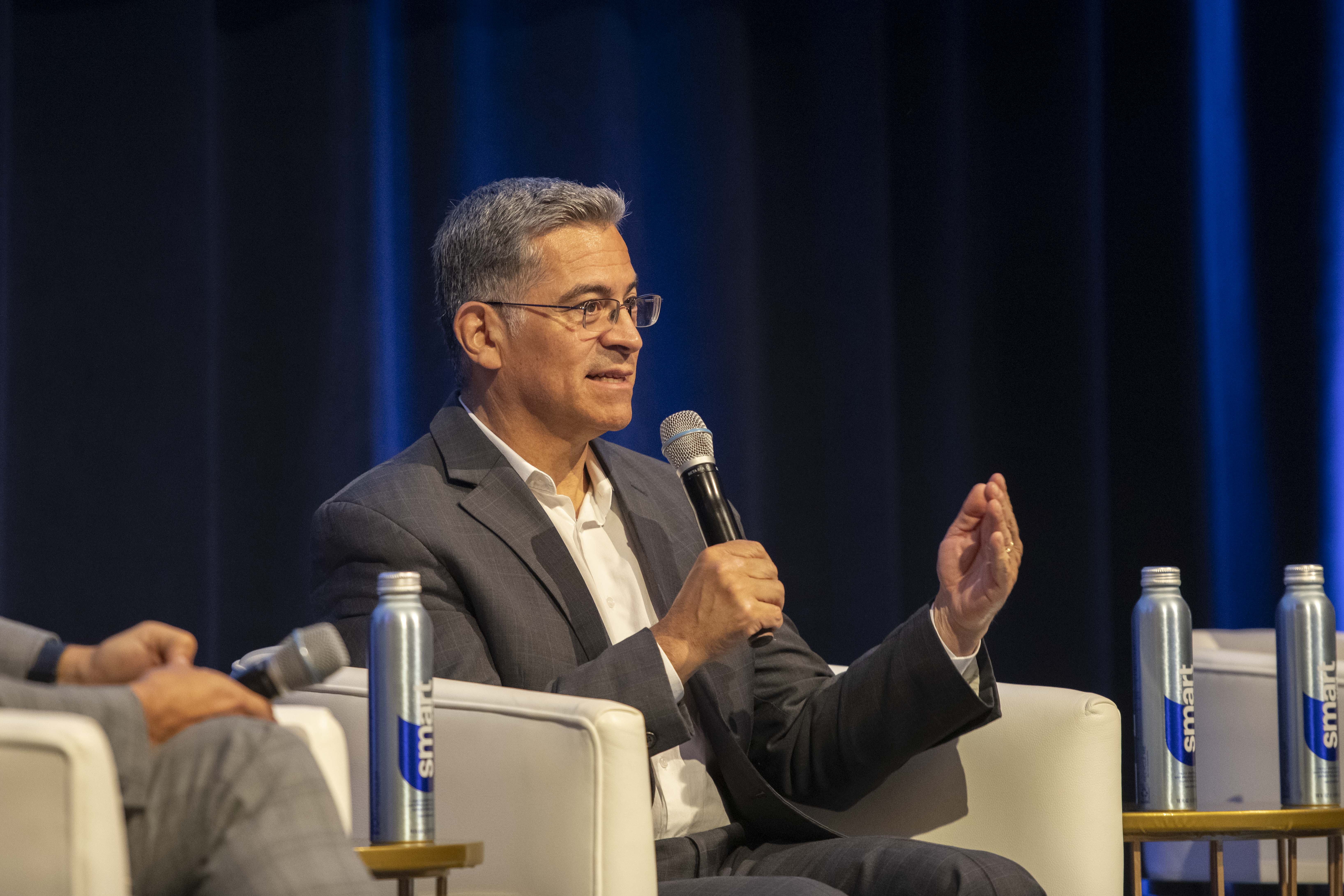
Former U.S. Health and Human Services Secretary and California gubernatorial candidate Xavier Becerra is pictured. Becerra expressed support for Proposition 50 and criticized Texas’s partisan redistricting push at an event at UCLA on Tuesday. (Michael Gallagher/Assistant Photo editor)

By Jenna Saklawi
Oct. 31, 2025 12:47 p.m.
This post was updated Nov. 2 at 10:03 p.m.
Former U.S. Secretary of Health and Human Services and California gubernatorial candidate Xavier Becerra expressed support Tuesday for Proposition 50 and criticized Texas’s partisan redistricting push at an event at UCLA.
The event, co-hosted by the UCLA Luskin School of Public Affairs and the UCLA Voting Rights Project, began with a discussion led by Becerra on redistricting in California and Texas. Becerra was also California’s attorney general from 2017 to 2021. The discussion was followed by a panel of experts, including UCLA lecturer Chad Dunn and associate professor Natalie Masuoka. The discussion was moderated by Matt Barreto, the faculty director of the UCLA Voting Rights Project.
Proposition 50, the ballot measure that Californians will vote on in the Nov. 4 special election, would grant the state legislature – rather than the state’s independent redistricting commission – redistricting powers through 2030. Gov. Gavin Newsom proposed a legislative package in August titled the Election Rigging Response Act, which allowed the proposition to go on the ballot, in a direct response to mid-cycle redistricting efforts in Texas backed by President Donald Trump that would likely give Republicans five new seats.
Trump worked with Texas’ governor to pass legislation to redraw congressional districts without current census data to potentially favor the Republican Party, Becerra said. He added during the lecture that Trump’s statement that Republicans are “entitled” to five additional congressional seats in Texas signifies a break from democracy.
“We somehow seem to have forgotten what democracy means,” Becerra said. “Democracy is nothing more than people-power – it is rule by the people.”
Becerra added that he believes Proposition 50 signals that California, which will only redistrict with citizen approval, strives to remain a democracy.
Chad Dunn, the director of litigation for the UCLA Voting Rights Project, said on the panel he believes Texas has repeatedly used redistricting to dilute the voting power of residents from minority communities. Dunn, a UCLA lecturer of law, added that while a significant amount of Texas’ growth over the past two decades has come from Black and Latino populations, the state legislature has drawn new congressional maps that deny them proportional representation.
Dunn said Trump’s call for five new congressional seats in Texas did not abide by the Voting Rights Act of 1965 and constitutional protections under the 14th and 15th Amendments, which guarantee equal protection under the law and prohibit racial discrimination in voting, respectively.
Texas redrew its congressional map in September after it received a U.S. Department of Justice letter criticizing what it deemed as unconstitutional racial gerrymandering in four majority-minority districts where people of color have been elected, he said. He added that dismantling those districts reduced political representation for voters of color – including Black, Latino and Asian communities in Houston and Dallas-Fort Worth.
Masuoka, a professor of Asian American studies and political science at UCLA, said she believes redistricting can both harm and strengthen the voting power of minority groups. She added that while the Voting Rights Act was designed to ensure representation for minority communities, she believes redistricting has often been used to marginalize them.
Masuoka said her research on California’s current congressional map found that it created opportunities for Latino, Asian American and Black voters to elect candidates of their choice. She added that Proposition 50 would maintain Latino voting strength while increasing the number of Asian American plurality districts from three to five – potentially expanding political opportunities for candidates from minority communities.
“If we have more districts that are empowering minority voters, that is going to create more potential for minority candidates to have a plausible path towards elected office,” Masuoka said.
When asked about how California can push back against federal incursion, Becerra said states hold powers not explicitly granted to the federal government, such as some voting and public safety regulations.
He added, however, that the federal government has exceeded those limits in recent months, including by deploying the National Guard in states. Trump deployed the National Guard and Marines to Los Angeles in June as a response to immigration protests – despite pushback from Newsom and Mayor Karen Bass.
“There are limits to federal power – but if you have someone who decides to exceed the scope of that power – you can see how damning it could be for the states,” Becerra said.
[Related: National guard troops station in Westwood after Trump administration deployment]
Dunn said he believes Texas’ redistricting was a partisan attempt to give Republicans more congressional seats, but the method used was racially discriminatory.
While showing a map of Texas detailing how officials redrew district lines in cities including Dallas, Fort Worth, Austin and Houston, Dunn said the map merged predominantly Black and Latino neighborhoods with mostly White counties.
Dunn added that he believes partisan decisions are often also racial in southern states like Texas.
“They’re not accidental connections. They’re intended connections,” he said. “What was done in Texas to deliver five new Republican seats was done in a very systematic, surgical way to disenfranchise and silence the voices of a state that is now majority-minority.”
Becerra said California’s redistricting process allows voters to review and comment on proposed maps, unlike in Texas, where residents had no input.
Masuoka said California’s growing Latino and Asian American populations have become central to the state’s Democratic majority. She added that while California’s 2021 citizen-led redistricting map sought to increase partisan competition as a fairness gesture, it somewhat divided communities of color.
“By doing this partisan gerrymander, we’re seeing, really, the potential of how many majority Latino districts we can create, and also how many Asian American majority districts we can create,” she said.
Despite pushing Congress and the Supreme Court to police partisan gerrymandering for 25 years, Dunn said he supports Proposition 50. Several states that were red in the 2024 election – including North Carolina, Indiana, Missouri and Florida – are working on new maps to silence voters based on race or political beliefs, he added.
The Supreme Court’s decision in Rucho v. Common Cause – that federal courts cannot decide cases involving partisan gerrymandering – made clear the court would not serve as a check for the practice, Dunn said.
“What California does to press back on it isn’t just tit for tat,” he said. “It isn’t just fighting fire with fire, although those are all true. It is ensuring that Congress, at least, is representative – or as representative as it can be – of the nation as a whole, which gives you a Congress that you can have some confidence in the decisions it makes.”
Masuoka said she encourages UCLA students to not only vote, but to contact elected officials, post on social media, join protests and engage in other grassroots efforts to make their voices heard.
With many people engaging on social media, standing up against disinformation can combat threats to democracy, Becerra said. He added that voters can stay safe by preparing to record potential instances of voter intimidation when casting their ballots.
Joselyn Martinez, a UCLA alumnus, said she attended the event to hear more about former Secretary Becerra’s experience. She added that, following the panel, she felt empowered to cast her vote in the upcoming election.
Antonia Torres-Tinoco, a fourth-year political science and sociology student, said she attended the event to make an informed decision on Proposition 50. She added that hearing from experts reinforced her choice to vote “yes” and motivated her to defend democracy.
After the panel, Dunn said, he believes states may need to temporarily abandon nonpartisan redistricting as a response to state partisan gerrymandering to ensure Congress better reflects the nation as a whole. He added that he believes young voters have historically been difficult to engage but emphasized their power in shaping democracy.
“Every great thing you think about American history was the result of a bunch of people deciding to focus on their right to vote, and harness it and use it towards that end,” Dunn said.
Los Angeles residents can vote in person Nov. 4 in Kerckhoff Charles E. Young Grand Salon and Hammer Museum’s Bay-Nimoy Studio, among other locations across the county. Voters can also submit a vote-by-mail ballot as long as it is postmarked by Election Day.