Scouting report: UCLA football vs. Maryland

By Jack Clarke
Oct. 17, 2025 8:32 p.m.
This post was updated Oct. 18 at 10:03 a.m.
Anyone floating the idea of the Bruins making the Big Ten championship would not have been taken seriously just two weeks ago.
However, back-to-back conference wins have generated some optimism in Westwood about the direction the team is trending.
Currently tied for third in the Big Ten, UCLA football (2-4, 2-1 Big Ten) will have another chance to demonstrate its unprecedented season turnaround Saturday against Maryland (4-2, 1-2) at the Rose Bowl in the team’s first home game since the upset of then-No. 7 Penn State. The matchup is the first showdown between the two squads in 70 years and it is also UCLA’s annual homecoming contest, representing a must-win conference matchup for a team that still has a chance at bowl eligibility.
Maryland’s Offense:
Offensive scheme: Pro style
Run-pass percentage: 43% Run, 57% pass
Strength: Passing attack
Weakness: Ground game
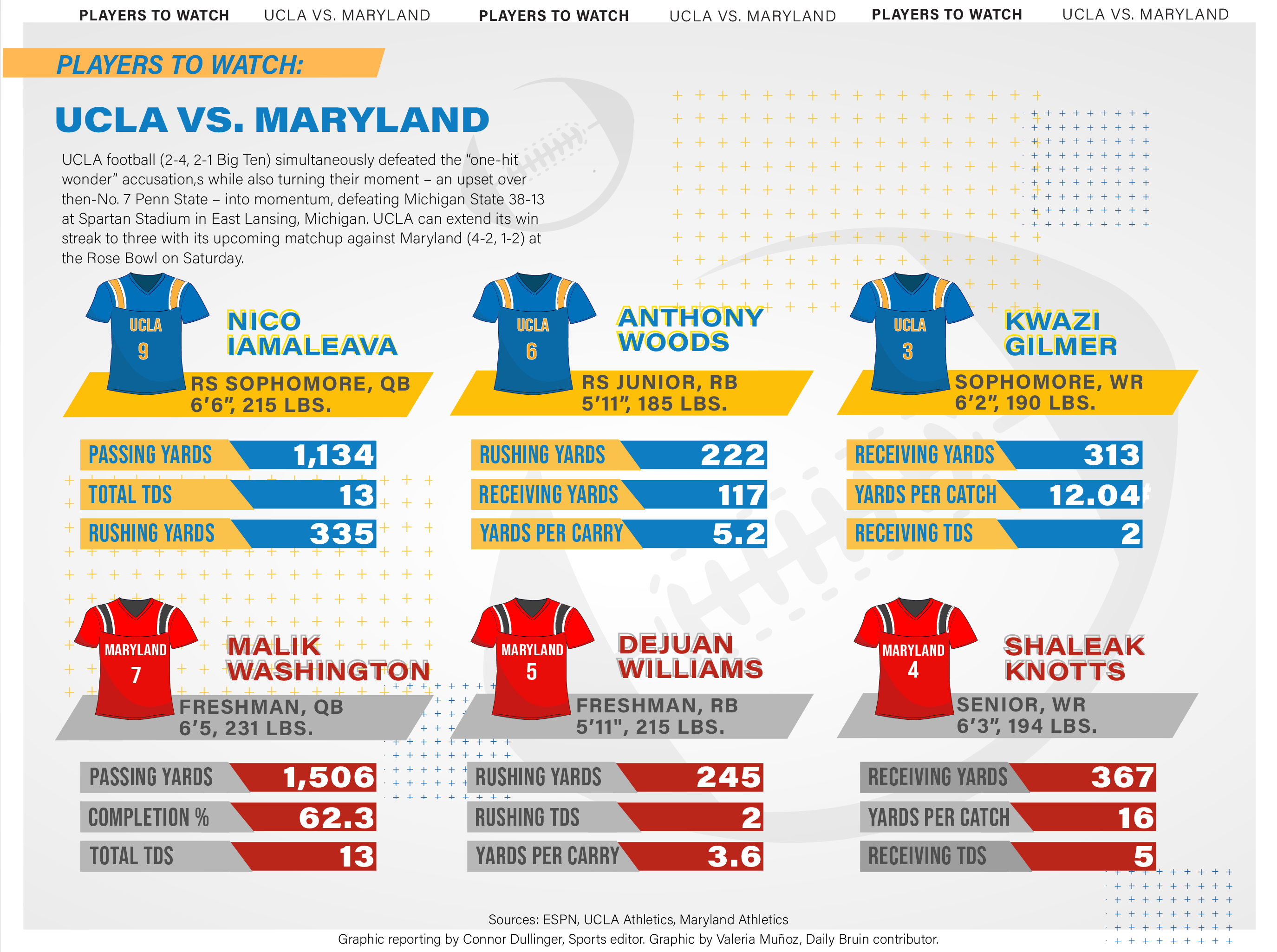
X-factors: Quarterback Malik Washington
The Terrapins were receiving Associated Press Poll votes just four weeks ago after winning their first four games with a combined 87-point advantage. However, Maryland has lost two consecutive conference games by less than a touchdown, and its offense has averaged an uncharacteristic 23.5 points across both defeats.
Despite the recent setbacks for longtime coach Michael Locksley and offensive coordinator Pep Hamilton, the Terrapins’ four wins already match their tally last season.
Maryland’s early-season success was aided by the emergence of one of the nation’s premier true freshman quarterbacks, Malik Washington.
A former four-star recruit and the No. 5 quarterback in the 2025 class, according to 247 Sports, Washington beat out former UCLA quarterback Justyn Martin for the starting role, an opening that appeared after Billy Edwards Jr. departed for Wisconsin after last season.
Washington boasts a 62.3% completion percentage with 10 passing touchdowns and two interceptions so far. Despite operating more efficiently from the pocket, Washington has also ran in three scores, helping minimize his sack total to just two.
Washington plays with considerable confidence, particularly for a young quarterback at the start of his career. This can most clearly be seen with his pocket presence and ability to make multiple reads. Especially when under pressure, Washington has relied on his feet to buy time and find downfield receivers.
With Washington under center, Hamilton has implemented a pass-first attack that emphasizes the middle of the field and five-step drops that provide numerous reliable passing targets.
Hamilton has also shown a tendency to keep his scheme fresh, with the Terrapins’ most recent contest against Nebraska featuring Washington’s highest number of rushing attempts on the season, with six.
After losing the Terrapins’ leading rusher in 2024, Roman Hemby, who transferred to Indiana, Hamilton has built a ground attack with DeJuan Williams and Nolan Ray, who average 3.6 and four yards per carry, respectively, this season.
Maryland’s 99 rushing yards per game is the lowest in the Big Ten, which doesn’t provide much of a threat for opposing defensive coordinators to prepare for. Instead, the run game is used as a complement to set up the pass, particularly play-action concepts.
While Hamilton may scheme more run plays to counter a UCLA defense that surrenders a conference-worst 195 rushing yards per game, it is likely that Washington’s ability to move the ball through the air will be the emphasis Saturday.
UCLA’s defense has struggled with bringing adequate pressure all season, as displayed by a conference-low six total sacks. For the Bruins to shut down the Terrapins’ offense, they will have to be sound in their downfield pass coverage and personnel matchups.
The increased emphasis on designed quarterback runs seen from the Terrapins’ offense last week against the Huskers should continue against the Bruins on Saturday, including read option concepts in the red zone.
To best combat this, the UCLA defense has to adjust to the running threat that Washington poses, a common preparation from its previous two contests.
While the pass attack should be the emphasis, the multiple dimensions of playmaking that Washington brings will be a challenge for a rebounding UCLA defense.
Maryland’s Defense:
Defensive scheme: 4-2-5
Strength: Turnovers
Weakness: Finishing in the fourth quarter
X-factor: LB Daniel Wingate
In March, Maryland brought in longtime NFL coach Ted Monachino to coach linebackers and coordinate the defensive unit after a 2024 campaign in which the defense surrendered the Big Ten’s second-most points per game.
Under Monachino’s leadership, the Terrapin defense has slashed its average points per game allowed nearly in half, with opponents averaging 16.8 points this season compared to last season’s 30.4 mark.
Running a 4-2-5 scheme with a true nickel has helped the defense stifle opposing runs and get off the field on third down, with opponents only converting at a 29.5% rate.
The biggest strength seen from this renewed 2025 Maryland defense has been its ability to force turnovers, registering an NCAA-leading 12 interceptions through the first six games of the season, including three pick-sixes.
With nine defensive players registering at least one interception on the season, the depth of their pass defense will be something to consider for UCLA’s offense.
Elsewhere, Maryland’s defensive success has been aided by the emergence of two freshmen on the defensive line, Sidney Stewart and Zahir Mathis. Both players are tied for a team-leading 4.5 sacks and have challenged each offensive line that they have faced thus far.
Linebacker Daniel Wingate has also become a player to watch. The Bowie, Maryland, local is tied for a nation-leading 36 solo tackles, alongside being named to the Butkus Award Watchlist.
While the overall depth of the Maryland defense has significantly improved, the unit has struggled recently in the second half, especially in the fourth quarter.
Holding a 17-point lead going into the fourth quarter against the Huskies, the Terrapins surrendered 21 unanswered points for their first loss in 2025. The following week, Nebraska would score 10 unanswered fourth-quarter points to defeat Maryland by three.
Success for UCLA’s offense has come early due to assistant head coach and tight ends coach Jerry Neuheisel and redshirt sophomore quarterback Nico Iamaleava, with the offense averaging 25.5 points in just the first half. The Bruins will have to play a clean game this week that limits turnovers and prioritizes efficiency over big plays against a stout defense that can shut down opponents early.
The 4-2-5 opposing scheme should provide the Bruins opportunities to explore the run game against a lighter box than the previous two weeks. If the offensive line can open running lanes and keep Iamaleava upright from the Terrapin pass rush, the Bruins should be able to wear down a defense that has fallen apart near the end of contests.
UCLA will once again face a significant challenge during Saturday’s homecoming matchup, tasked with taking on a Maryland squad that has emerged as one of the most balanced teams in the Big Ten, with the ability to generate big plays on both sides of the football.
If the Bruins are able to successfully execute a clean game plan at the Rose Bowl to get their third consecutive win, the momentum towards bowl eligibility will only increase.