BruinBot to launch accessible AI academic advising designed by students
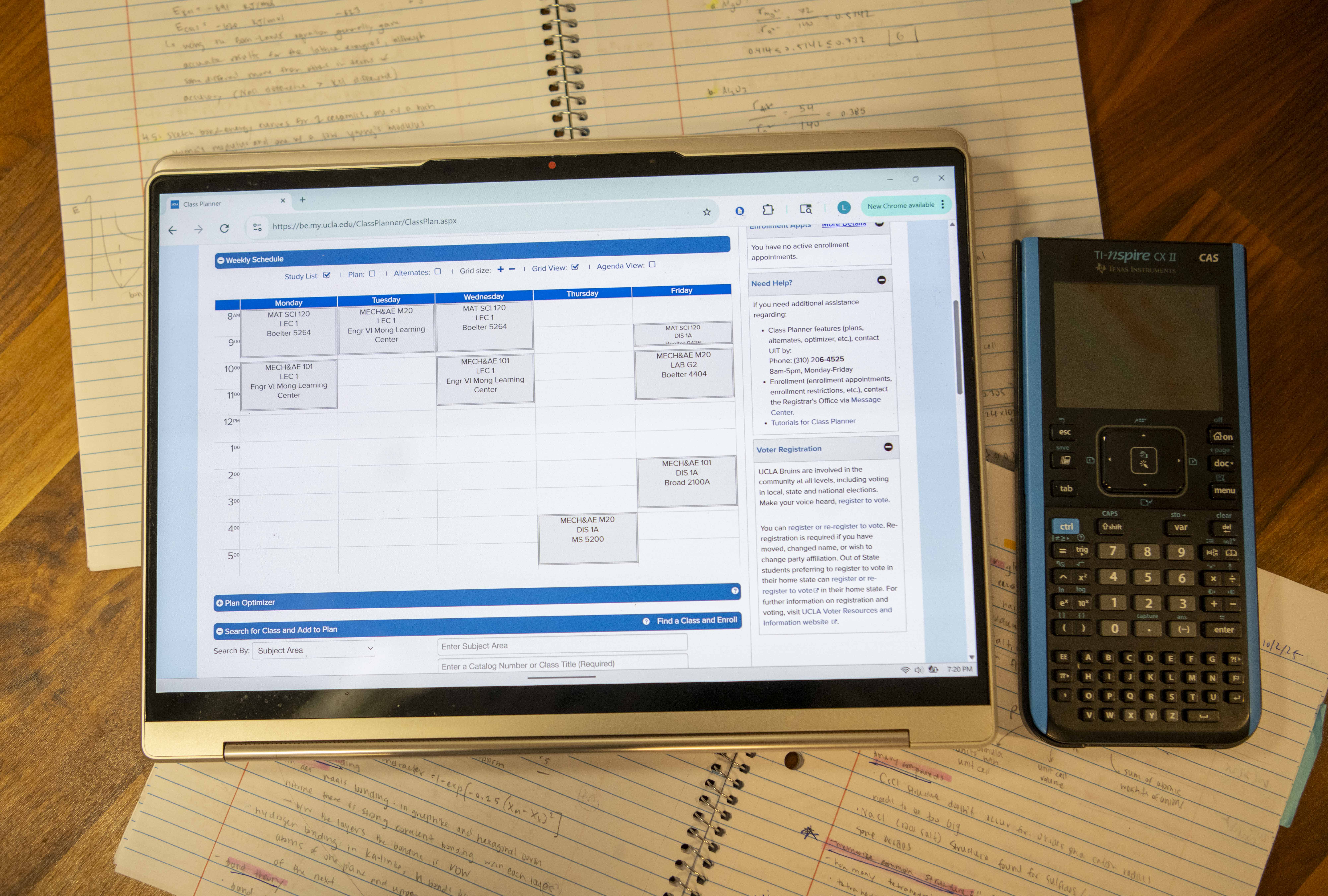
A MyUCLA class planner with STEM classes is pictured. BruinBot, which was developed through a UCLA Digital Technology program with OpenAI’s enterprise platform, helps students generate tailored class schedules by analyzing their degree requirements and preferences. (Leydi Cris Cobo Cordon/Daily Bruin senior staff)

By Caitlin Brockenbrow
Oct. 16, 2025 5:38 p.m.
This post was updated Oct. 16 at 11:34 p.m.
A UCLA student created a new tool powered by artificial intelligence that aims to make academic planning faster, simpler and personalized for students.
BruinBot, which was developed through a UCLA Digital Technology program with OpenAI’s enterprise platform, helps students generate tailored class schedules by analyzing their degree requirements and preferences. The tool, which is yet to officially launch, uses registrar data and user input to account for prerequisites, units, instructors and timing – providing students with schedules that align with graduation requirements.
Ananya Anand, the project lead and a third-year computer science and engineering student, said she was scrolling through her email one day and found an opportunity from DGIT, which sponsors students and faculty with project ideas and gives them OpenAI enterprise licenses. She added that her course-planning struggles as a student inspired her to create BruinBot.
[Related: UCLA to become first California university to offer ChatGPT Enterprise accounts]
“I found it very difficult to navigate the plethora of courses that are offered at a large public university like UCLA,” Anand said. “I really wanted to create some sort of streamlined way for students to be able to pick courses according to their preferences in terms of timing, instructors, building types, etc. and be able to come up with a plan that helps them to complete their degrees on time.”
Chris Mattmann, UCLA’s chief data and AI officer, said BruinBot was chosen through UCLA’s yearlong OpenAI pilot, which invited proposals from across campus to use the platform and was reviewed by leaders in research, administration and teaching. He added that a major reason the project stood out was because of its focus on the student experience.
“There’s a lot of different schools, there’s a lot of different classes that you can take, even at UCLA. And so I think students get a little overwhelmed and can use some potential help,” Mattmann said. “Just even figuring out what class to take, what planning to take, using AI to help that is very beneficial, because people aren’t necessarily so willing to kind of go out and look (up) the process.”
Development for BruinBot lasted from January to June, Anand said. The current product can filter through over 60,000 course selections and 8,000 instructors using the student’s parameters to come up with a tailored schedule, she added.
Students can input several preferences – including the day of the week, time of day, instructors, building type, number of units and if they want to allow conflicts. Using this information, as well as a list of credits the student has already completed, BruinBot then lists the courses that fit into the criteria.
“The AI takes in all these preferences. It looks for the student’s major, and it looks through all the courses that are associated with that major. And it tries to come up with a list of courses that the student needs to take,” Anand said. “Then it schedules it according to those course prerequisites and the student’s preferences using algorithms.”
Key campus partners, including personnel from the Registrar’s office, were involved in consulting on BruinBot, Mattmann said. He added that these officials’ direct experience with student academic planning made their input critical. He said UCLA plans to expand its enterprise-level use of OpenAI tools, which could allow successful pilot projects such as BruinBot to become permanent tools integrated into the registrar.
The program also connects with Google Maps and Google Calendar for students to navigate to classes and add their preferred schedule to their calendar, Anand said.
Anand added that BruinBot is also intended as a tool for academic advisors – not solely students.
“It’s not just to help students, but also, in a school like UCLA, where the counselor-to-student ratio is pretty low, it’s a great way to allow counselors to dedicate their time to more precise advising,” Anand said. “It’s a way for students to be able to come up with these schedules, and if they have further questions on these schedules, they can turn to advisors to get more specific advice on how they can improve their academic planning.”
Rohan Sinha, the project’s developer and engineer, said BruinBot is also meant to let users plan either their next set of courses or their whole degree. The product allows students to test out hypotheticals with different factors they may want to change – something that can be difficult to do with MyUCLA, he added.
Clifford Kravit, a program manager at UCLA Health IT Research Informatics and Technology, said he helped facilitate registrar requests and vouch for the project. He added that his experience managing projects helped keep BruinBot on track.
Anand also acted as the team’s software lead, developing much of the project’s back end, she said. She added that she created a database to store all the information and an AI assistant to help students and understand the different courses in their schedule.
Sinha, a third-year computer science and engineering student, said his work primarily focused on integrating coursework data and other major information into the project. He added that he contributed to BruinBot’s functionality when processing user submissions.
Sinha said he also worked on ensuring there was an explanation for the student’s schedule, making the program interactive. This allows the user to ask why a particular suggestion was being made, as well as if there were possible alternatives and modifications.
While the DGIT program ended in June, Anand said they are still developing the project and hope to have a beta deployment of the product soon for students to test and provide feedback for improvement. Anand added that UCLA DGIT is reviewing a plan for phase two of the project and said she is waiting for them to let her and her team know if it is willing to keep funding their work. Sinha said he hopes BruinBot can be deployed within the next couple of quarters.
Kravit also said he hopes that the university will adopt the project, but added that if not, it will take “creativity and some networking” to make BruinBot work – particularly given the uncertain future for campus access to Open AI licenses.
“Getting this as something that can be used en masse and also finding ways to (work) more tightly with UCLA websites, so I think being able to get some more live data from the UCLA website too would be the goal to make sure that it’s updated on its own,” Sinha said. “Overall, this big picture goal is making sure that we can get this product to production.”
Mattmann said he hopes to continue supporting student-run projects after BruinBot’s success. He added that he wants to see more students from non-engineering disciplines take part in future AI initiatives such as this one.
“I check myself every day, because most of the people I interact with, if they’re not faculty or researchers or whatever, are students,” Mattmann said. “I want people from physical, life, natural sciences and public policy … you are all the people that are going to define the use of AI.”
Contributing reports from Shaun Thomas, science and health editor.