Scouting report: UCLA football vs. Michigan State

By Jack Clarke
Oct. 10, 2025 9:44 p.m.
For the curious eyes that peeked into the windows of the Wasserman Football Center on Tuesday afternoon, the same five-word message could be seen on every weight room television screen:
“Are we one-hit wonders?”
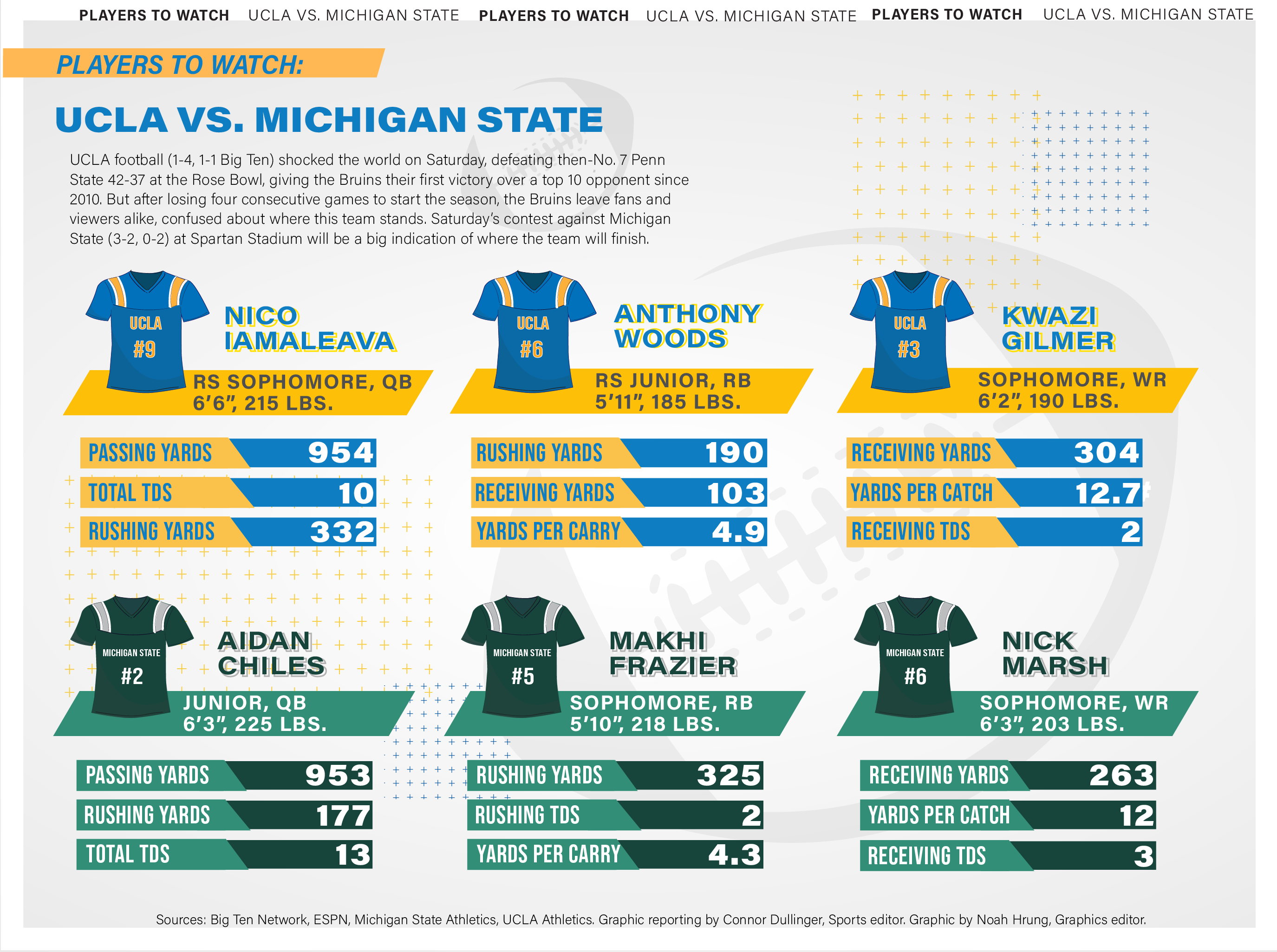
Following one of the most improbable upsets of the 2025 college football season, UCLA football (1-4, 1-1 Big Ten) will have the opportunity to answer this looming question when it heads to East Lansing to take on Michigan State (3-2, 0-2). Saturday’s clash in Spartan Stadium is the first meeting between the two squads in 51 years and will be a key indicator of the trajectory of the Bruins’ program for a reinvigorated fanbase and newly engaged national audience.
Michigan State’s Offense:
Offensive scheme: Pro style
Run-pass percentage: 57% run, 43% pass
Strength: Pass catchers
Weakness: Offensive line
X-factors: QB Aidan Chiles and WR Nick Marsh
If there was one aspect of Penn State’s offense that kept them competitive in a game against UCLA where nothing seemed to work, it was quarterback Drew Allar’s ability to extend broken plays on his feet.
The Bruins will once again have to contend with a true dual-threat quarterback Saturday.
Aidan Chiles has the ability to challenge a UCLA defensive front that has seen opposing quarterbacks average over 5.2 yards per carry.
The Long Beach, California, local – a former four-star recruit and the seventh-ranked quarterback in the class of 2023, according to 247 Sports – enters his second season as a full time starter following a true sophomore campaign in which he threw for 2,415 yards and ran for an additional 420.
In five matches, Chiles has nearly matched his 13 passing touchdown mark from last year, tossing nine through the air total while also improving his touchdown to interception ratio from 1.18 in 2024 to three thus far in 2025.
Bolstering Chiles’ confidence throwing the ball has been his connection with his top target from 2024, wide receiver Nick Marsh. Marsh is currently the leading scoresheet among Michigan State wide receivers, hauling in three passes for touchdowns in 2025 after a campaign where he set Michigan State freshman records in both receiving yards with 649 and receptions with 41.
Alongside Marsh, Chiles’ increased efficiency through the air has been supported by multiple viable passing targets including Middle Tennessee State transfer wide receiver Omari Kelly, the Spartans’ receiving yards leader, with 326 yards.
The passing game has also been bolstered through a reliable connection with tight end Jack Velling, another former Beaver who made the move to East Lansing to follow coach Jonathan Smith after the 2023 season.
With his dynamic running ability and strong arm, Chiles is more than capable of generating explosive plays in offensive coordinator coach Brian Lindgren’s pro-style scheme, provided he has ample time in the pocket.
However, finding enough time has been an issue for the past two seasons.
The Spartans’ quarterback has already been brought to the turf 14 times in 2025 after being sacked 30 times across 12 games in 2024.
While Chiles’ archetype as a dual threat should help alleviate sack totals, the high pressure that he experiences can hinder Lindgren’s desire to call longer-developing deep shots that require the offensive line to hold their ground. Pressure also accelerates Chiles’ reads on downfield concepts, leading to errant throws that contributed to his 11 interceptions from 2024.
Expect Lindgren to place further emphasis on the quarterback rushing attack to extend drives while also moving the pocket consistently to allow Chiles to throw on the run and alter launch points, reducing the reliance on his pass blockers to maintain a stationary pocket.
The availability of multiple pass catchers provides Chiles with numerous outlets in a variety of situations including finding Velling in the flat and Marsh – the Spartans’ big play receiver – deep off primarily play action concepts or in one-on-one matchups in the redzone.
While continued pocket integrity issues should reduce the frequency of deeper concepts, Chiles’ arm talent is more than capable of punishing the UCLA secondary through the air.
For the Bruins to replicate their success on defense from the week prior, they will have to rely on challenging a thin Spartan offensive line through stunts and simulated pressures that force assignments to switch rapidly.
Playing a linebacker in a quarterback spy alignment will also help to limit Chiles’ playmaking ability on his feet.
Michigan State’s Defense:
Defensive scheme: Base 4-3
Strength: Rush defense
Weakness: Pass defense
X-factor: LB Jordan Hall
While the Michigan State offense has the ability to generate big plays, the Spartans’ defense is unable to stop them.
Michigan State’s opponents are averaging 30.6 points per game against defensive coordinator Joe Rossi’s scheme, the second highest score allowed in the conference behind only UCLA at 32.4. The Spartans have also surrendered nearly 360 yards per game, the fifth most in the Big Ten.
However, the Spartans are not just going to roll over defensively.
One of Michigan State’s defensive strengths this season has been its capability to limit its opponents’ ability to run the ball, holding teams to under 110 yards per game.
Team captain and linebacker Jordan Hall has registered the team lead in tackles in 60% of Michigan State’s contests in 2025 including 15 total tackles in his squad’s double overtime victory over Boston College on Sept. 6.
Hall has been a crucial contributor for a Michigan State defense that has limited explosive run plays, with opponents averaging under four yards per rushing attempt.
While the front seven has effectively slowed down opponents on the ground, the secondary has struggled to limit big gains through the air.
Just under 70% of the Spartans’ average yards given up per game in 2025 have been through the air, with opponents averaging nearly 250 passing yards per game – the third-highest total in the conference.
The high total of passing yards can be attributed to the heavy seven-man box that Rossi’s 4-3 base defense generates. The scheme places more emphasis on addressing the run – a strong suit for many Big Ten squads – than pass defense.
While Rossi can rotate in nickel and dime personnel packages to place more secondary pass defenders onto the field, these smaller defenders are likely to have a more difficult time stopping the run as box players.
Assistant head coach and tight ends coach Jerry Neuheisel should continue to take advantage of sophomore quarterback Nico Iamaleava’s ability to throw on the run with quick-hitting pass concepts and a high emphasis on concepts that would force Michigan State’s linebackers to cover in space.
Quick concepts will also help to set up the deep ball, a valuable tool for stretching the field against the Spartans’ secondary.
While establishing the run game might be a challenge against a seven-player box, Iamaleava’s running ability will allow for another dimension of the offense that can pick up quick yards to put him in more comfortable passing situations.
While Michigan State’s numbers both offensively and defensively don’t exactly jump off the screen, the Bruins should prepare to face a formidable opponent that will fight fiercely for all 60 minutes Saturday.