Opinion: Record labels risk devaluing recordings with constant limited-edition vinyls
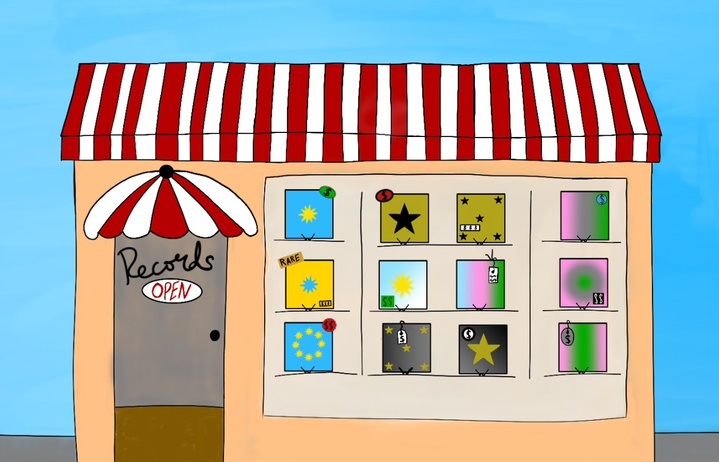
(Caitlin Brockenbrow/Daily Bruin Contributor)

By Caitlin Brockenbrow
Oct. 2, 2025 10:24 a.m.
This post was updated Oct. 2 at 8:12 p.m.
Broadway and the music industry have long excelled at selling merchandise.
But in recent years, the obsession with vinyl records has spun out of control.
What once felt like an act of preservation or a preference for physical media has now become a cash grab, most visible in the endless rereleases of cast recordings and soundtrack variants.
Generation Z’s revival of vinyl was supposed to be about reconnecting with the past and craving something tangible in an age of swipes and streams. Record collecting once meant hunting for misprints, rare imports or long out-of-print editions that carried history.
Now, the market thrives on making consumers feel excluded without them.
“We’re trying to get back to how it used to be, and feeling this sense of need to have something tangible rather than digital because it makes people feel more connected to life,” said Maiyah LaMar, the vice president of the Black Film and Theater Initiative at UCLA and a fourth-year film and television student. “Digital stuff can make you feel disconnected from a lot of things, so I’ve been seeing that sort of shift and I felt that shift in myself too.”
Looking at Wicked, the highest-grossing film adaptation of a Broadway musical, we begin to see this phenomenon.
There have been eight vinyl releases featuring only songs from the musical’s first act: a standard release, a Target split pink-and-green exclusive, a green Elphaba cover, a pink Glinda cover, a full-score edition, a signed insert version, a collector’s box set and a Record Store Day exclusive with an extra track.
That does not even include the original Broadway cast recording variants or what the sequel “Wicked: For Good” will add to the roster.
Most collectors may buy just one edition, but labels exploit loyalty with floods of variants. Aditi Sreenivas, a fourth-year music industry and political science student and president of Cherry Pop Records, a student-run record label at UCLA, said this trend may be a strategy to boost sales for the Billboard Hot 100 and similar charts.
Even long-running shows exploit this trend. “Hamilton,” celebrating 10 years on Broadway, will drop 10 different colored LPs on Oct. 31, branded as “Hamilton: 10 Shots.” These 10 records, which so far appear to be exclusive U.S. releases, all feature the same cover, exclusive poster and 10 songs, not the full 46-song soundtrack. The sole difference between each is the vinyl color, as each corresponds to a different character.
To make matters worse, each vinyl is exclusive to a different retailer, meaning that fans who want the complete set must chase them across multiple stores. This greatly increases shipping costs, a tactic that feels less like a celebration and more like manipulation.
These tactics directly exploit younger consumers’ habits. Sreenivas said college-aged collectors try to pick the single edition that is the most visually appealing, a preference companies manipulate by staggering and obscuring details.
The music industry now churns out deluxe editions, alternate covers, retailer exclusives and even 4-inch “tiny vinyls.” None of these celebrate the music itself.
Olivia Qi, a second-year design media arts and cognitive science student and Cherry Pop Records’ art and design manager said she heard this while interning at Rhino Entertainment Company, a record company that primarily rereleases special edition vinyls.
“They can re-run this at any point,” Qi said. “I think the only thing that matters is ‘limited to 5,000 copies,’ and still, it’s a lot of artificial hype.”
For theater lovers, this means buying multiple editions just to access one extra track or insert. For fans outside New York or London who already cannot attend in person, these exclusives become a cruel form of gatekeeping.
This reflects a broader market shift where packaging outweighs sound quality. Emma Sieh, vice president of Cherry Pop Records, said retailers view younger consumers as sales boosts, focusing very little on sound quality, since many of those collectors do not actually play their records. In this context, cast recordings become less about the performance and more about selling yet another collectible object, a practice that prioritizes novelty over substance.
The danger is not just financial fatigue. It is cultural.
Saturating the market with endless editions risks devaluing recordings altogether. What should be a definitive snapshot of a show instead becomes an overexposed product line. The artistry of the music is buried beneath brightly colored gimmicks.
The fallout especially hurts smaller productions and independent artists who rarely have the budget for multiple variants or a cast recording at all. Competing against Broadway’s blockbuster merchandising, their work risks being drowned out entirely.
LaMar said the transition into a more digital world could cause smaller businesses dependent on tangible items to struggle, especially as people go out to places less often and as physical goods become more expensive.
There is nothing wrong with wanting a beautiful, physical keepsake of a beloved show. But when physical media is reduced to a marketing tactic rather than a meaningful collector’s item, it betrays the very nostalgia that drew young people to vinyl in the first place.
The craving for “simpler times” has been hijacked by an industry eager to overcomplicate, overproduce and oversell.
At a certain point, the question has to be raised: Is this a celebration of theater, or is this a new spin on artificially scarce merchandise?