UCLA partners with Dongwoon Anatech to advance saliva-based diagnostic technology
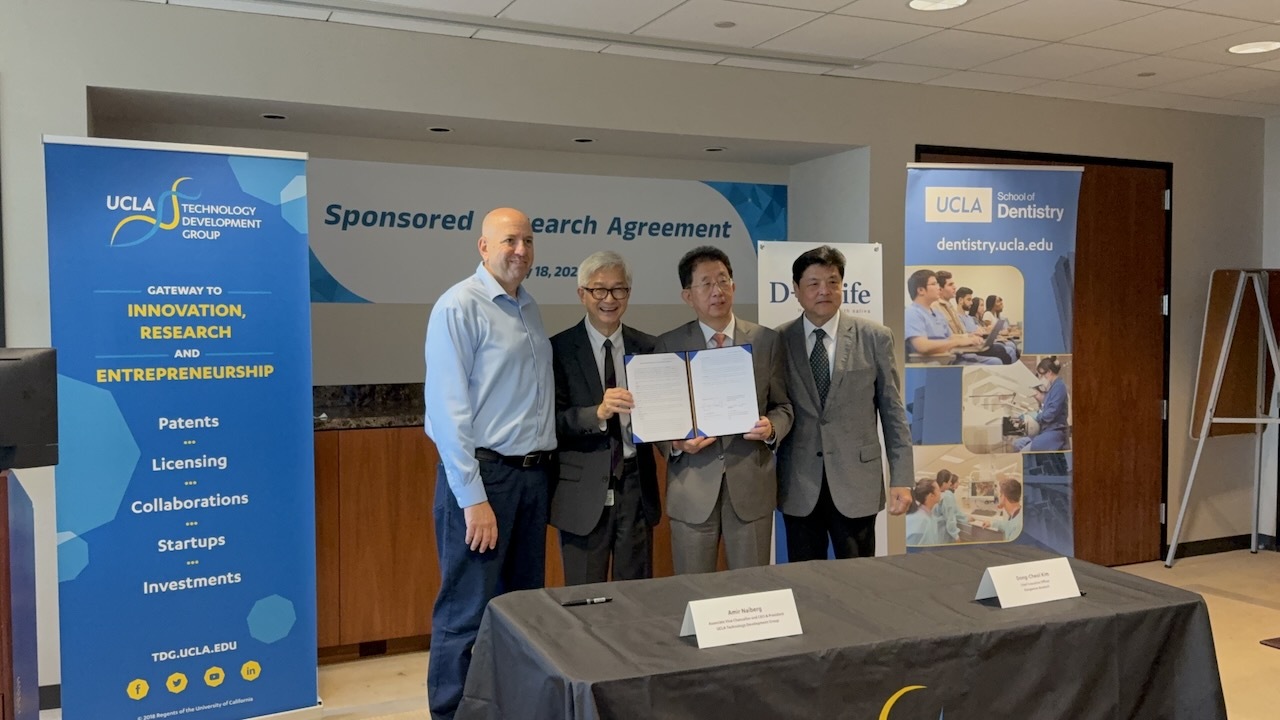
The UCLA School of Dentistry will partner with Dongwoon Anatech to annually support EFIRM, an electrochemical platform that detects molecular targets such as cancer mutations in small samples of blood or saliva. (Courtesy of Ben Alkaly)

By Catherine Wang
Aug. 19, 2025 6:19 p.m.
The UCLA School of Dentistry partnered with a South Korean semiconductor company to bring a saliva-based diagnostic technology into clinics – with the goal of enabling the noninvasive, early detection of diseases such as cancer.
Under the three-year agreement signed July 18, Dongwoon Anatech will provide $787,500 annually to support EFIRM – an electrochemical platform that detects molecular targets such as cancer mutations in small samples of blood or saliva.
EFIRM, which stands for Electric Field-Induced Release and Measurement, was first developed in 2006 by the UCLA Samueli School of Engineering in collaboration with Dr. David Wong, a professor at the School of Dentistry and the director of the Center for Oral/Head & Neck Oncology Research.
“We work in a lab, but they (Dongwoon Anatech) would like to bring it to the real world, benefiting patients,” Wong said. “That is what we set out to do in the first place.”
The agreement was negotiated and also signed by Amir Naiberg, the associate vice chancellor, president and CEO of UCLA Technology Development Corporation, who said that since federal funding is likely to be reduced in the next year, UCLA will look more to the industry to find support for its research.
On July 31, Chancellor Julio Frenk announced that three federal agencies suspended funding for UCLA research, totaling $584 million. Wong said two of his National Institutes of Health-funded training grants have been affected.
[Related: Federal government suspends research funding to UCLA]
Naiberg added that industry partnerships, such as the Dongwoon agreement, help sustain momentum during funding gaps.
While the current EFIRM device – roughly the size of a coffee machine – can only be used in laboratory settings, Dongwoon Anatech’s expertise could help transform the technology into an accessible sensor chip, said Fang Wei, an adjunct professor at the School of Dentistry and an inventor of EFIRM.
Wong said the human body produces about three times the volume of a soda can in saliva each day. Saliva contains valuable biological information – such as circulating free DNA, or DNA fragments from dead cells – that scientists are using for disease detection, he added.
A 2023 study showed that saliva is a promising source for detecting head and neck cancers because it is in direct contact with the tissues where these diseases originate, increasing the likelihood of capturing their fragments.
“We have an ability to develop this through EFIRM that could detect these targets with extraordinary performance and in an environment that is easily accessible,” Wong said. “The day that an Apple Watch can go into your mouth and monitor the earliest instance that tumor cells shed these fingerprints, that a body cell … is just beginning to have cancerous development.”
Unlike traditional liquid biopsies – which typically require 10 milliliters of blood and an expensive DNA extraction process known as polymerase chain reactions – EFIRM only requires a droplet of blood or saliva, Wong said.
EFIRM works by applying an electric field to rupture extracellular vesicles – entities that carry DNA fragments shed by tumor cells – and release their genetic material, Wong said. This DNA then binds to capture probes that can detect specific mutations and signal their presence, Wong added.
The technology is effective at detecting shorter fragments of DNA which are often missed by PCR-based methods that struggle with fragments shorter than 100 base pairs, said Neeti Swarup, a postdoctoral fellow in Wong’s lab. She added that EFIRM’s ability to detect these shorter fragments allows for greater specificity and sensitivity compared to other techniques.
According to a 2016 clinical study published by Wong’s lab, EFIRM was able to detect lung cancer-related mutations in five milliliters of saliva – roughly a droplet – with near-perfect accuracy. This outperformed digital PCR used in traditional liquid biopsies, which achieved around 80% accuracy.
The success of Wong and his team’s research drew the attention of Dongwoon Anatech, which had been seeking partnerships with academic institutions to expand its work beyond manufacturing computer chips, said Yun Rhee, head of the company’s health care division.
Rhee said he has known Wong, a leading researcher in salivary diagnostics, for years and finally initiated the collaboration last December.
Yong Kim, a professor at the UCLA School of Dentistry, said his team will lead the first phase of the partnership, which focuses on creating standard operating procedures for D-SaLife – a device developed by Dongwoon that monitors blood glucose levels with saliva as an alternative to blood.
One major challenge in developing saliva-based diagnostics is improving the sensitivity and specificity of the technology, Wei said. She added that while glucose concentrations in blood are naturally high – making it relatively easy to develop blood-based glucometers – the same is not true for saliva, where glucose levels can be up to 1,000 times lower.
Wong said the next phase of the collaboration will focus on advancing the current platform that detects disease biomarkers to an automated semiconductor-based system designed for clinical deployment.
Rhee added that he anticipates that it may be difficult to build rapport with health care providers on salivary diagnostics.
“At this very moment, not many medical doctors are really into saliva,” Rhee said. “They’re more used to detect diseases from blood.”
Nevertheless, Rhee said he believes that this skepticism can be overcome as EFIRM’s successful results gain more visibility.
Although the current agreement spans three years, Rhee added that both parties envision a long-term partnership spanning decades, given the potential for salivary diagnostics to expand into detecting biomarkers for Alzheimer’s disease.
“This is a classical structure where industry comes with their set of capabilities of manufacturing, upscaling, and UCLA comes with a basic understanding of science,” Naiberg said. “We were able to match-make the two together. So as a model, it is a very good model that we will try to do more often in years to come.”