Community members ask UC Regents to protect jobs, programs amid budget uncertainty
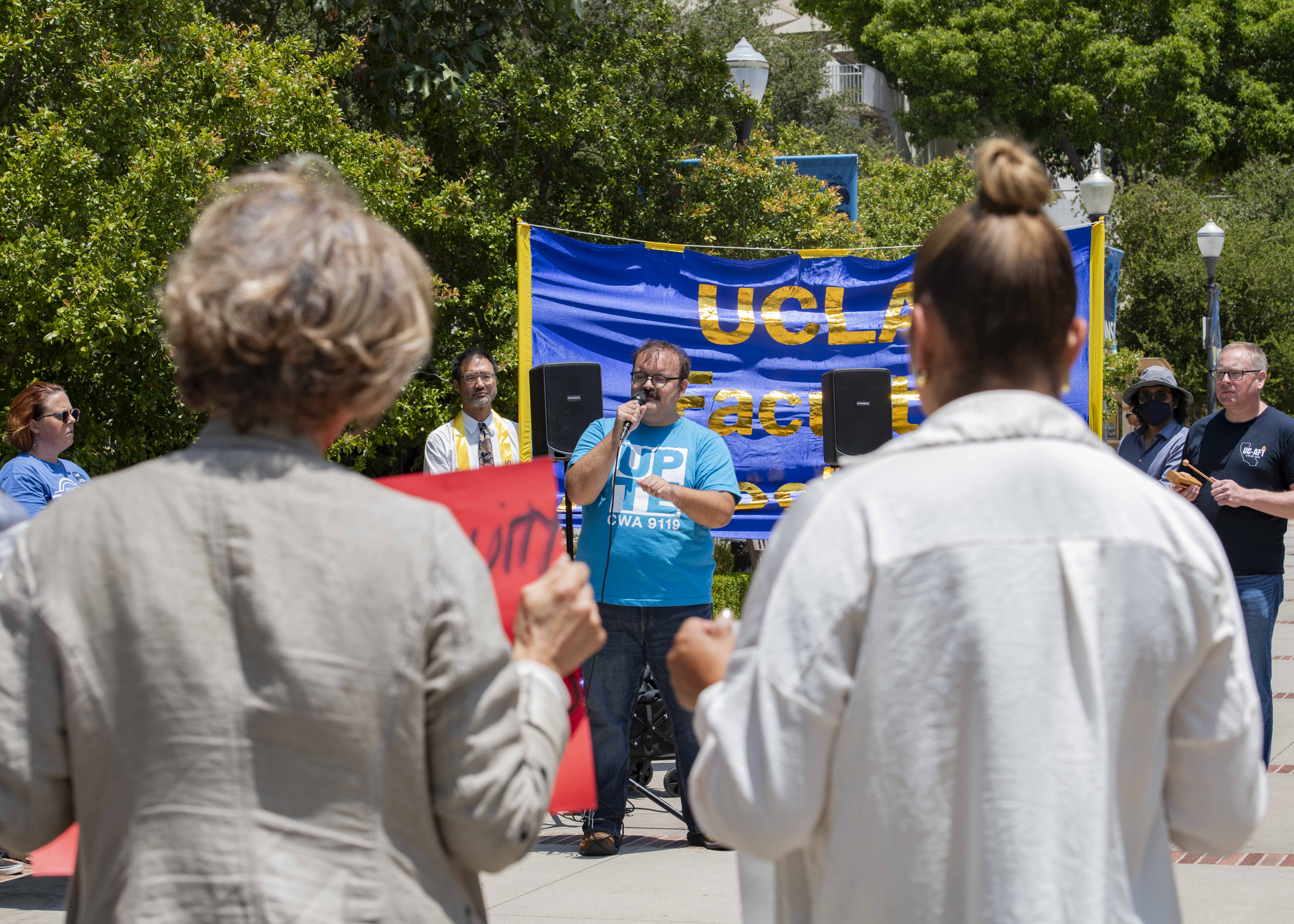
Max Belasco, a co-chair of UCLA’s University Professional and Technical Employees-Communications Workers of America 9119 chapter, speaks at a University Council-American Federation of Teachers Local 1474 protest July 15. Community members, students and faculty called on the UC Board of Regents to raise staff and health care workers’ wages, protect programs impacted by losses in federal funding and reverse layoffs at the board’s July meeting. (Leydi Cris Cobo Cordon/Daily Bruin senior staff)


Community members, students and faculty called on the UC Board of Regents to raise staff and health care workers’ wages, protect programs impacted by losses in federal funding and reverse layoffs at the board’s July meeting.
The UC Board of Regents heard public comment on issues including the University’s finances and the elimination of caps on insurance for staff, which sets the yearly maximum for out-of-pocket medical expenses before coverage applies, during its bimonthly meeting July 15 to July 17 at UCLA. Representatives from the University Council-American Federation of Teachers Local 1474 – a union representing librarians and nontenured faculty members across the UC – rallied outside the July 15 meeting to protest layoffs and nonreappointments.
Loretta Gaffney, a co-chair of UCLA’s UC-AFT chapter, said during public comment that although the UC-wide 2025-2026 budget has not changed, the University is acting as if the budget has been cut – through hiring freezes, layoffs and the closure of multiple courses and programs.
[Related: UC implements systemwide hiring freeze following federal, state threats to budget]
Heather Hansen, a spokesperson for the UC Office of the President, said in an emailed statement the UC is seeing increased costs that are primarily related to increases in benefits, inflation and wages.
“UC operating costs on core funds, enrollment expenditures, and financial aid costs are expected to increase by over $500 million in 2025-2026,” she said in the statement. “These increases will far outpace new revenues from the State and the University’s Tuition Stability Plan. The budget is further exacerbated by current and anticipated cuts to federal funding.”
Gaffney, a lecturer in labor studies, added that she believes cost-cutting tactics are counteracted by large raises to the top earners of the UC system.
“It’s clear that the UC does not know what it has in its teaching faculty and librarians,” Gaffney said.
[Related: UC Regents discuss operating budget, approve salary increases at September meeting]
Members and supporters of UC-AFT Local 1474 – which has nine chapters across the UC system – also protested outside the Meyer and Renee Luskin Conference Center after the July 15 public comment session. Around 35 people gathered to hear speeches from those affected by UC-wide cuts to jobs, department budgets and student programs.
One protester held a sign that read, “Labor rights are human rights,” while others chanted, “Lecturers and staff make the UC great.”
Undergraduate Students Association Council President Diego Bollo alleged in a speech that the UC is attributing cuts to educational programs and the introduction of antisemitism initiatives to pressure from the federal government.
Limitations to programs that provide educational accessibility and affordability – such as through UCLA’s recent cut to its Community Youth Programs, which supported low-income students in local high schools – are a threat to the student body, added Bollo, a fourth-year labor studies and political science student.
[Related: ‘The program saved my life’: UCLA to eliminate Community Youth Programs]
Bollo also said he believes federal funding cuts will result in decreased enrollment from students who are part of marginalized communities – especially for postgraduate programs.
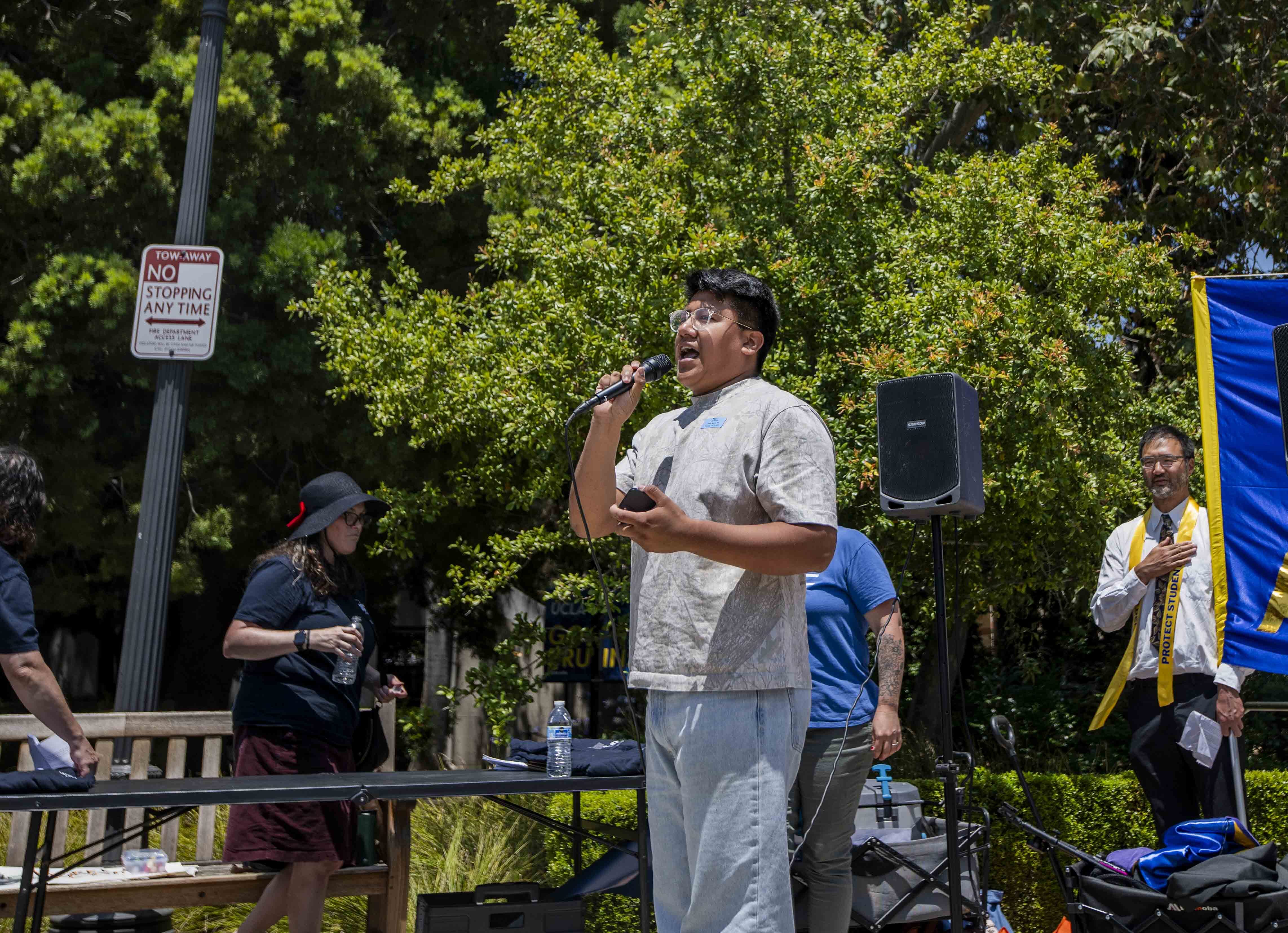
Michael Chwe, a board member of the UCLA Faculty Association and a professor of political science at UCLA, said in a speech at the protest that the UC has failed to protect professors and students. He added that he believes the UC leadership has been “eager to do the work of the Trump administration,” including by laying off librarians and lecturers in response to federal funding cuts.
Chwe also alleged that Eric Martin, a now-former lecturer at UCLA and member of UC-AFT, was fired for exercising his own constitutionally protected rights. An Instagram post from UC-AFT claimed that UCLA fired Martin for not complying with the university’s Time, Place and Manner policies when police arrested him in May 2024 during the sweep of the first Palestine solidarity encampment.
UCLA Media Relations declined to comment on Martin’s termination, with a spokesperson for UCLA saying the university does not comment on personnel issues.
[Related: Hundreds of protesters detained after police breach pro-Palestine encampment at UCLA]
Students set up the encampment in late April 2024 to demand that UCLA and the UC divest from companies with ties to the Israeli military – whose offensive in Gaza has killed over 60,000 Palestinians, according to the Associated Press. Police swept the encampment after UCLA released a statement saying the Palestine solidarity encampment was unlawful and that UCLA-affiliated participants may face disciplinary actions.
Dr. Diana Dayal, an emergency medicine resident physician at the Ronald Reagan UCLA Medical Center and the regional vice president of the Committee of Interns and Residents/Service Employees International Union, said that while medical research budgets have faced federal cuts, the University still has the financial means to provide immediate raises for medical staff.
The Trump administration issued guidance in February that would cap indirect costs for National Institutes of Health grants, which include administrative expenses such as money for lab equipment and office space, to 15%. While a federal judge blocked the ruling, the NIH appealed the decision, leaving the amount that researchers will receive from their grants uncertain. The NIH is the UC’s biggest funder of UC research, providing a total of $2.6 billion to the UC in the 2023-2024 academic year.
[Related: Federal judge stops plan to reduce NIH grants that could limit UC research funding]
The median salary of UC resident physicians, who work 80-hour weeks and do not receive overtime pay, is roughly $22 an hour, Dayal said.
“Invest in the workers who make your health system function,” Dayal said.
Kadidia Thiero, a policy project analyst for the UCLA Center for Developing Leadership in Science, said cuts to federal funding shrank the program’s budget by 75%.
Thiero added that the board should consider allocating internal grant or endowment funds to preserve core staff and operations while the program creates long-term solutions. The current federal funding cuts are set to affect over 200 fellows, 30 staff and 60 community partner organizations, she said.
Candy Stangler, a certified nursing assistant at UC San Diego who was recently laid off, called on the UC to rescind mass worker layoffs. UCSD Health laid off 230 employees in June, citing rising costs and uncertainty regarding federal funding, according to KPBS.
Todd Stenhouse, a spokesperson for the American Federation of State, County and Municipal Employees Local 3299, said in an emailed statement that about 130 members of the union have been laid off between UC San Francisco and UCSD since June 1.
Stangler said she found out her medical insurance was terminated less than 48 hours after her layoff notice during a routine checkup while pregnant. She added that she is concerned about the firing of CNAs in an “already short-staffed” medical center.
“We were already short-staffed, but now with these layoffs, there is no CNA to answer the call light at night,” Stangler said. “Who is going to take care of these brand new moms?”
Naomi Hammonds, the president of the UCLA Graduate Students Association, denounced the layoffs of project directors for UCLA’s student-initiated access and retention programs at a public comment session July 17. These programs – which seek to recruit and retain students from marginalized backgrounds – are being destabilized because of “broader” federal directives, she added.
The project directors who were laid off wrote in a July 2 letter that UCLA’s Campus Life office said the layoffs were due to federal directives that “reinterpret diversity, equity and inclusion initiatives as potentially non-compliant with anti-discrimination laws.”
[Related: UCLA lays off some retention, access program staff amid federal DEI scrutiny]
Hammonds added that the University should work to find pathways to continue the programs, particularly given the University’s precedent of upholding DEI.
Despite several universities across the country – including the University of Southern California and the University of Michigan – closing or renaming their offices dedicated to diversity, equity and inclusion in response to federal directives, the UC’s diversity-related offices remain open across all ten of its campuses. However, the UC announced in March that it would no longer require diversity statements as part of its hiring process.
[Related: Trump’s push against Education Department raises concerns over DEI, civil rights]
Andrew Martinez, an executive board member of the AFSCME Local 3299, said union members are looking for increased wages, adding that he believes the University should stop the elimination of their staff’s health insurance cap.
“I demand a future where I don’t have to sacrifice health and family just to survive,” Martinez said.