Nightly Bruin: The Hidden History of the Arroyo Bridge
Photo credit: Lindsey Murto

By Olivia Miller
July 11, 2025 10:42 a.m.
Beneath UCLA’s Dickson Court lies a hidden structure with a storied past. Built in 1927, the Arroyo Bridge was the university’s first major structure—used to transport materials, shelter students during the Depression, and store wartime supplies. Though buried in 1947, it still stands, now part of a six-mile underground tunnel system that powers the campus. Listen as contributors Srinidhi Nagarajan and Olivia Miller uncover its history, speak with UCLA’s Assistant Vice Chancellor of Facilities Management, and share firsthand audio from Olivia’s guided tunnel tour.
Olivia Miller: It’s 7:15 a.m., 60 degrees Fahrenheit, and today I’m going underground – underground and inside the tunnels at UCLA. I went early that morning because later on in the day, it gets too hot.
OM: Have you ever seen that odd weight limit sign at Dickson Court?
Srinidhi Nagarajan: Yeah, the one about the bridge. But … where’s the bridge?
OM: Hey Srinidhi, how are you? It’s great to be chatting with you tonight!
SN: Hi Olivia, I’m doing great. I’m super excited to dive into this mystery with you and uncover the fascinating story of the Arroyo Bridge for our listeners, so, let’s get into it!
SN: To provide a little bit of background information for our listeners, the Arroyo Bridge was actually UCLA’s first structure, built back in 1927. It was inspired by Roman aqueducts and measured 285 feet long, 75 feet wide, and stood 40 to 50 feet tall. And get this, it was $100,000 – equal to around 2 million dollars today.
OM: Wow – where exactly was it located back then?
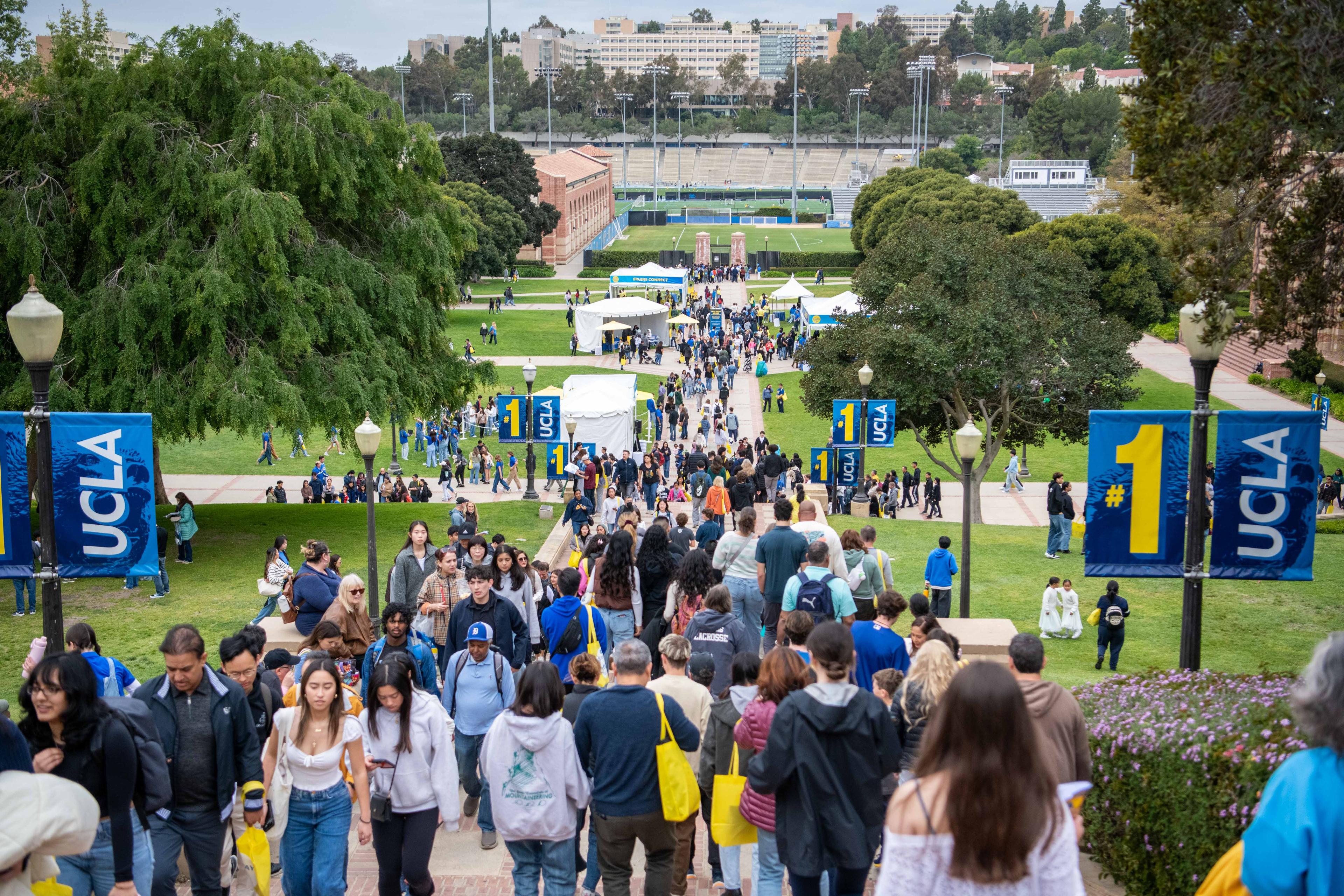
SN: Well, it’s actually not that simple as campus looked completely different back then. The bridge spanned a ravine where Dickson Court and the Sunken Gardens are today, connecting Royce, Powell and a few other buildings on the west side to ones like Dodd Hall and Murphy Hall on the east. It was absolutely crucial for linking the two halves of campus.
OM: Why was the bridge needed in the first place?
SN: This bridge was used during the construction of the campus, as it was essential for transporting materials like cement, bricks, and lumber. And, it also became the main entrance to the campus, with Governor C.C. Young attending the bridge’s opening ceremony.
OM: And the Great Depression hit not long after, right? Did this bridge play any role during that time?
SN: Definitely. One story that stands out during that era is about a student who lived under the bridge during the Depression. Her father lost everything in the stock market crash, so she slept under the bridge on a bed of planks and straw and used the women’s gym to shower.
OM: Yeah, I remember reading that story in UCLA on the Move. It’s amazing how the community rallied around her, even providing emergency loans so she could graduate with honors. There was even a proposal in 1937 to convert the space under the bridge into a dormitory to address housing shortages, though it never materialized.
SN: Yeah and by the time World War II came around, the bridge had taken on a whole new function, right?
OM: Yes! During the war, the West Coast feared submarine attacks, so UCLA stored enough food under the bridge to feed 50,000 people. It became a strategic part of the university’s wartime preparedness.
SN: So if the bridge was so useful, why get rid of it?
OM: It wasn’t that the school wanted to get rid of it. After the war, UCLA saw a massive enrollment surge due to the GI Bill. The campus needed more space, so in 1947, the ravine was filled in, and the bridge was buried to create 24 acres of additional campus land.
SN: That’s insane. When did the operation happen, and how was it preserved during the process?
OM: It took place during the summer of 1947, and it was a very meticulous process. Concrete retaining walls were installed, and plywood protected the bridge’s intricate brickwork during the fill. Even today, the bridge still exists underground and plays a vital role in campus infrastructure. It houses electrical conduits, water and steam pipes, and emergency generators as well.
SN: And it’s part of UCLA’s six-mile underground tunnel network, right?
OM: That’s right! The tunnels connect major buildings like the Young Research Library, Kerckhoff and Murphy Hall. A storage room under Macgowan Hall stores a collection of theater props, and other departments have used areas under the tunnels for storage through the years. They’re musty and humid, with sections over 75 years old. The original stream still flows through them, too.
SN: That’s incredible – and kind of eerie. Facilities workers say it would take almost a full day to walk the entire system, which isn’t just one straight line but a complex network with pipes and cubby holes. Which is crazy, since in 1967 the tunnels even served as an emergency exit for George Lincoln Rockwell, the leader of the American Nazi Party, after a speech at Royce Hall.
OM: And on top of that, not all parts are easily accessible. Maintenance workers have to climb through tight spaces, some so remote that even they don’t know about every corner.
SN: So I’ve heard these tunnels have become something of an urban legend among freshmen. Is there any truth to that?
OM: Absolutely! Students have passed down stories for generations, almost like a secret tradition. However, getting into the tunnels isn’t easy – they’re tightly secured, especially during fraternity rush week, when students are most tempted to explore. There are hundreds of locked entrances all over campus, from basements to hidden grates.
SN: And the tunnels themselves are full of mystery. Some sections have old, disconnected power lines no one remembers the purpose of, alongside abandoned library books, beer cans and graffiti. But, despite its hidden nature, the Arroyo Bridge remains a symbol of UCLA’s history and evolution.
OM: It’s amazing how a structure originally built for practical purposes has adapted to serve so many roles over the decades, from wartime storage to modern infrastructure. And its stories – like the student who lived beneath it, the wartime preparations, and the tunnel legends – add to the bridge’s mystique.
SN: So, the next time you’re walking through Dickson Court and see that weight limit sign, remember it’s not just a quirky relic. It’s a powerful reminder of the hidden history beneath our feet.
OM: The Arroyo Bridge is more than just a buried structure – it’s a testament to UCLA’s ingenuity, resilience, and the rich tapestry of its past. Let’s hear what Kelly Schmader from maintenance has to say about the bridge.
Kelly Schmader: My name is Kelly Schmader, and I run facilities management for UCLA. My title is assistant vice chancellor for facilities management at UCLA since July 1st of 2012. So facilities management has all the utilities for the campus, which is just one of many things we do, including maintenance, repair, construction grounds, custodial, all of that. But the utilities part is what has made me familiar with the tunnels and this bridge. I think I’m the last man standing at UCLA who gives tunnel tours every once in a while. I’ve been under that bridge a number of times and have read a lot about it. So that’s pretty much my background with it.
OM: Why is there a bridge and a six-mile tunnel system under campus in the first place?
KS: When the campus was first built, the initial intent was to build Powell Library and Royce Hall. They were the first two buildings. There was a giant arroyo just to the east of where those two buildings currently sit. The university had to span that arroyo – that gully if you will – to get construction materials across to build the campus. So that’s why that bridge was initially built back in 1927.
The reason we have as many as six miles of tunnels is because all the power, chilled water and steam for the campus is generated in our cogeneration plant, right behind the police station across from the Mattel Children’s Hospital. All of that energy – electricity, steam, chilled water – emanates from that location. It’s piped to all areas of campus underground through these tunnels. That’s why you don’t see telephone poles or overhead wires – it’s all buried for safety and convenience.
OM: How does the university map and keep track of the tunnels?
KS: We do routine inspections. We have a couple of guys who are utilities engineers who work down there and inspect them on a recurring basis. They’re very old, so we also do a lot of unplanned, reactionary maintenance. The guys have been in the tunnels many many times and are very familiar with all the ways to get to the different buildings.
OM: Which kinds of technology do you use to monitor the tunnels?
KS: It’s not really sophisticated, to be honest with you. Typically, whenever you have a steam leak, you will see the steam coming out of the ground or through the air vents, or we’ll recognize that we have a drop in pressure in the lines, which we can monitor from the cogeneration plant. And of course, with power outages, we know when buildings go dark and we’re able to trace to see what the source of that problem is. It’s nothing that’s really overly sophisticated. Steam especially is one thing that’s easy to find whenever you have a break.
OM: And how has the management of the tunnels evolved over time from when UCLA was getting filled to where it is nowadays?
KS: I would say that it’s obviously been expanded. When we first started building the tunnels, we didn’t have nearly as many buildings as we have today. I mentioned earlier that the first two buildings we had were – well, actually, the first four are the ones that surround Royce Quad, which currently is Haines Hall, Kaplan, Powell Library and Royce. But today we have as many as 220 buildings on campus, so the tunnel system has had to expand with that. In terms of the maintenance, there’s improved tools and methodologies, but it’s largely the same. It’s not a whole lot different than it was a hundred years ago.
OM: Wow. And are there efforts to preserve the original Arroyo bridge?
KS: There has been. In fact, as you probably know, we had the Northridge earthquake in 1994. As a response to that, several buildings on campus and the bridge were seismically retrofitted. If you go under that bridge today, you’ll see what looks like a much more newer bridge than what it really is. That bridge is almost 100 years old. The reason it looks bigger or newer is because it was completely retrofitted underneath to support the structure in 1994, following the earthquake damage that it sustained.
OM: Are there any original architectural features that are still visible, or is it mostly modernized to fit earthquake threats?
KS: You can’t really see the architectural features of the bridge from underneath it. But if we were to dig away the five stories of earth that were packed up against that bridge on both sides and exposed it and hosed it down, you would see the same Roman aqueduct type of architecture that was in the original structure. When the arroyo was filled in in 1947 to create more space for the campus, it was essentially just buried. So we have somewhat of a buried treasure below that bridge.
OM: How do you handle other natural threats like flooding in the tunnels?
KS: We haven’t really had a lot of significant flooding in the tunnels. You may know that we’ve had some major water breaks on campus. The most threatening were the ones that happened out on Sunset Boulevard, where we had 80-year-old 36-inch water mains that broke and flooded the campus[15]. Ironically, that water never made it into the tunnels. When we have flooding in the tunnels, it’s just the natural rainfall that comes through the vents. One of the reasons we can walk around in the tunnels is because every so often, there is an air vent to allow air to get in there so that people can breathe. Otherwise, they would be a confined space where you would not have sufficient oxygen to survive. It’s really just normal water intrusion that has caused a little bit of flooding. And when I say flooding, I’m talking about mud puddle kind of things – not two feet deep. In my experience here from 12 years, we’ve never had anything like that.
OM: I did notice that some department sort of use – it’s too broad to say the tunnels – but parts of underground. How is the underground tunnel system linked with what people can use versus what’s totally off limits and untouched?
KS: I guess I would say all of the tunnel areas are off limits, but maybe what you’re asking is how do you access these tunnels from the various buildings. A lot of times it’s mostly in our machine rooms. We have rooms on the campus where we house the dynamic equipment and components that keep the building operational – whether it be electrical panels or chillers or whatever you might have. Typically there is access into the tunnels from those machine rooms. Almost every building somewhere has a place where you can get into the tunnels. But of course, they’re all secured because the machine rooms are locked. One of the reasons I still periodically give tunnel tours is because I know how curious UCLA students are. I would rather guide them through that tunnel than have them down there by themselves. It really is kind of a dangerous environment down there if you don’t know where you’re going.
OM: Yeah, absolutely. That was kind of what I was going to ask about next. How have security measures evolved over time for the tunnels?
KS: The one thing that I have learned in 12 years at UCLA is that you cannot out-engineer the scary-smart UCLA students we have on our campus. We’ve installed security doors in the tunnel in a variety of places so that if anybody does get unauthorized entrance in the tunnels, they can only get so far before they come to a door that’s locked. It stops them from going any further and putting themselves in more danger.
OM: Yeah. Okay.
KS: One of the most recent additions to the bridge – if you were to go underneath the bridge and follow the path toward the tunnels that runs beside the bridge – you’ll notice there’s about a 12-foot tall chain-link fence that prevents anyone from walking out onto the structure. That was done shortly before my time, shortly before my time 12 years ago. It was specifically intended to keep curiosity from folks crawling out on the beams. It’s kind of like a flying wallendas. You almost have to be an acrobat. The last thing we would want is a curious student to walk out there – or a curious campus member wherever they are – and fall. It would probably be a fatal incident. So that security fence along the understructure of the bridge is probably one of the newest features we have.
OM: What’s something that has been an unusual maintenance challenge in the tunnels?
KS: I would say probably the numerous steam leaks that we’ve had. The infrastructure down there is aging. We’ve had a number of steam leaks over the past few years. It’s one of the reasons why I don’t give a lot of tunnel tours, because that’s the biggest hazard down there. Believe it or not, it’s not electrocution. It’s not drowning. It’s not even a fall. If we were to have a significant earthquake or anything like that and a high-pressure steam line broke, it would be very dangerous. Repairing those steam leaks is a big challenge. The first thing you have to do of course is isolate that leak so that there’s no high-pressure steam coming through while our technicians cut or repair that pipe. You can’t have the pipe active with high-pressure steam while that’s going on. I think that’s been our biggest challenge in the tunnels over the last several years.
OM: Okay. And have you found anything or has anyone on the maintenance team found anything unusual in the tunnels before?
KS: We always find graffiti, which tells us we’ve had visitors. We’ve found a number of Solo cups down there, which tells us we’ve had visitors. Other than that, I always tell the folks on the tours, “Hey, do you think we’re going to run into any rats or cockroaches down here?” And they’re like, “Well, I don’t know.” I say, “We won’t, because there’s no food source. It’s extremely hot. Even animals will stay out of that environment when they can.” There hasn’t been anything really unusual that I’ve seen in my time through the tunnels.
OM: Okay. I’ve noticed photos from the Daily Bruin when they did a tour – there were things left over from before or from the bridge. Especially Dewey Decimal System cards. Is that still there? Are there still relics?
KS: Well, yeah. That’s not in the tunnel. When I give a tunnel tour, every time I come to one of the buildings, I take the group into the building – and it’s almost always the basement. When you go into YRL, there is the Dewey Decimal System card catalog. I find it humorous that when I ask the students, “Hey, you probably know where you are now, right? Look at that.” And they’re like, “What is that?” You guys are growing up in a different age than I did. Another popular one is when we pop out in Macgowan. Macgowan Theater is where they have all the props for the theater and I think that’s probably the most well-liked place we visit during tunnel tours. All those old props – jukeboxes from the 1950s. It’s pretty interesting.
OM: Wow. I was thinking about it yesterday because I know there’s obviously an entrance by Dickson Plaza that goes down and has that sign – “Restricted.”
KS: That’s the bridge.
OM: But it’s interesting. Yeah, it’s quite interesting because I looked around Royce and couldn’t find any signs. I found grates on campus, so you could kind of look in and see, and it looked like there was maybe something, but I couldn’t find anything to get to the tunnels. I went in the basement of Royce – couldn’t find anything. And I don’t know, it’s just interesting how well hidden it is.
KS: Yeah. Places where there is unfettered access into the tunnel system from inside buildings – there are security cameras there that are monitored by the police and all that, just to make sure nobody gets in there. Again, it’s not about keeping people out. It’s about keeping people from getting hurt. That’s the main thing.
In one of the buildings that has an entrance into the tunnel system from the machine room, we’ve had that machine room breached a few times. In order to get to the next building, you have to crawl down a two-story wall ladder. A wall ladder is a ladder that is affixed to the wall. And two stories – you know what that means.
So, we would go over there and take a look at this ladder periodically, and again, you’d see the red Solo cups. The folks who are doing this are partying a little bit, and it’s just so dangerous. We’ve really beefed up the security around that ladder to keep people from getting in there and potentially hurting themselves.
OM: Wow. Do people ever – for research projects – ask if they could use the tunnels? Does that ever happen?
KS: I think maybe once in the past I’ve been asked to allow a group to video down there – more for a movie than for any sort of research. I’ve never had any research requests, but one of the students was making a movie one time and wanted to do that. We’re not trying to be difficult about it. It’s just, there’s a big liability having folks down there in those tunnels, as you can imagine. So it’s pretty restricted.
OM: Okay. Is there anything else interesting, or anything else about the tunnels that you would like people to know or think is noteworthy – worth discussing?
KS: Any of the folks that go down there – obviously, you don’t want to be on a tunnel tour, if you want to get one of those, I’m, like I said, I’m the last man standing that gives them every once in a while, maybe, once or twice per quarter. You can’t be claustrophobic. Anybody that’s over about five foot six has to bend over. I’m six foot three, so I really have to bend over. It’s uncomfortable. I would discourage people from trying to break into the tunnels.
There are security cameras down there, and if people really want to go bad enough and they can get a group together, I’m always happy to try to help them get a tour of the tunnels.
OM: I did it. I went in the tunnels.
We accepted that going into the tunnels is not necessarily meant for just students to go in. We were there to observe, and we’re not here to encourage unsafe behavior.
If you do want to go in the tunnels and contact Kelly, you should know that it’s dimly lit, narrow and it’s over 100 degrees and really easy to get lost in. There are low ceilings, a lot of hot pipes, and it kept being underscored that watch out for the pipes that aren’t insulated because they’re dangerous. You could just feel the heat coming off of them.
We entered at the northwest corner of Murphy – or basically where the bridge was – and we walked down the stairs under into the tunnel. There were a bunch of signs for asbestos warnings, but we didn’t have to worry ourselves because the asbestos wasn’t airborne. There were areas that were blocked off, so we didn’t have to worry about asbestos poisoning.
We saw a generator and walked in the area kind of around and under the bridge. It was dark and looked like just a structure. It was fenced off, and the tour guide discussed how it’s fenced off because they found alcohol cups there. It basically just looked like a skeleton of a bridge.
The air in the tunnels was very strange because it doesn’t circulate like a normal building. There’s no tunnel AC or fans. Everything was natural ventilation, and there were grates above that let air and rain drift in. We kept hearing sounds of dripping water, and there were even puddles inside where the arroyo was, where the water was. It was definitely a damp environment, and it never fully dries. At some parts of the tunnel, we were walking through puddles and we were told, “Okay, stay to the left where it’s less deep.” And so we just had to walk through some puddles.
We also saw a blue pipe, and the guide explained that that’s the chilled water. It’s part of UCLA’s cogeneration system. They pump cold water from the central plant to buildings across campus for air conditioning. So when you walk into Royce Hall, the Broad Art Center or the libraries, you feel the cool air coming from basically this whole system.
We also walked past a lot of steam lines. And like I said, a lot of the steam line insulation was missing, and you just felt how hot it was. It was superheated even without touching it. These heat buildings run hot water systems and help power some of the mechanical infrastructure of the campus. We made sure when we were walking by to avoid the uninsulated parts.
There were also a lot of phone lines that were stapled to the walls – long abandoned telephone cables. At one point, they ran the entire campus telephone system, but now they’re just there. They were never taken out. What’s fascinating is that these tunnels are the reason UCLA doesn’t have phone poles because communication is just buried under this ground, so it keeps the campus looking clean.
In one section, we walked past where graffiti had been repeatedly painted over, more toward the entrance of the tunnel.
One of the most physically demanding parts of the tour was when we had to climb a ladder. It led up into Haines Hall. The guide told us how students would sneak into the machine room above and climb down the ladder. He said they’d find beer bottles and just all kinds of stuff. They put in hardened steel doors because it’s just really not safe.
We visited the basement at Royce Hall. We also visited the basement of YRL, where we saw the Dewey Decimal System cards in a wooden drawer. I’ll leave some photos of that.
And Macgowan Hall – the School of Theater, Film and Television – the tunnel opened and revealed a massive mechanical platform. The guide explained that it’s a worm drive elevator and raises and lowers the orchestra pit and stage sets. It was just crazy seeing the guts of a theater.
Inside, we saw a bunch of other theater props, worn out furniture and there was even a sign that said, “Do not use props for lounging,” which I thought was funny.
We also went into the Broad Arts Center – or under the Broad Arts Center – which is across Charles E. Young Drive North from the Chancellor’s residence. That was the northernmost point of the tunnels. We climbed out through the Perloff Architecture Building, and overall, that’s how the tunnels tour went.
OM: And that’s it for this episode of the Nightly Bruin. We hope you enjoyed uncovering the hidden history of UCLA’s Arroyo Bridge and its incredible legacy. Stay tuned for our upcoming episodes, where we’ll dive into more untold stories and behind-the-scenes looks at our campus and beyond.