






UCLA student and faculty researchers approximated location of Osama bin Laden’s hideout in 2009
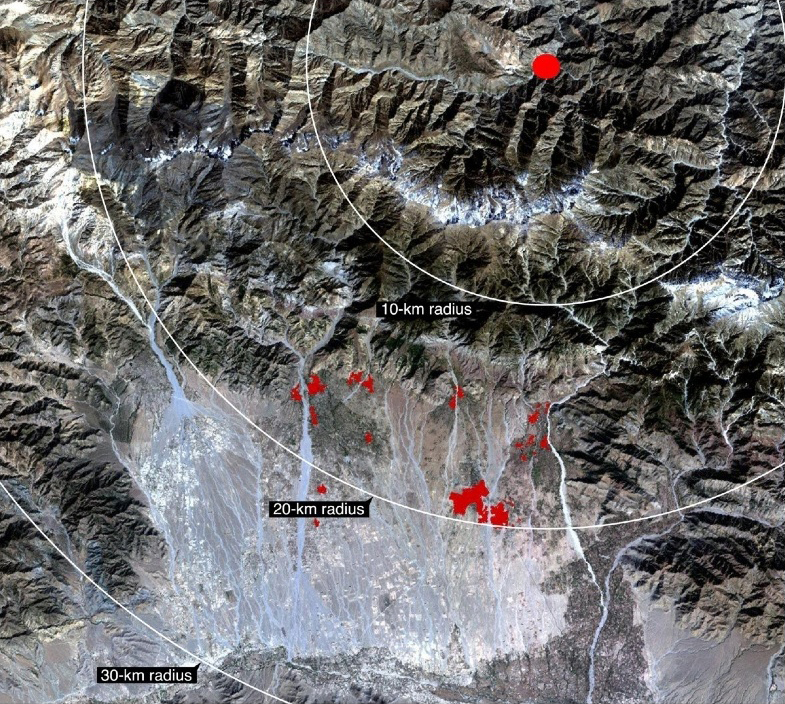
This image shows a regional analysis of the area within a 20-km radius of Osama bin Laden’s last known location, marked by a red dot.
Courtesy of THOMAS GILLESPIE

By Samantha Masunaga
May 4, 2011 12:53 a.m.
Just a few years ago, three UCLA geography students tackled one of U.S. intelligence’s greatest frustrations ”“ the search for Osama bin Laden.
The class project eventually became a full-blown research endeavor.
Using geographical distance theories for animal migration, the team, comprised of students and two UCLA professors, narrowed bin Laden’s whereabouts to Parachinar, a large city in Pakistan.
In actuality, the terrorist was seven hours’ drive away, in Abbottabad, a city located about 288 km from the predicted area.
Animals tend to migrate to areas with a lot of open space, and the researchers thought the theories could relate to human migratory patterns ““ in this case, bin Laden.
“It’s a geography question and a location theory,” said Thomas Gillespie, a UCLA geography professor and one of the lead researchers. “That’s all it really was.”
The report didn’t turn many governmental heads when it was released in 2009, but since then, it has garnered great attention.
“Since his death, we’ve gotten a lot more media coverage,” said Erika Mariano, a UCLA alumna who worked on the project.
“It’s got to be because we were pretty accurate ““ we were one of very few people who put something out there.”
After the report was published in 2009, the team submitted its research to Leon Panetta, director of the CIA.
The team never got a response, though Mariano said she hoped he considered the findings.
“We didn’t expect anything to come from it,” she said. “(Panetta) probably got so many theories that this was one of many.”
But controversy brewed over whether the report should have been released at all.
Online reviewers fumed over the possibility of giving away bin Laden’s location if the data was ultimately correct, possibly leading to a longer search for the terrorist.
Mariano defended the project, saying that all the information and satellite images were gathered from Google Images and personal research, which would be available to anyone with the proper training.
Though many speculated that the FBI’s most wanted fugitive was hiding in a cave in an isolated region, the UCLA team said that such a location would actually be counter-intuitive to bin Laden’s security and concealment.
In a large city with a familiar culture, bin Laden would be less likely to garner attention, thus allowing him to find dwellings that would match his personality and traveling characteristics.
By drawing on information such as his height, supposed kidney disease diagnosis and tendency to travel with a small number of bodyguards, the researchers determined that he would need a tall building with electricity and enough space to maintain personal privacy.
Based on this experience, Mariano encouraged students to engage in research projects, emphasizing that they never know what could potentially come out of it.
With reports from Devin Kelly, Bruin senior staff.


