






Mark Twain’s writings still appeal to broad audience 100 years after his death
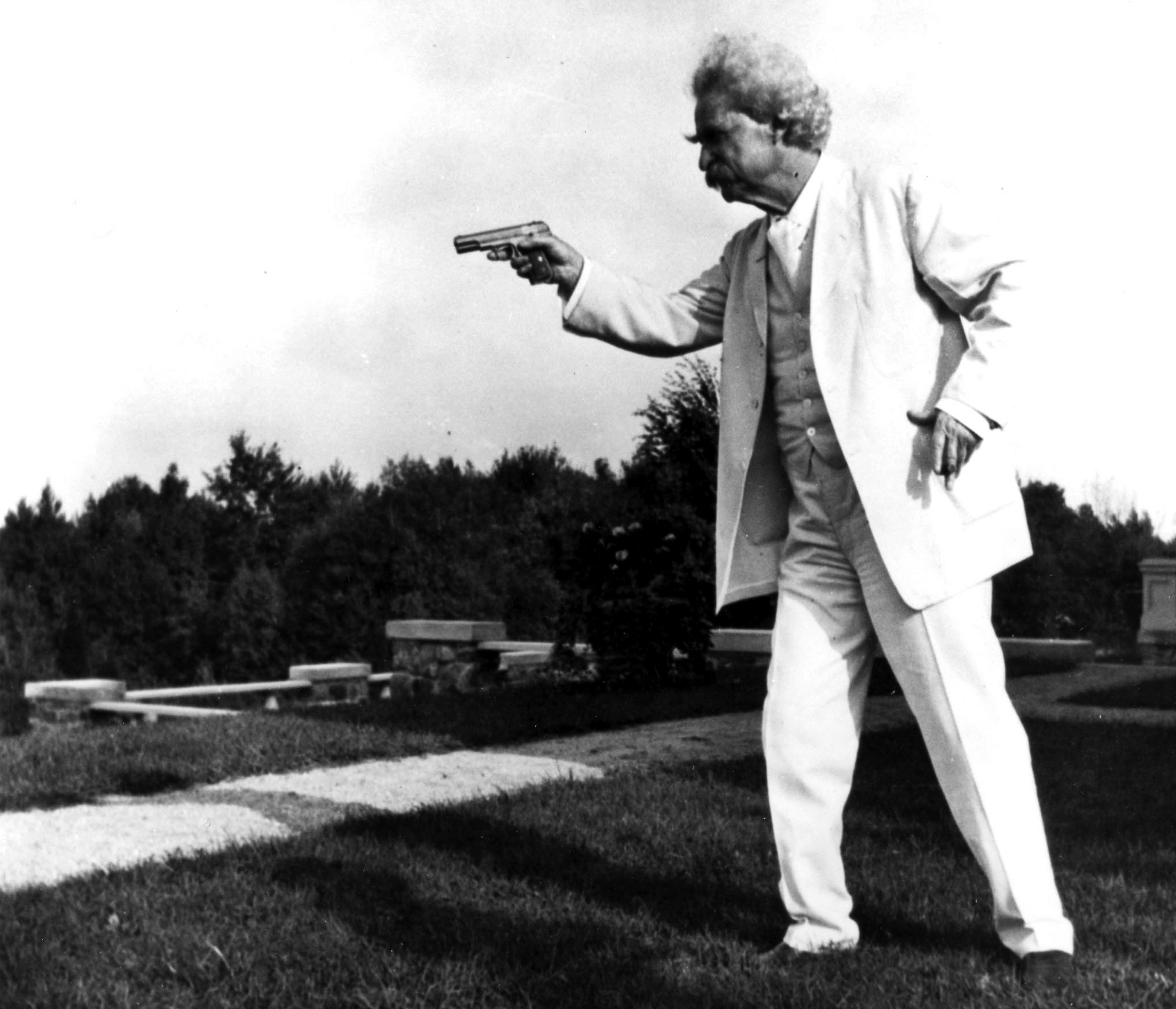
On Tuesday, the Hammer Museum will host a celebration of “The Autobiography of Mark Twain,” the first volume of which was published in November 2009.
Credit: HAMMER MUSEUM
Autobiography of Mark Twain Celebration with Hal Holbrook
Tuesday, 7 p.m.
Hammer Museum, FREE

By Ruiling Erica Zhang
Feb. 7, 2011 12:14 a.m.
Late in his career, in 1905, author Mark Twain claimed to have a new hobby: collecting compliments paid to himself.
Twain and pages of his writings will be the focus of the Hammer Museum’s Tuesday celebration of the American icon’s autobiography ““ which was largely researched from the Mark Twain Papers and Project archive, housed in Bancroft Library at UC Berkeley.
Another page from the archive records one of these compliments in one of Twain’s speeches, called “Little Montana Girl’s Compliment.”
The project’s general editor, Robert Hirst, sat in his office and read a part of Twain’s speech aloud. “”˜She was gazing thoughtfully at a photograph of Mark Twain on a neighbor’s mantelpiece. Presently she said, reverently, “˜We’ve got Jesus like that at home, only ours has more trimmings.'”
Hirst laughed at Twain’s characteristic humor and said he may use it to begin his upcoming talk at the Hammer Museum on Tuesday at 7 p.m.
The Hammer Museum will host and present the Autobiography of Mark Twain Celebration With Hal Holbrook in honor of the publication of the autobiography by the University of California Press and the Mark Twain Papers. The first volume of three was published in November 2009, 100 years after his death, in keeping with Twain’s request.
The evening will begin with Hirst’s presentation of “Tales from the Mark Twain Papers,” followed by a discussion with Hirst and Emmy- and Tony Award-winning actor Hal Holbrook, known for his dramatic portrayal of Twain. The evening will conclude with live rockabilly and folk music by The Americans and a book signing.
Hirst, who was an English professor at UCLA for three years, plans to read from Twain papers that are not in circulation or are unlikely to be published.
According to Hirst, Twain answered some requests from relatives and fans for money or autographs with empty envelopes and others with “booby trap letters” that asked the requester to pay for an autograph in some way.
Hirst also plans to show historical photographs that aren’t typically on view to the public.
Discussion moderator David Kipen, who served as director of literature at the National Endowment for the Arts for five years, is a self-proclaimed “Twain nut.”
He wrote about the Mark Twain Papers when he was a book critic for the San Francisco Chronicle and became acquainted with Hirst. He recalled conducting a memorable onstage interview with Holbrook and his wife as part of the endowment’s Big Read program.
Kipen plans to discuss many topics, including where someone such as Twain comes from and how various aspects of his personal background and economic condition shaped him into a great writer.
“If he hadn’t come West looking for his fortune … would he be the Twain we know today? Or did California help do that for him?” Kipen said.
“Hirst as (a) scholar who’s devoted his life to (Twain), and Holbrook as (an) actor who’s devoted the great art of his career to him, can give perspectives that I don’t think you can get anywhere else.”
According to The Americans’ guitarist-vocalist Patrick Ferris, the band will play old American music, ranging from quieter ’20s and ’30s folk to danceable ’50s rockabilly and early rock ‘n’ roll, and even the band’s own original music.
Although he has not yet read the 500-plus-page autobiography, Ferris said he and upright bass player Jake Faulkner are both avid readers of Twain and plan on reading the work.
“I think any great artist is sort of defined by the fact that his time never runs out,” Ferris said.
According to Hirst, Twain was always conscious of addressing what he called “the great general public.”
“Autobiography” may be a scholarly publication by the UC Press, but Twain himself was never interested in writing for academics or critics.
From the get-go, Twain positioned himself as a writer who was interested in talking to a wide range of people.
“He tailors his humor, and he tailors his writing so that he can appeal to a broad audience,” Hirst said. “Now I think the real question is, how can he do this in such a way that, 100 years after he’s dead, he still appeals in that way?”


