






Q&A with Charles E. Young
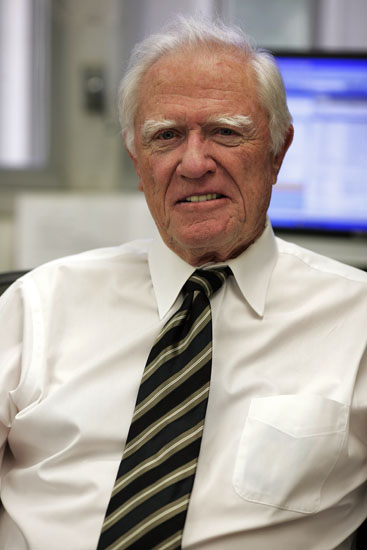
Charles E. Young served as chancellor from 1968 to 1997. Young and Coach John Wooden spent several years as iconic figures at UCLA together.
By Daily Bruin Staff
June 6, 2010 7:54 p.m.
As Chancellor of UCLA, Charles E. Young oversaw a period of tremendous growth at the university. From the beginning of his tenure in 1968, to its end in 1997, UCLA flourished into a major research institution with multi-billion dollar endowment.
Young, who is now 78 years old, also happened to begin his tenure as UCLA chancellor during the peak of Coach John Wooden’s basketball dynasty. He served as chancellor when Wooden’s teams became a national sensation, and when all-time great players Kareem Abdul-Jabbar and Bill Walton dazzled crowds at Pauley Pavilion.
In Young’s 29 years here, UCLA earned one of the most dominant athletic programs in the nation, in large part because of the foundation Coach Wooden had set in the 1960s and 1970s.
On Saturday, one day after Wooden’s death at the age of 99, Chancellor Young spoke to the Daily Bruin’s Sam Allen about his memories of Wooden and the legacy Wooden has left on this campus.
Daily Bruin: What are your thoughts and feelings today, the day after Coach Wooden’s death?
Charles E. Young: Well, lots of things. I’m obviously saddened that he died. I’m pleased that I had a chance to see him (Thursday) for a few minutes. He was unconscious, or sleeping. I was able to see his daughter and his other family. I’m very happy that (Wooden) died without pain and without stress, as best can be told.
DB: What are the greatest lessons that Coach Wooden taught to you?
CY: The lessons that were taught to all of his players and to those who knew him. They are the lessons of the pyramid, lessons of success: to be the best that you can be, to work to do that, and that as you do that, other things will come, (but) the things that come are not the important things, it is what you do in order to make them happen.
DB: What was it like to be friends with John Wooden?
CY: Well, it was like having a wonderful uncle, who was wise, who was a philosopher, a poet, a teacher, who was loving and kind and helpful.
DB: Do you remember your first meeting with him?
CY: I don’t remember my first meeting with him, but I remember my first serious conversation with him very clearly. It must have been 1962 or 1963. I was working with Franklin Murphy, who was predecessor as chancellor of UCLA. We had some serious concerns about the performance and actions of the then-athletic director (Wilbur Johns), and I set out to try to find out if our concerns were well-founded, and if we should act to terminate him, and what we should do in case we did that. And I had a long talk with John. Having had the talk with John, I knew what needed to be done. (Young later clarified: “Johns was replaced with J.D. Morgan, who was then athletic director during Wooden’s great period of success.”)
DB: How would you describe Coach Wooden’s sense of humor?
CY: Very subtle. He was not a jokester, but he had a coy sense of humour. He would say things that had double entendre, but not in the way one normally uses them. It was a very educated sense of humor.
DB: How did you respect him as an intellectual?
CY: He was a student of literature. It was not wide-ranging literature, but it was literature of the positive, literature of the good. He especially liked poetry. He knew an amazing amount by heart, and he was very quick to recite poetry that he thought was pertinent to the discussion at hand.
DB: How do you hope UCLA will remember Coach Wooden?
CY: As a person who brought to the campus great student-athletes and treated them as great student-athletes, and who produced great men. That is almost without exception. He saw to it that they received their education, that they did well in their education, that they performed well in academics that they were interested in and skilled at, that they learned lessons which would make them great men when they ceased being athletes.
E-mail Allen at [email protected].


