






Geolocators key into birds’ migratory habits
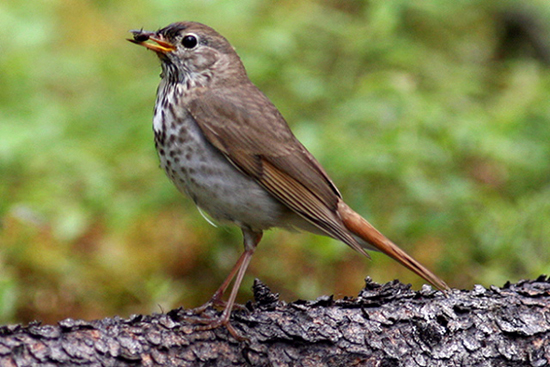
The hermit thrush returns to British Columbia each summer to breed and take advantage of food availabilities.

By Alexa Parmisano
June 6, 2010 11:04 p.m.
In a mountainous, forested region of British Columbia, songbirds will arrive for the summer breeding season, outfitted with tiny devices that have been tracking their migration patterns for the past year.
During the summer of 2009, Allison Alvarado made her first trip to British Columbia to attach small tracking devices to 58 adult male hermit thrushes. These birds often travel from very distant locations, heading north in order to breed and take advantage of the food availabilities, Alvarado said.
The tracking devices are called geolocators, and they are attached to the birds like lightweight backpacks ““ holding information that will hopefully provide answers to the many mysteries surrounding songbird migration, she said.
Alvarado, a UCLA graduate student in the department of ecology and evolutionary biology, will return this summer to the field site where the geolocators were first attached in order to download and analyze the information the devices hold.
Using changes in light levels to determine the location of the birds, the geolocators have been systematically logging data for the past year, she said.
Alvarado works at UCLA’s Center for Tropical Research ““ a group of scientists, researchers and graduate students dedicated to advancing conservation efforts.
“In an age of cell phones and global positioning systems, one thing that many people are surprised about is how little we know about migration,” Alvarado said. “This new technology allows us to reconstruct the migration routes of these very small birds and inform us about where they are going and how quickly they’re moving.”
Larger animals like turtles and geese have been outfitted with tracking devices for quite some time; however, it is only recently that technology has produced something small enough for the tiny songbirds, she said.
With this type of research, the trick is to use a species that is territorial so that a good portion of the birds may be recaptured, Alvarado said. Because songbirds are so small, they often have shorter life spans and migration journeys tend to be more exhaustive than they would be for larger species. In a best-case scenario, they would expect to recapture about 50 percent of the birds equipped with the geolocators, she said.
“This study will be the first to use geolocators to quantify migratory orientation across populations spanning a migratory divide,” said Dr. Thomas Smith, director of the Center for Tropical Research and professor in ecology and evolutionary biology.
While this trip will be Alvarado’s second visit to British Columbia, there is significant material and mental preparation that must take place, she said.
The birds are protected under the Migratory Bird Treaty Act, so Alvarado and her field assistants needed to obtain permits certifying their research. She added that they also must prepare themselves for one month of camping in a remote location with a very high population of bears.
Although Alvarado is currently conducting research on one species, she said studies like her own are becoming more and more common.
“(The geolocators) will allow us to determine with an accuracy of about 100 miles, where these populations are going, which stopover locations they use, and how quickly they migrate,” Alvarado said. “By getting this data for an individual bird, we gain insight into what the population is doing, and ultimately, what the species is doing.”
Migration studies comparable to Alvarado’s are also being used to keep track of the transmission of disease.
Ryan Harrigan, a postdoctoral researcher and colleague of Alvarado, revealed the importance of being able to connect the migratory bird routes to the transmission of disease. Comparable to Alvarado’s field work, researchers hope that one day, keeping track of birds will allow them to simultaneously map out the spread of diseases like the avian flu and West Nile virus, Harrigan said.
Alvarado said she believes the creation of the geolocators is a huge breakthrough in the realm of research because they can be used as a conservation tool for endangered populations.
She added that it is only when researchers figure out where these birds are going that they will be able to figure out what may be threatening their species.


