






Decades after meeting Wooden, Scates is still influenced by legendary coach’s methods
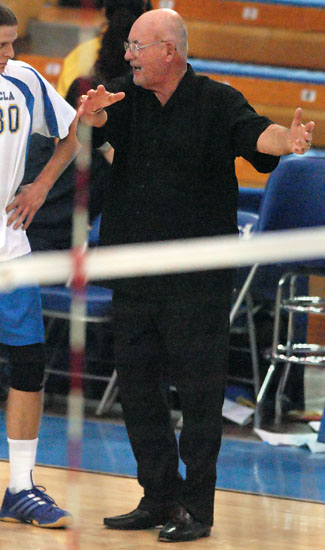
Al Scates models his coaching after Wooden’s. Al Scates said that when he began coaching at UCLA in 1963, he was too much in awe of Wooden to speak to him. After Wooden retired, he took an office next door to Scates and they became close friends.

By Farzad Mashhood
June 6, 2010 8:53 p.m.
Al Scates was nervous to talk to him ““ check that, eventual 19-time NCAA champion Al Scates was nervous to talk to him.
In 1963, when Scates got a job coaching the UCLA men’s volleyball team, he had a unique co-worker in the Athletic Department: John Robert Wooden.
Despite having not yet won an NCAA title, Wooden had already built a reputation as a special coach and as a teacher who taught the fundamentals under a strict regimen. As an undergraduate student, Scates had already taken a class on coaching offered by Wooden’s top assistant, Jerry Norman, who taught Wooden’s style.
“I learned more from that than I did in any coaching class or the 50 or so volleyball books in my office,” Scates said, adding that he has continued to use Wooden’s techniques throughout his 48 years at the helm of the men’s volleyball team.
But Scates was not just a detached admirer of Wooden; he was, in fact, a dear friend.
When Wooden retired from coaching in 1975 with 10 national titles, he elected to move into a smaller office despite the university’s offer to let him keep the large one in the men’s basketball suite. Wooden still came to campus, mostly to answer fans’ mail.
Much to Scates’ pleasure, Wooden’s new office was right next door to his own.
At the time, coaching the men’s volleyball team was still a part-time gig for Scates, who was also teaching at Hawthorne School in Beverly Hills. It was during Scates’ offseason that he and his new office neighbor became close friends. Scates would rush from Beverly Hills to be with Wooden.
Each had a naturally outgoing style that blended well with the other, both leaving their doors open to invite conversation. It was during those years that Scates grew close with the famed coach; they would serve on sports advisory boards together, go out for meals together and generally build upon that bond.
Scates and Wooden would frequently talk about baseball, a sport neither one of them coached. Scates once brought his copy of Wooden’s 1966 book “Practical Modern Basketball” to discuss the sections on teaching he had underlined.
Their relationship continued despite Wooden’s declining health in the past decade.
Wooden also had a keen sense of humor, often poking fun at the volleyball coach. When Scates won his most recent national title in 2006, Wooden was watching the team closely throughout the season. After Scates’ historic win, he got a voicemail.
“”˜Well, it’s about time you got your team together, and got a good streak going,'” Scates said of Wooden’s jesting message. “”˜But why didn’t you work hard enough to do that in the beginning of the season?'”
It was Wooden pretending to be “a disgruntled UCLA alumnus,” Scates said, noting that his colleague and friend was always keen to keep people’s egos in check, even on their best of days.
“I feel like I lost a dear friend,” he added.
For years, Scates learned from Wooden.
Sometimes, it was through watching how he ran his 3 p.m. varsity basketball practices in the Men’s Gym in 1963, Scates’ rookie season coaching the volleyball team.
“Even then, I knew he was a great coach,” Scates said.
Wooden was always a master of constructive criticism, always assessing the situation and able to correct a player’s technique without slowing down practice.
“He did that so fast without breaking up the sequence of the drill,” Scates said. “He’d show them what they did wrong and show him how to do it correctly. This would take just a couple of seconds without breaking up the drill with other players standing around.”
Wooden’s novel instructions were reflected in those afternoon practices that Scates looked in on, and still show up in his coaching today.
“”˜A fundamental must be explained and demonstrated,'” Scates recited from memory, a quote from “Practical Modern Basketball.”
“”˜The players must imitate the correct demonstration carefully. Their demonstration must be constructively criticized and corrected. And then the players must repeat the execution of a proper model until a correct habit has been formed to a point where they will instinctively react in the correct manner.'”
Flash forward to 2010, with Scates still perched on his stool in the same place Wooden and Scates ran their practices throughout their careers, now called the Student Activities Center.
The 70-year-old Scates continues to channel Wooden’s lessons, getting up out of his seat to physically demonstrate how a quick hitter can use the right timing for a block rather than simply shouting instructions from his chair.


