






Film, theater meet on the stage at Francis Ford Coppola One-Act Marathon
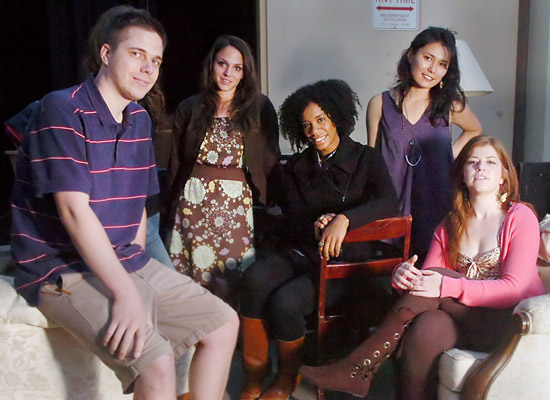
Directors and playwrights participate in the Francis Ford Coppola One-Act Marathon, a film student performance that will premiere tonight at Macgowan Hall in Studio 1340 at 7:30 p.m.

By Daniel Boden
May 5, 2010 10:41 p.m.
Before Francis Ford Coppola completed his graduate studies in film at UCLA, he was a theater student. The writer and director, perhaps best known for “The Godfather” trilogy, got his beginnings at Hofstra University before moving to Los Angeles to pursue a career in the film industry.
The Francis Ford Coppola One-Act Marathon, which runs tonight through Saturday, honors the man whose name it bears by giving UCLA graduate student playwrights an opportunity to present new theatrical works while, at the same time, involving their film director counterparts in stage productions. Performed in the intimate space of Macgowan 1340, the marathon showcases three one-act plays, each written by one of three first-year master of fine arts playwrights.
“All three playwrights, in the first quarter of our first year, take the one-act class. … We write the one-act play in the class, and we work on it the whole time,” said first-year graduate playwriting student Joe Marciniak, whose one-act play “Two Weeds” will be the first of his works to be actually staged.
“Then we just sort of throw it away. We just sit on it. We don’t look at it for a quarter. Then we bring it back out this quarter, and we take a class that goes with the Coppolas … with Jose Luis (Valenzuela). We read, discuss; we workshop a little bit more; we do rewrites.”
Taking the winter quarter away from their scripts allowed the playwrights to deal with their own work more objectively.
“I’m actually really glad that I had that time off because I got to approach it in a detached manner,” said Kate Sullivan Gibbens, a first-year graduate playwriting student, of her play “The Great Buford Fire Funnel.”
“I think the changes that I made, because of the break, were stronger than if I had made them immediately after. I got to take the criticism from fall quarter that really stuck with me and apply that rather than all the little bits that would have been there immediately.”
Erica Jones, as a first-year graduate playwriting student, had the rare opportunity to have her full-length play “Gross Sales” featured in the New Play Festival during fall quarter. Usually, the New Play Festival focuses on works of graduate students in film. Jones was able to compare her experience of writing “Gross Sales” to the process of writing her much shorter one-act play, “Turner Money.”
“I find that writing a one-act play is difficult, very difficult. You have to get in late, get out early. You have to pose one major conflict, and you have to somehow develop all of your characters in the space of under 50 minutes,” Jones said.
“And you have to get across whatever your thesis is … or whatever your artistic idea for what the play is about in a really short period of time. So it’s way more condensed. Things have to happen a lot faster.”
Jones said that writing one-act plays was a useful exercise, not only as practice, but also because one-acts are more marketable for fledgling writers. The Coppola One-Act Marathon also permits select graduate film directing students to step outside of their comfort zone, switching from the screen to the stage.
“Francis Ford Coppola, he was a theater student. It was really important for him that directors would do theater,” Valenzuela said.
“We take them from a class where we teach them major playwrights, how plays work different than films, and then those who are more interesting and interested, we ask them to direct a one-act written by the MFA writers.”
Directing for the stage teaches great lessons in blocking, script analysis, rehearsal management and working with writers and actors. The directors often agreed with Valenzuela’s comments about the merits of applying stage directing techniques to their work behind the camera.
“I’m still learning film directing, so I think working in theater has helped me understand the differences,” said Masami Kawai, a graduate film directing student and the director of Jones’ play.
“Theater, this process has actually been a great training ground, and I wish I did this first.”
The theater has no cut, which revises the director’s view on editing. Kawai also explained how the three-quarter thrust of Macgowan 1340 ““ in which the audience wraps around three sides of the stage, as opposed to a flat proscenium viewing similar to the cinema ““ has made her think about blocking.
“We’re using diagonals, and it’s pushing my mind to think about how to block a scene. It’s basically (like) I’m seeing a scene from different camera positions. Essentially, there are three master (shots),” Kawai said.
Just as the directors had to face the challenge of directing for a new media, the playwrights had to cope with dissociating themselves from their scripts and handing the reigns over to their directors.
“Dana (Turken), my director, is great,” Sullivan Gibbens said. “I was a little cautious at the beginning, but she really dived right in. … Her ability to create pictures on stage and place the actors in places and create images is so strong because of her film background. That’s something I hadn’t anticipated being a benefit.”
Finding a quality director who will work closely and cohesively with the playwright is one of the challenges involved with the Coppola One-Act Marathon. Allyson Schwarz, a graduate film directing student and the director of “Two Weeds,” explained how rigorous and in-depth Valenzuela’s selection process was.
“The most important thing for Jose Luis is to find a director for each play that’s passionate about that play and will commit 100 percent to their playwright’s work and to this experience, because if you can’t commit fully to this, you won’t get as much out of it. And it really is an all-consuming project.”


