






University provides resources for financially distressed

By Will Weiss
May 5, 2009 9:16 p.m.
Times are hard.
Since the start of the nation’s economic crisis last fall, a growing number of UCLA students have had trouble making ends meet, and as things have continued to precipitate, some students have come upon challenges they had not expected to find in college.
Experiences vary, but many students have sustained economic impediments severe enough to threaten their college careers, faced with the ever-mounting expenses of tuition, room and board, and many of them without the financial support of parents and family.
“We see a lot of students who have a parent who lost a job, or whose financial situation has changed drastically over the last few months,” said Karen Minero, student care manager for the Student Affairs Office. “Depending on the case, we are able to put students in touch with various resources and help them cope with stress ““ financial distress or otherwise.”
In an effort to keep such students from slipping through the cracks, UCLA administrators have launched series of initiatives aimed at consolidating and allocating resources to students in need.
With gifts totaling $155,000, the university has assembled an economic crisis response team to help relieve severe economic stress by providing help with housing, academic, social, psychological, nutritional and other needs, according to an e-mailed statement sent on April 30.
Composed of representatives from the Office of the Vice Chancellor of Student Affairs, the Financial Aid Office, the Student and Campus Life Office, the Community Programs Office, the Graduate Student Resource Center and the Academic Advancement Program, the team meets weekly and takes referrals from all over campus.
Because most of the students in these circumstances are incapable of taking out additional loans, Chancellor Gene Block has also elected to allocate $250,000 from his discretionary fund to provide grants of up to $4,000 to students on the verge of suspending their academic work because of financial troubles.
“The university is resource rich,” said Enku Gelaye, executive officer in the Office of the Vice Chancellor of Student Affairs. “We wanted to bring together those resources so we could streamline the information students are getting and perhaps keep them informed of resources they might not even know about.”
Gelaye elaborated, saying that administrators adopted the model in an effort to reduce the hassle involved in finding and getting access to resources on campus. As part of this consolidation of resources and expertise, the response team recently launched a Web site to serve as a resource guide for students in distress. It can be found on the student affairs Web site.
Students in immediate need of critical resources such as food can also utilize the food voucher system and food closet, established in the Student Activities Center for just this purpose.
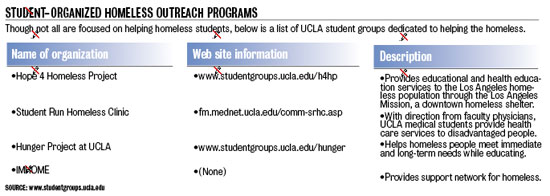
Student groups on campus also play a role in UCLA’s efforts to address financial distress both on campus and in the outside community.
Last month’s BruINTENT event, spearheaded by undergraduate student government President Homaira Hosseini, raised approximately $4,000 to benefit the Los Angeles homeless population, and the organization will be pursuing a matching grant from the UCLA Alumni Association, Hosseini said.
Though the event was initially targeted at nonstudents, Hosseini said that priorities changed when she learned of UCLA’s homeless students during winter quarter, and half the funds raised will be put toward providing grants to distressed students.
“The fact that the issue of homeless students was not recognized until my staff and I brought it to others’ attention shows that it’s under the radar,” she said. “I don’t know how these students are surviving. It’s very important.”


