(Photos by Chenrui Zhang/Daily Bruin staff, Andrew Ramiro Diaz/ Photo editor, Daily Bruin file photo. Design by Erin Brauer/Daily Bruin)
By Anna Gu
March 13, 2026 at 7:43 p.m.
This post was updated March 14 at 11:56 a.m.
Controversial professors often face calls for their removal.
More than 20,000 people signed a petition calling for the firing of Gordon Klein, a continuing lecturer at the UCLA Anderson School of Management, after he denied accommodations to Black students after the murder of George Floyd. Priyanga Amarasekare, a now-former tenured ecology and evolutionary biology professor, came under fire after sending mass messages to students with unsubstantiated allegations of fraud, racism and slander. Earlier this month, a petition calling for the removal of Mark Tramo – an associate adjunct professor who communicated about students with Jeffrey Epstein – received over 10,000 signatures.
But what does it take to actually fire a UCLA faculty member?
The Academic Personnel Manual – written by the UC Office of the President and the Academic Senate – outlines the dismissal process for UCLA faculty. The procedures vary depending on whether a faculty member is tenured, a member of the Academic Senate or a union member. While the chancellor and the UC Board of Regents have broad powers in the firing of professors, the removal process for both tenured and nontenured professors follows a formal process.
Four different manuals outline the faculty removal process, said Michael Levine, UCLA’s vice chancellor for academic affairs and personnel.
“The APM is a list of all of the rules and regulations that go on related to academic personnel,” Levine said. “It is a very, very large manual, and the way we deal with it is by the issue that we in particular want to deal with at that time.”
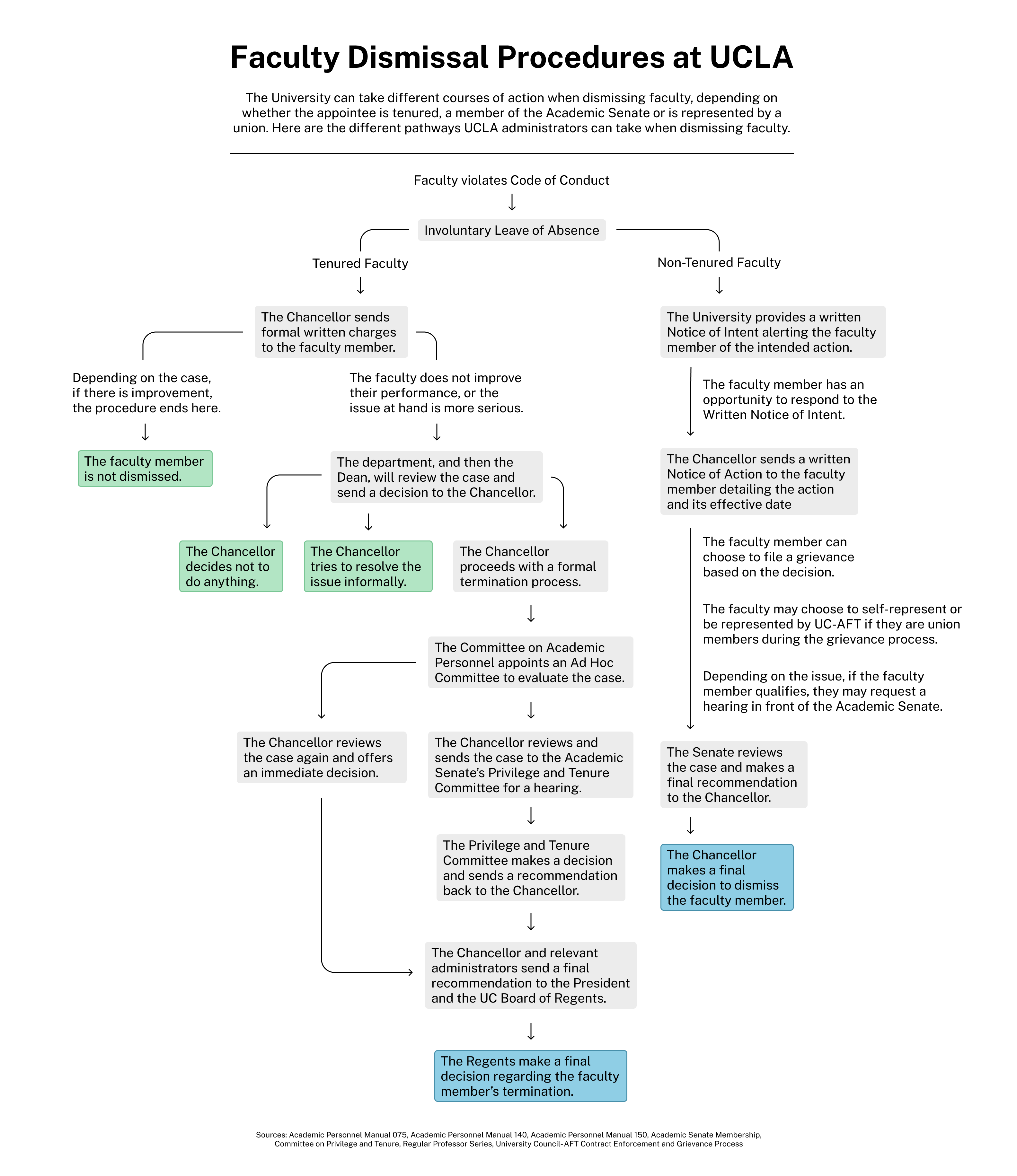
The dismissal process typically begins when a faculty member is accused of violating the faculty code of conduct.
The faculty code of conduct outlines the rules of behavior for faculty, with unacceptable conduct, including inappropriate romantic relationships with students, intentional disruption of university functions and fraudulent scholarly research, potentially leading to a firing.
More serious violations, including sexual harassment and discrimination, are handled by the Title IX Office and the Discrimination Prevention Office, said Anna Markowitz, the president of the UCLA Faculty Association and an associate professor in the UCLA School of Education and Information Studies. However, she added that students also have the right to submit complaints alleging a faculty member violated the code of conduct to these offices or to department chairs to initiate an investigation.
Once an investigation is initiated, the chancellor has the authority to place the faculty member on immediate involuntary leave if they believe the faculty member poses a serious risk of harm or could interfere with the investigation.
The dismissal process looks different for tenured and nontenured faculty.
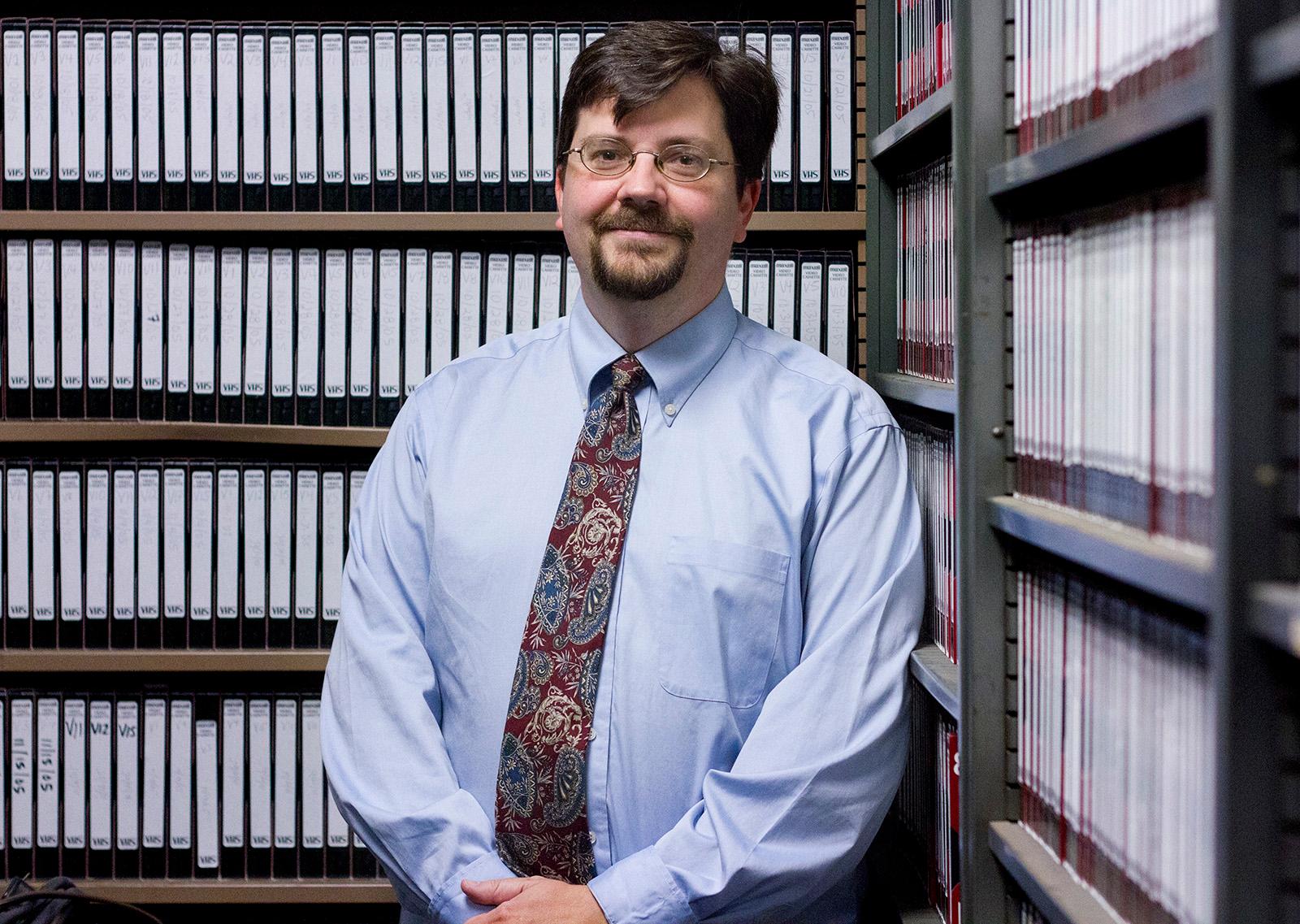
Academic tenure, defined as an indefinite appointment for university faculty, includes associate professors and professors at UCLA. Faculty members are typically given tenure after a lengthy process that considers their research and teaching merits. The status was first invented in part to protect academic freedom by stopping professors from getting fired based off their speech and research, according to the American Association of University Professors.
Nontenured faculty – including adjunct professors and visiting professors – do not have these same job protections.
Tenured faculty are entitled to a hearing in front of the UCLA Academic Senate’s Committee on Privilege and Tenure, as the senate, which represents the faculty, shares governance with the administration in these cases. The UC Board of Regents will then vote on the final decision of whether to fire a faculty member.
While all tenured professors are members of the Academic Senate, other nontenured faculty, including assistant professors, deans and certain instructors, are also part of the body. For nontenured faculty, the process is mostly dealt with under the chancellor unless the procedure is escalated.
The process differs because tenure is a form of employment that falls under just-cause contracts, said Deepa Das Acevedo, an associate professor of law at the Emory University School of Law. A just-cause contract refers to when an employer must have a good reason to terminate employees, particularly in the public sector.
“Tenure makes it harder for your employer to fire you,” Das Acevedo said. “They can still fire you if they have good cause, but they need to have a reason, and it needs to be a reasonable reason.”
A violation of the faculty code of conduct would fall under a just cause for the University to take disciplinary action against the accused faculty.
Conversely, nontenured faculty fall under an at-will contract, where the employer or employee can terminate the employment relationship at any time, with or without cause, Das Acevedo said.
“You can imagine that that creates a lot of insecurity for employees who are subject to this at-will rule of employment,” Das Acevedo said. “If you can be fired for good reason, bad reason or no reason at all.”
The Academic Senate serves in both advisory and jury roles for disciplinary cases involving senate faculty, said Senate Chair Megan McEvoy in an emailed statement. She added that the senate’s Charges Committee oversees the initial investigatory phase, while the Committee on Privilege and Tenure appoints a hearing committee to review the case.
The Council on Academic Personnel will also nominate an ad hoc committee to evaluate the case, according to APM 075. CAP works closely with the chancellor and other administrators to put forth a recommendation to the UC president and the regents for a final decision.
In January, the regents voted to approve Amarasekare’s dismissal.
[Related: UC Board of Regents approves dismissal of tenured ecology professor]
The Privilege and Tenure hearing committee had previously found that Amarasekare had violated confidentiality policies after her mass messages to students and faculty in which she made the unsubstantiated claims.
The dismissal process is an indication of the UC’s commitment to tenure and shared governance with the UC Academic Senate, a UCOP spokesperson said in an emailed statement.
For nontenured faculty, the dismissal process is often more streamlined, with the chancellor able to dismiss a faculty member.
The case only escalates if a faculty member decides to file a grievance. A grievance is a contractually guaranteed way a worker can file a formal complaint to their employer letting them know their rights have been violated, according to the University Council-American Federation of Teachers union website.
The grievance process varies, depending on the type of nontenured faculty.
Lecturers, who are a member of the bargaining unit under the UC-AFT union, are able to bargain with the support of their union, while other faculty may choose to represent themselves during the grievance process.
The union aims to address the shortfalls nontenured positions have in terms of job security, said Caroline Luce, the communications committee chair of the UC-AFT union, which represents lecturers at UCLA.
“Our union contract becomes an alternative to the protections of tenure,” said Luce, who is also a labor studies lecturer. “It’s not equivalent, it’s not the same, it’s not as great – we’d love it to be – but the argument is that it’s about bolstering, protecting each other.”
In June 2020, UCLA placed Klein on administrative leave after he refused to provide accommodations for Black students after the murder of George Floyd by a Minneapolis police officer.
Klein fell under the bargaining unit of the union, and the union represented him throughout this grievance process. However, a Superior Court judge recently ruled against some of Klein’s claims.
[Related: Court tentatively rules in favor of UC administrators in lawsuit by UCLA lecturer]
A UCLA spokesperson declined to comment on the university’s response to Tramo, who communicated with Epstein about his class and students seeking research opportunities. Tramo disclosed his spring retirement in a March 6 email to a Daily Bruin reporter.
The university spokesperson said the university typically does not comment on personnel matters.
Chancellor Julio Frenk has broad discretion in deciding whether to fire Tramo, who is not tenured.
[Related: UCLA professor to retire, cancel spring class amid criticism over Epstein ties]
The faculty dismissal process generally follows an administrative due process to ensure UCLA is held accountable to California taxpayers, Markowitz said.
“We have to say to Californians, ‘This is the process we’re going to put forward,’ because we know you as Californians fund us,” Markowitz said. “Here’s the way that we’re going to walk this line of transparency, so you understand what our decisions are.”