
Allen Daniels Jr. leveraged the holding bar, twisted his torso and pushed his arm forward, propelling the cast iron ball into the air. It landed on the soft turf of the field. A young volunteer ran after it and called out the distance. Daniels, sitting on the throwing frame – a tall metal seat strapped to the ground – nodded and stretched his arm. He was still warming up.
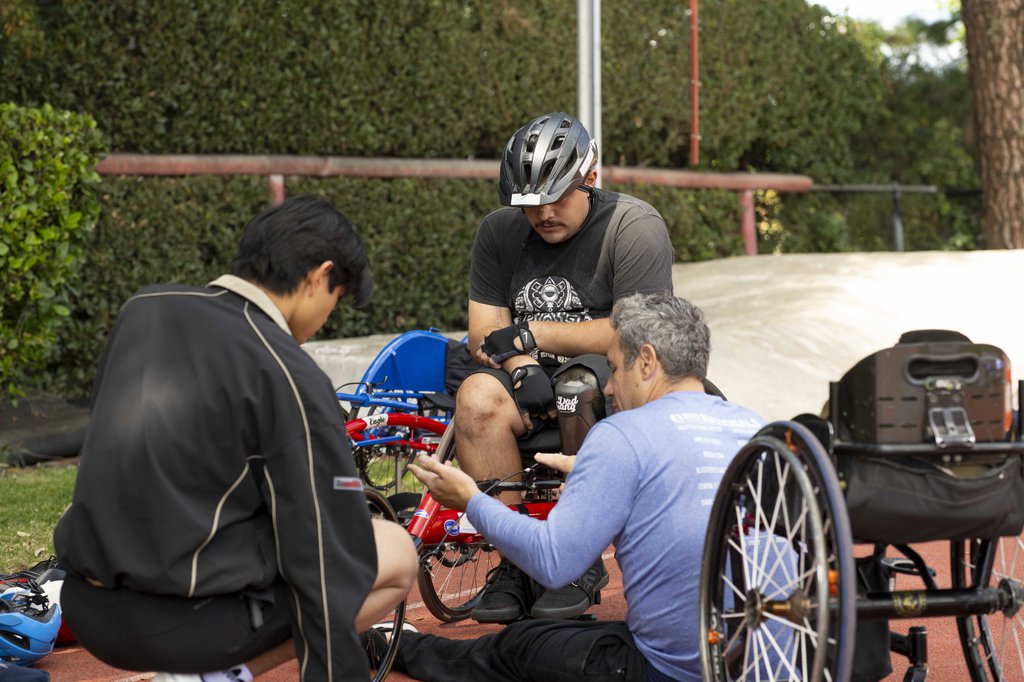
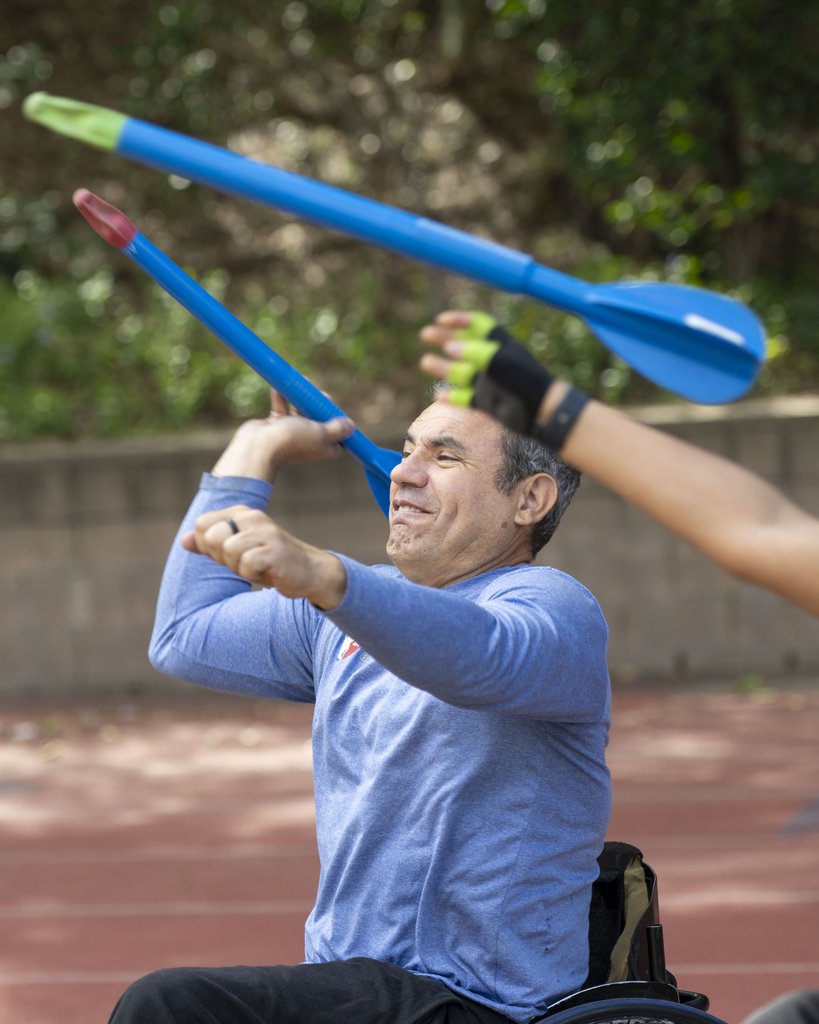
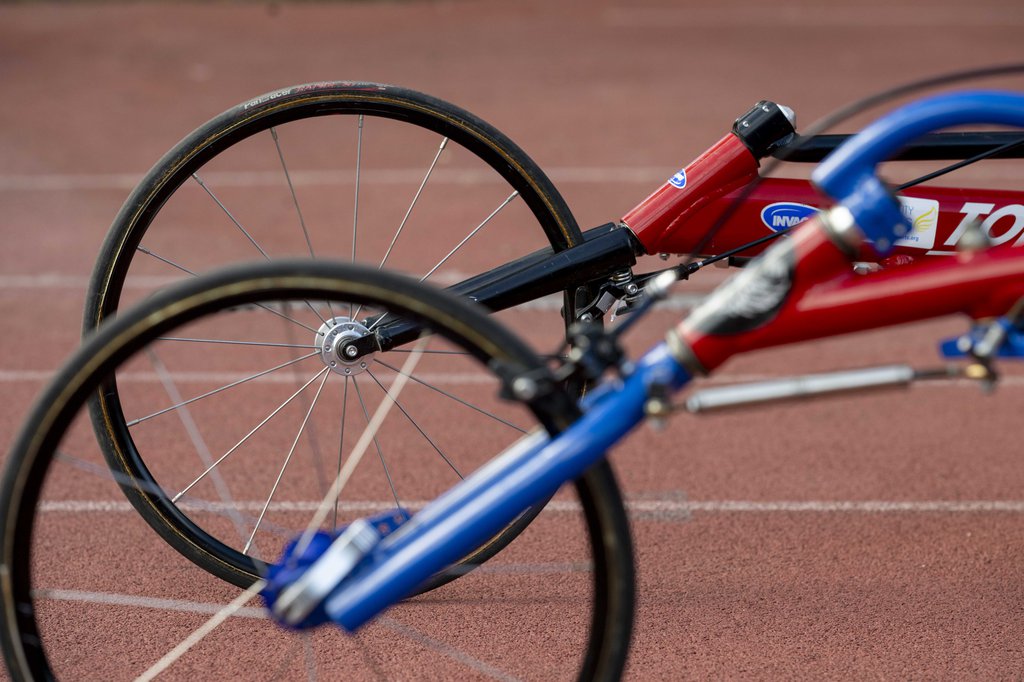
On this chilly March afternoon, Daniels was competing at a track meet held by Angel City Sports, an adaptive sports nonprofit, on Harvard-Westlake Upper School’s campus. On the track next to Daniels’ shot-put zone zipped three wheelchair racers. Their hands alternated between thrusting their wheels forward and adjusting the compensator, which helps them turn and propel at the same time. Coaches pumped the tires of a few bright blue racing wheelchairs, while a handful of volunteers carried around water bottles and rubber javelins.
Angel City Sports intersperses smaller events such as these with larger competitions and fairs across Los Angeles to promote adaptive sports, athletic activities modified to accommodate people with disabilities. The organization hopes to expand access to adaptive sport opportunities and equipment to Angelenos, which is something the city has historically lacked. Their work is more important than ever because in three years, LA will become the center of the para-athletic world.
With the 2028 Paralympic Games coming to LA, para-athletes, activists and officials are rushing to meet the moment. UCLA, which will host the Paralympic Village and accommodate thousands of athletes with varying mobility and visual disabilities, often struggles to support the needs of its disabled student community. Three years out from the opening ceremony, LA’s accessibility and adaptive sports landscape reveals not just what to expect in 2028 but also how prepared our city and campus really are to support athletes and communities with disabilities.
LA has previously hosted the 1984 Olympic Games, during which UCLA hosted the Olympic Village, but 2028 will be the first time both the city and the school host Paralympians. The 1984 Paralympics were split between New York City and Stoke Mandeville in the United Kingdom.
LA may now be hosting the 2028 Paralympics, but 10 years ago, Team USA said it had given up looking for Paralympic talent in Southern California, said Clayton Frech, Angel City Sports’ CEO and a UCLA alumnus.
He said one of main obstacles to providing adaptive athletic infrastructure in LA is a lack of public awareness. It is hard to convince many corporations, big donors and foundations – the major sources of funding for many nonprofits – that adaptive sports are a worthwhile pursuit, he said. Additionally, he said schools, parks and recreation programs, and other organizations such as the YMCA or the Boys and Girls Club of America generally don’t do this work at scale.
Much of the work is left to small regional nonprofits, said Frech, which is particularly challenging in LA.
"This is one of the best talent pipelines in the world for professional sports," Frech said. "And yet we're in the dark ages when it comes to Paralympics."
Alvin Malave, the program manager for Angel City Sports, said it is a little frustrating that building adaptive sports infrastructure can be so slow in a city with so many resources. As I spoke with Malave over Zoom, he was driving around a car loaded with adaptive athletic equipment to prepare for the Abilities Expo 2025 – an adaptive sports expo. He occasionally stopped to direct others where to unload their equipment.
"The work that we do is truly life-changing work," Malave said. "We give kids and adults and veterans a space where they could come and connect with their peers and have all this social emotional learning – along with moving and doing exercise and getting fit and living a more active, healthy life."
Despite over one in five adults living with a disability in California, Frech said adaptive athletics programs are uncommon and limited in scope across the state. Malave said that in the past decade, awareness and programs for adaptive athletics has increased – particularly because of social media and the internet – but more work needs to be done.
In 2015, he co-organized the first Angel City Games, held at UCLA, to meet the significant demand for adaptive sports in LA. Now, Angel City Sports facilitates more than 25 sports and 250 clinics per year, according to its website. It has a loaner program to connect people with equipment and three annual competitive games. But people still have to drive multiple hours on weekends to go to adaptive athletics events, Frech said.
"We've got this incredible need. No one's filling it, except for nonprofits," Frech said. "The business model of the nonprofits is a real challenge, and so what we have is really inconsistent quality and quantity of programming around the country."
In the past decade, organizations such as Angel City Sports and Triumph Foundation, which specializes in assisting people with spinal cord injuries or disorders, have improved the landscape of adaptive athletics in Southern California. A $160 million investment from the LA Organizing Committee for the Olympic and Paralympic Games 2028 and the International Olympic Committee led to the creation of the PlayLA Youth & Adaptive Youth Sports Program, which aims to increase sport accessibility ahead of the 2028 Games. The city is no longer the "black hole for Paralympic sport" it was 10 years ago, Frech said.
As LA’s adaptive athletics organizations expand their reach, concerns have emerged over whether the city has the infrastructure to support the 2028 Paralympics. Many of the buildings in LA are compliant with the Americans with Disabilities Act, but that just means they have the bare minimum accommodations, said Celina Shirazipour, a research consultant with Invictus Games and an assistant professor at the David Geffen School of Medicine. She said many facilities in LA and on UCLA’s campus may be unable to accommodate the thousands of visitors the Olympics and Paralympics will bring – even if they are technically compliant.
That influx of visitors may impact other aspects of the city’s infrastructure. Christopher Ikonomou, a 2023 UCLA alumnus and disability rights activist, expressed concerns about the capacities of LA’s metro ahead of the influx of visitors over the summer, even though bus ramps and elevators of LA’s metro were generally accessible in his personal experience.
Although LA has not announced the construction of any new facilities for the Olympic and Paralympic competitions, it has received nearly $900 million in federal funding to increase subway and bus transportation throughout the city. One such improvement is a metro line connecting UCLA to downtown, which is expected to be completed by 2027. LA has stated it is aiming to add 2,700 buses to its fleet for the 2028 Games.
With this spotlight and attention on LA for the upcoming games, there is the potential to demonstrate strong support for athletes with disabilities.
"We have an opportunity to be a huge success. We also have an opportunity to be a bit of an embarrassment," said Sam Silverman, the interim track coach for Angel City Sports.
Those concerns extend to UCLA’s campus. UCLA announced in 2016 that it will host the Paralympic and Olympic villages, essentially providing housing and facilities for all the athletes and any care partners. There is, however, concern about the accessibility of UCLA’s campus among those familiar with the school.
Frech shared he did not anticipate his son Ezra, a Paralympic gold medalist who competes in track and field, would explore much of Westwood or the campus if he competed in the 2028 Paralympics because of the valuable energy it expends to navigate UCLA’s steep terrain.
"That is not an easy campus to get around," Frech said. "Their ability to be on a podium or to medal is fractions and fractions of a second, ... where every little ounce of energy is important. I think this campus is actually going to be a real challenge."
Many of the training facilities at UCLA are topographically far below where the Paralympians would be living, Malave said. It is very difficult for a wheelchair user to go up the Hill, he said, even if they’re a trained athlete. He and Ikonomou said there is a particularly steep section of Bruin Walk that is circumvented by the elevator by the tennis courts. Ikonomou said it was frequently broken.
A recent Daily Bruin investigation found that a majority of elevators on the Hill have expired permits, and elevators are frequently out of order. Jennifer Miyaki, a coordinator for the Disabled Student Union who will graduate with her BA and MA in linguistics, said out-of-service elevators are a regular problem.
"I know that the Kerckhoff one is going to go under maintenance. Kerckhoff only has one elevator," Miyaki said. "They (the administration) had said you can email us if you need accommodations, but I'm thinking, ‘Well, what accommodations could you provide?’"
Ikonomou described UCLA’s campus as notoriously inaccessible. It was not the first time the word "notorious" had come up in my interviews.
Other, more administrative, issues came up. Ikonomou said that when he went to UCLA, the BruinAccess vans were unreliable, and the drivers were not properly trained to support students with disabilities. Another Daily Bruin investigation found that the Bruin Access vans were frequently delayed and unreliable.
Two sources alleged that the UCLA administration has violated the ADA on multiple occasions. In 2021, several student organizations performed a 16-day sit-in at Murphy Hall in the longest continuous protest action since the pandemic and demanded changes such as the hiring of an ADA compliance officer. In April, two students filed a lawsuit alleging that UCLA had violated the ADA through inaccessible campus navigation and incomplete staff training.
Miyaki said it is hard to connect with disability specialists because they are so overworked. There are 11 disability specialists on the staff registry at the Center for Accessible Education, serving approximately 4,000 students with disabilities – with sometimes as few as three specialists on staff during the past three years, according to a Daily Bruin investigation.
Despite these reservations and concerns for UCLA’s readiness, the arrival of the Paralympics could change the status quo. The money and public pressure the Olympics and Paralympics bring to LA and UCLA could fund the changes that disability activists have been fighting for, Ikonomou said, expressing disappointment that it might take until 2028.
"UCLA talks a lot about being No. 1," Ikonomou said. "How about we become No. 1 in accessibility for students and letting people excel because we're giving them all that they need to succeed?"
Additionally, many people are excited about UCLA hosting the Paralympic village because of its welcoming community and state-of-the-art athletic facilities, Frech said. UCLA’s Adaptive Recreation Program is a valuable resource for students interested in adaptive sports, Malave said, offering programs like wheelchair basketball. The program partners with other organizations in LA, such as Angel City Sports and the Triumph Foundation.
The 2028 Paralympics could also increase the public’s awareness of adaptive sports and disability activism. Frech said the U.S. is behind other countries when it comes to understanding the event, and he hopes hosting will help it catch up. The broadcast of the 2012 London Paralympics marked a shift in people’s awareness of para-athletics, Shirazipour said. Since then, the U.S. viewership gap between the Olympics and Paralympics has shrunk, all while participation in the Paralympics has grown.
The 2028 Paralympics is a big chance to show the world – and the U.S. – what the disabled community can do, Frech said. He said it is important to spread awareness for the Paralympics because 90% of Paralympic tickets are bought by locals.
"They compete in silence with nobody in the stands all year long. Let's give them one moment where we actually pack the stands and show up for them," Frech said.
At the Angel City Sports track meet, Mayra Lopez watched as her 12-year-old son dashed around the track in a racing wheelchair. She said he enjoys Angel City events and keeps asking her when the next one is. Malave was right behind him, shouting words of encouragement.
Silverman doesn’t get many days off, but when they do, they said they spend them with Angel City Sports. She said working with Angel City was the ideal intersection of her health care career and her love of sports – all while doing fulfilling community work.
"This is my life and my work-life balance," Silverman said. "I recommend to anyone and everyone – if you're needing some time to build your faith in humanity, if you want to get out in the community, if you want to volunteer – this is a great opportunity."
Daniels, the shot put thrower, said he hopes to compete in the 2028 Paralympics. Until then, he said he was going to stay involved with Angel City Sports for the foreseeable future because it was the closest adaptive athletics organization to him.
He said goodbye and headed toward his car. He was facing an hour-and-a-half drive home. But he said it was worth it – and he’s going to keep coming back.
"I'm motivated to work out, meet other people, hear their stories, get the conversations, converse with other people that are in similar situations," Daniels said. "It's definitely a blessing."