(Illustration by Helen Sanders/Daily Bruin staff. Design by Vienna Vipond/Daily Bruin. Photo by Nicolas Greamo/Daily Bruin senior staff)
By Danielle Workman
July 28, 2025 at 9:53 p.m.
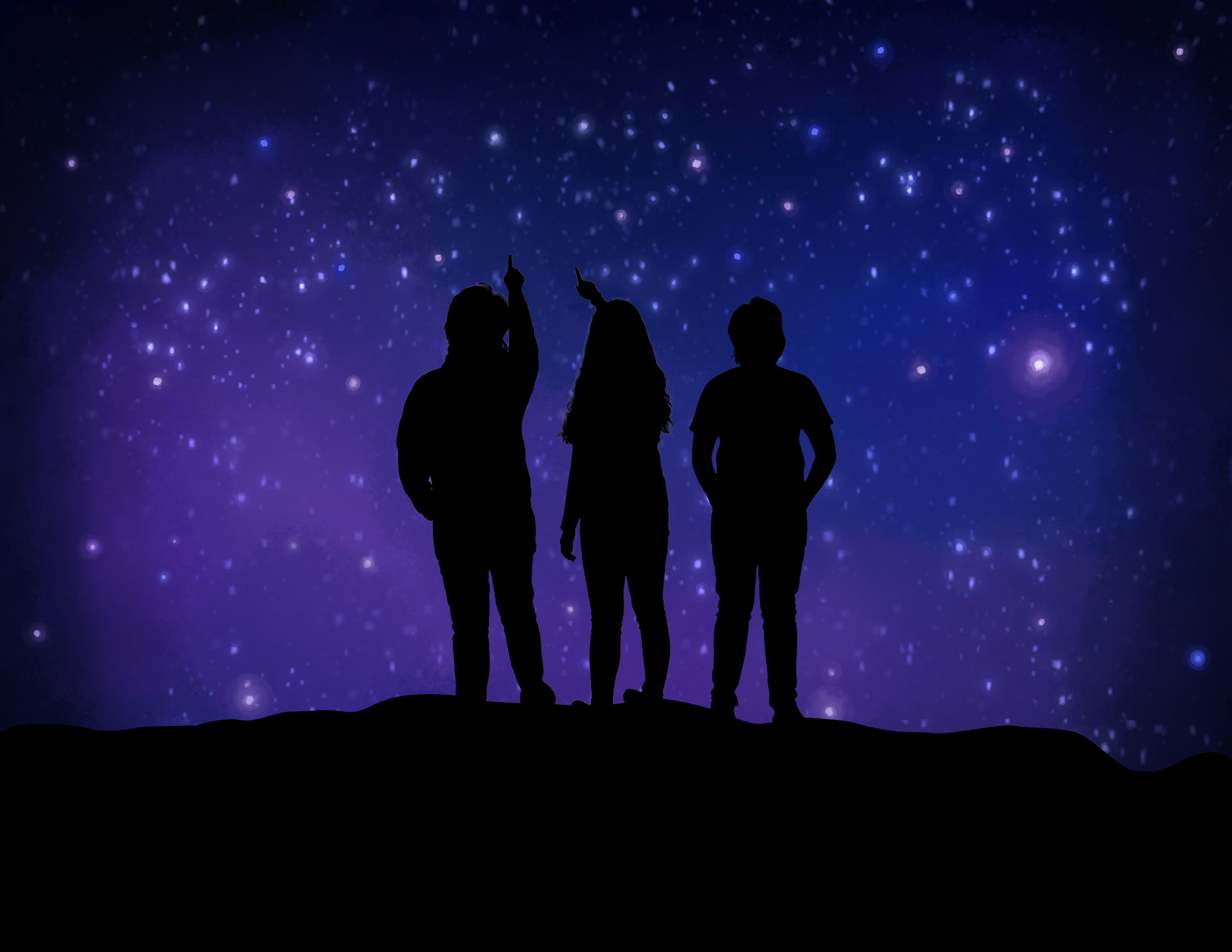
The archetype is familiar: The solitary physicist, deep in thought, paces beside a chalkboard peppered with symbols and equations. The astronomer, perched alone at the edge of the night, peers into a telescope aimed at a distant galaxy, searching into the abyss of the cosmos.
For centuries, the story of scientific discovery has been told through the lens of isolation – a lone genius driven by curiosity, obsession and flashes of brilliance. The image is romantic, dramatic and deeply individualistic: science as a “one-man revolution.”
While the image of the solitary scientist still lingers in the cultural imagination, at UCLA, the reality is far more dynamic and human. At a research institution, discovery doesn’t happen in a vacuum. In the undergraduate physics lounge, first-years ask upperclassmen for help on problem sets. Weekly colloquiums with visiting researchers take place on the Physics and Astronomy Building’s patio. Decades-long research collides with fresh perspectives and experiences as professors invite undergraduate and graduate students into their labs.
In a discipline often portrayed as rigid, isolating and reserved solely for the once-in-a-generation genius, UCLA’s approach to the field is anything but. The department thrives on teamwork, inclusion and shared effort. Its faculty and students understand that progress in science is rarely achieved alone – it is the collective input of many that sparks innovation and pushes boundaries.
Before it distinguished itself with illustrious awards for both teaching and research – such as numerous UCLA Distinguished Teaching Awards and an Instrumentation Award from the American Physical Society – the then-Department of Physics was established as part of UCLA itself in 1919. Though it began with a singular professor of physics, John Mead Adams, it ultimately merged with the former Department of Astronomy to become a well-respected physics and astronomy program – boasting more than 80 professors, including a Nobel laureate and winners of the Kavli Prize in astrophysics.
Among the department’s faculty roster was David Jewitt, who discovered the Kuiper Belt through a collaborative effort while conducting research at the University of Hawaiʻi at Mānoa. Now part of the Department of Earth, Planetary and Space Sciences, Jewitt said he has long been guided by a focus on discovery for its own sake – a perspective that continues to influence his work and teaching today.
“The key thing about astronomy is it is absolutely pure,” Jewitt said. “It is not of any economic value at all, which is its strength. It’s pure science, so it’s motivated by the desire to understand the world and the universe and the origin of the solar system – the origin of everything.”
While asking questions that have no known answers may seem discouraging to some, for astronomers and astrophysicists, it’s a challenge to embrace. This spirit runs deep in the physics and astronomy department, in which the faculty encourages their students to pursue answers to their bold questions and think beyond current scientific boundaries.
Physics and astronomy professor Andrea Ghez said her course content throughout her 31 years in the department has had to change with and adjust to the rapidly evolving nature of new discoveries in the field. Ghez, an internationally recognized astrophysicist, received a Nobel Prize for her research while at UCLA on a black hole in the center of the Milky Way galaxy.
“It’s such an amazing field – to be able to work in something that speaks to us on such a profoundly human level,” Ghez said. “We are so insignificant in this universe that’s so much bigger, both in space and time. … We have this ability to explore, reflect – and that we’re living in a moment where the technology is exploding and our understanding of the universe is rapidly changing.”
Within the collaborative ecosystem of the department, faculty members mentor graduate students – and graduate students, in turn, support and guide undergraduates. As they push the boundaries of scientific discovery, students of all levels also play a vital part in fostering the next generation of scientists.
For Aidan Gibbs, an astrophysics doctoral student in his final year of the program, mentorship from his advisor – Professor Michael Fitzgerald – shaped his six years in the department.
“Your relationship with your advisor is probably the most important choice and aspect of doing a Ph.D. because it’s a pretty long process, and they’re going to guide you the whole way,” Gibbs said. “You want that to be as smooth and as friendly as possible, but you also want to be doing the most impactful work you can as a Ph.D. student as well.”
Vikram Seenivasan – the president of UCLA’s chapter of the Society of Physics Students – said graduate students often serve as approachable mentors to undergraduates, as they understand the challenges undergraduates are facing and help them find their footing in the field. This spirit of guidance can ripple outward: Seenivasan, a fourth-year physics student, said he sets out to pay forward the mentorship that graduate students offer him.
“When freshmen come to me, all the time, I always yap. I’m an A-tier yapper. I’m always down to talk and give advice,” Seenivasan said. “As a freshman, I was definitely a lot more timid. A lot of the ways that I was able to become more comfortable talking with people was, I think, when an upperclassman would approach me, I would be like, ‘Oh, they’re talking to me. I can talk to them now.’ And so I think that made it easier for me to approach other people on my own in the future.”
A commitment to teaching doesn’t end in the classroom or between peers – it’s woven into the structure of the department itself. After their first year, every graduate student is assigned a job to help maintain and run the department. For example, astronomy and astrophysics doctoral student Judah Luberto engages new audiences in the field of astronomy through his role as a planetarium coordinator. From weekly shows for the UCLA and Westwood community to private presentations for middle and elementary schoolers, Luberto said these events are designed to introduce planetary science concepts to attendees of all ages in an understandable way.
As students gain confidence and build connections with peers, many also begin to engage more deeply with faculty. The department’s faculty culture makes research opportunities all the more involved.
Swathya Chauhan, a fourth-year astrophysics student, said faculty don’t just oversee projects – they actively mentor students through the challenges of real-world scientific work.
“They understand that when you start a project at the beginning or even for the first couple of months, you will need a lot of time and help to get oriented,” Chauhan said. “Professors are very willing to teach you those skills.”
Chauhan has been involved with research since the end of her second year and has worked with multiple astronomy professors. As a part of a research group studying stars near the Milky Way’s center, Chauhan used data from the Hubble and James Webb space telescopes.
Karen Clark, a second-year physics student, has worked with assistant professor Alvine Kamaha on both hardware and software projects, gaining hands-on experience.
“A lot of people worry that when they start research, they’re just going to be tightening bolts or doing busy work,” Clark said. “I feel like I’ve actually gotten to do real, meaningful projects that … are leaving lasting impacts on the lab.”
Clark originally began her undergraduate education as a geography student. Despite her interest in the field, Clark felt she would become bored in the social sciences and took a chance on physics. She added that she was apprehensive about pursuing the field, particularly given her lack of exposure to female physicists. However, Clark said her time as a physics student at UCLA has been the happiest she’s ever been and has given her a stronger sense of community than she’s ever known.
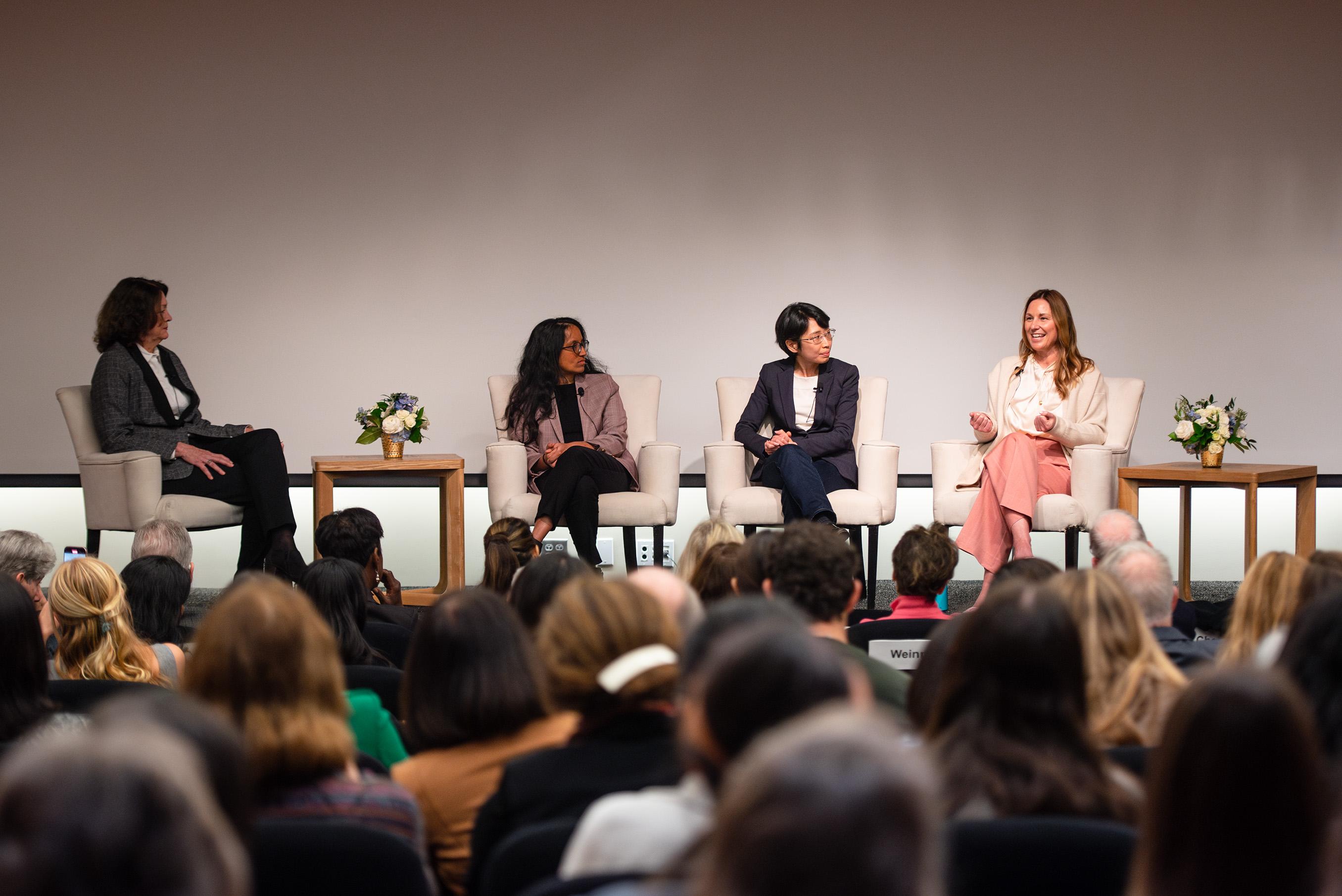
Through their work as vice president and president of Women+ in the Physical Sciences at UCLA, respectively, Clark and Chauhan create personal and professional opportunities for women and gender minority students in the field, connecting them to a community that can understand their experiences firsthand. Beyond her contributions to the organization’s community, Chauhan was also selected by her department advisor to represent the Division of Physical Sciences at Bruin Day.
While the presence of scientists such as Ghez and Chauhan has helped pave the way, increasing leadership and representation of gender minorities in STEM remains an essential part of building a more equitable and dynamic scientific community.
At Bruin Day, Chauhan delivered a speech about her experience in astrophysics at UCLA, prompting her to reflect on her growth from a quiet, overwhelmed first-year to a confident student leader.
“I try to look for Indian astrophysicists that happen to be female or happen to be queer,” Chauhan said. “That’s something that is always in the back of my mind. But I want to be the representation for myself out there, and I think I feel empowered to do that because of the supportive environment I’ve had in the department.”
Chauhan said the department’s undergraduate gender ratio trends fare somewhat better than national averages. According to UCLA’s Office of Equity, Diversity and Inclusion, women comprise approximately 30% of the undergraduate physics program and about 45% of the undergraduate astronomy program at UCLA. In comparison, national statistics as of 2021 showed that women earned 25% of physics bachelor’s degrees, according to the American Physical Society and the American Institute of Physics. Additionally, 33% of astronomy bachelor’s degrees are earned by women, according to the American Institute of Physics. While leadership diversity remains limited, the demographics of undergraduates offer hope for change.
“I had very few women mentors, and there were times when I felt like I was not playing in the right playground,” Ghez said. “Understanding the incredible value of seeing somebody else you could imagine yourself being – … that really encourages me.”
When it comes to teaching, Ghez said she loves the introductory level because being there, doing her part and connecting with students can be incredibly meaningful. For Ghez, success isn’t just about individual achievement but is about nurturing the next generation of scientists who can thrive in the community. Ultimately, Clark said collaboration is at the core of the field.
“There’s no such thing as a lone genius,” Clark said. “All of physics is a bunch of teamwork – a lot of people working. The most important thing is hard work. It doesn’t matter how smart you are. What matters is how much effort you want to put into it. And if you’re willing to put in the effort, you will totally be able to succeed.”