
"All the world’s a stage," William Shakespeare wrote. But for whom? Whose triumphs are celebrated, and whose losses mourned?
The shows that brought Broadway and Shakespeare’s Globe glittering to life were not made with diverse audiences in mind. A 2018 study found that 94% of Broadway shows were led by white directors, while nearly two-thirds of the roles on Broadway and the 18 largest nonprofit theater companies in New York City were played by white actors. As the entertainment industry continues to grapple with its history of marginalization, some artists are raising the question: Do the classics still matter?
According to theater magazine Backstage, a classic play can be loosely defined by its features of elevated language and an epic plot. Many of these plays, such as those written by Shakespeare and Anton Chekhov, were released centuries ago without considering the stories of diverse audiences. Now, as people of color, the LGBTQ+ community and other marginalized groups push to be included in the theater industry, the value of these plays is debated.
Sara Ryung Clement, a lecturer in the UCLA School of Theater, Film and Television, said the theater industry is hard to crack for people of color because audiences are so used to seeing white actors in starring roles.
"It's hard to visualize something until you're asked to break a paradigm about it," Clement said.
Dominic Taylor, a professor in the departments of African American studies and film, theater and television, said racial economic disparities further exacerbate the issue. With the median wealth value of Black households 7.8 times lower than that of white families in 2019, Black audiences have not always had access to expensive theater performances, he said.
But at UCLA, the Color Box Production Company spotlights works written by diverse creators and challenges the limitations of theater.
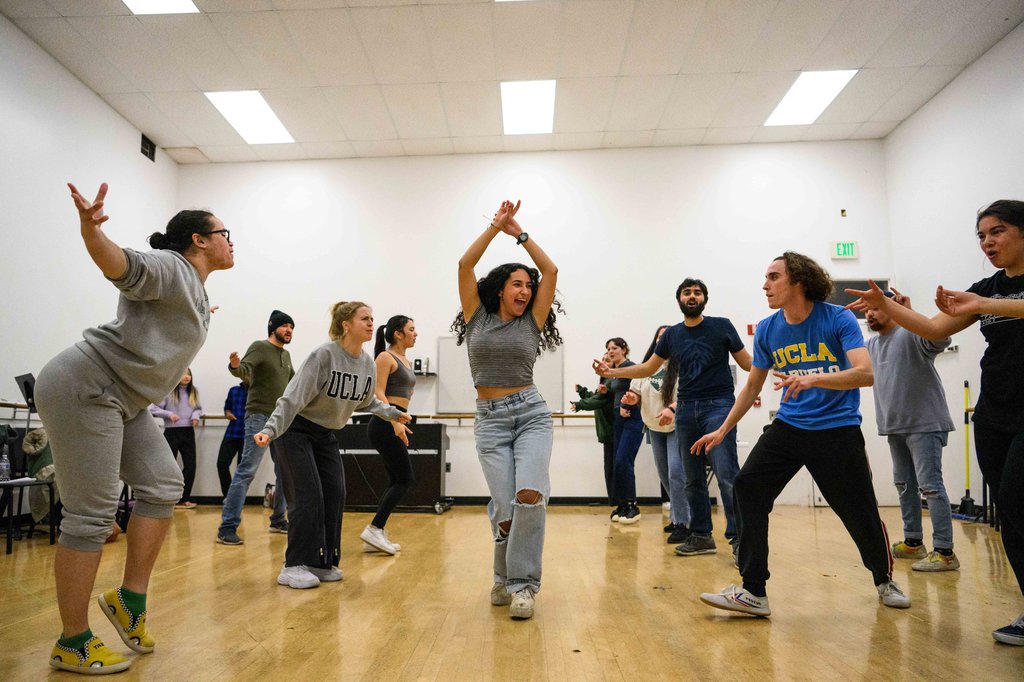
Since 2017, the Color Box has aimed to create an inclusive performance space for students at UCLA. Each quarter, the student-run organization aims to push the boundaries of contemporary performance art. Keeping with this tradition, the company is performing Lin-Manuel Miranda and Quiara Alegría Hudes’ "In the Heights" in the winter. The musical tells the story of the dreams and struggles of a tight-knit Latino community in Washington Heights, New York.
Isaiah Mateas, the director of "In the Heights" and a third-year theater student, said the Color Box chose the 2005 show because they wanted to perform a piece already centered on minority communities. Although the company has reimagined older works, such as a sapphic production of "Grease," in the past, Mateas said he felt it was time to take on a work specifically exploring themes important to marginalized groups.
For Madurya Suresh, a third-year linguistics and computer science student and the company’s managing director, diversity in theater is not just a concept – it’s a commitment. In her previous theater experiences, Suresh said she was acutely aware that her peers did not look like her. In comparison, the Color Box offered her a safe platform to proudly tell the stories of marginalized communities. She pointed to how the company’s current musical allows students to infuse elements of Los Angeles’ own tight-knit Latino community into its production.
The rehearsals felt very much like the musical itself: a vibrant community.
Surrounded by a cornucopia of pizza boxes and Veggie Grill takeout containers, the cast and crew came to life in a hodgepodge of low-rise skinny jeans and sweatpants. Bursts of vocal riffs and choreographed dances were interrupted by jokes, and Mateas himself continuously stepped into the performance space to build chemistry between his actors.
The cast specifically experimented with minute character interactions in the musical’s titular ensemble number to establish familiarity among characters whom the audience doesn’t know. Small details, such as the ladies of the hair salon walking in coordination with each other and strategically angling the performers diagonally across the stage, contributed to Mateas’ vision of the production.
During a rare rehearsal break, second-year theater student Al Hiciano De Gongora and first-year playwriting graduate student Mario Vega stepped outside for an interview. De Gongora plays Abuela Claudia, the matriarch and acting grandmother of the "In the Heights" barrio. Vega plays Kevin Rosario, the endlessly proud father of one of the main characters, Nina.
For De Gongora, who has a Dominican and Cuban background and was born in Puerto Rico, "In the Heights" closely resonates with their identity. De Gongora said their character reminds them of their own mother and grandmother. All three women fled from Cuba to the United States, and De Gongora attributes their current life and opportunities to their family’s courage.
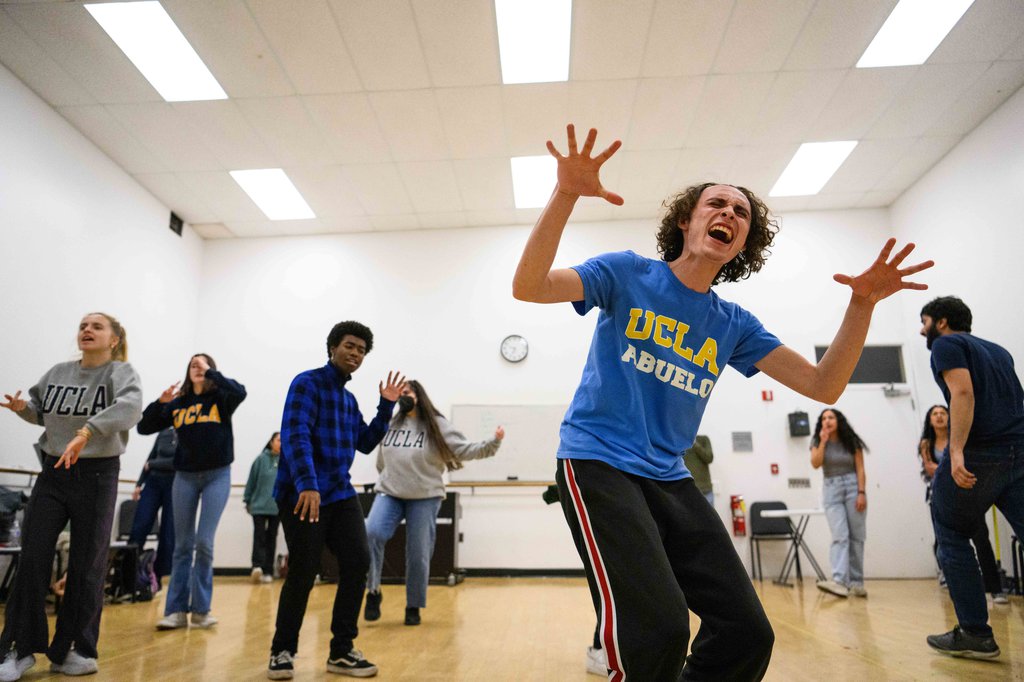
More importantly, the members of the Color Box understand what it is like to be a minority, De Gongora said. Learning that the performance space was supportive of people from all backgrounds was especially significant to them.
Vega said "In the Heights" balances the whimsical escapism of musical theater with the real-world struggles people of color face today. While older pieces of theater offer an escape from reality, Vega said people of color often don't have the luxury of escaping from constant prejudice and marginalization. "In the Heights" strikes a balance of accurately portraying xenophobia and gentrification while also using a magical neighborhood of singers and dancers to add some levity, he added.
As if to illustrate his point, he was interrupted by a burst of music from one of the musical’s ensemble numbers "96,000," in which the characters discover the bodega has sold a winning lottery ticket worth $96,000 and wonder what they would do if they had a small fortune.
"I mean, they're dancing about money right now," Vega laughed.
At another rehearsal across campus, there are no choreographed musical numbers, but the fervent exchanges of old English are equally energizing.
The Shakespeare Company at UCLA aims to reinterpret Shakespeare’s works to reflect modern realities. Past productions include "Ophelia," as well as a rendition of "King Lear" that reinterpreted the play as a dark comedy illustrating the tumultuous state of American politics.
The director behind this quarter’s production is Cerulean Long, a second-year theater student. Long chose to direct her all-time favorite play, Joe Calarco’s 1998 piece, "Shakespeare’s R&J," which is about four students in a Catholic school who find a creative outlet by sneaking out to rehearse Shakespeare’s "Romeo and Juliet."
Some audiences may think "Romeo and Juliet" is just an overdone love story, Long said. But because the Shakespeare Company at UCLA’s rendition of "Shakespeare’s R&J" emphasizes and explores gender roles, the story remains pertinent today, she explained.
The original "Shakespeare’s R&J" focuses on four Catholic school boys, but the Shakespeare Company at UCLA’s production translates the narrative into a sapphic love story set in a dystopian future, tackling themes of lust, liberation, disobedience and conformity, Long said. The freshness of Shakespeare came to fruition in Macgowan Hall 101, where the cast and crew of "Shakespeare’s R&J" lounged in foldout chairs and laughed about astrology signs before rehearsal in a sparsely furnished dance studio. However, their body language shifted from lighthearted informality to focused intensity as they began their first read through.
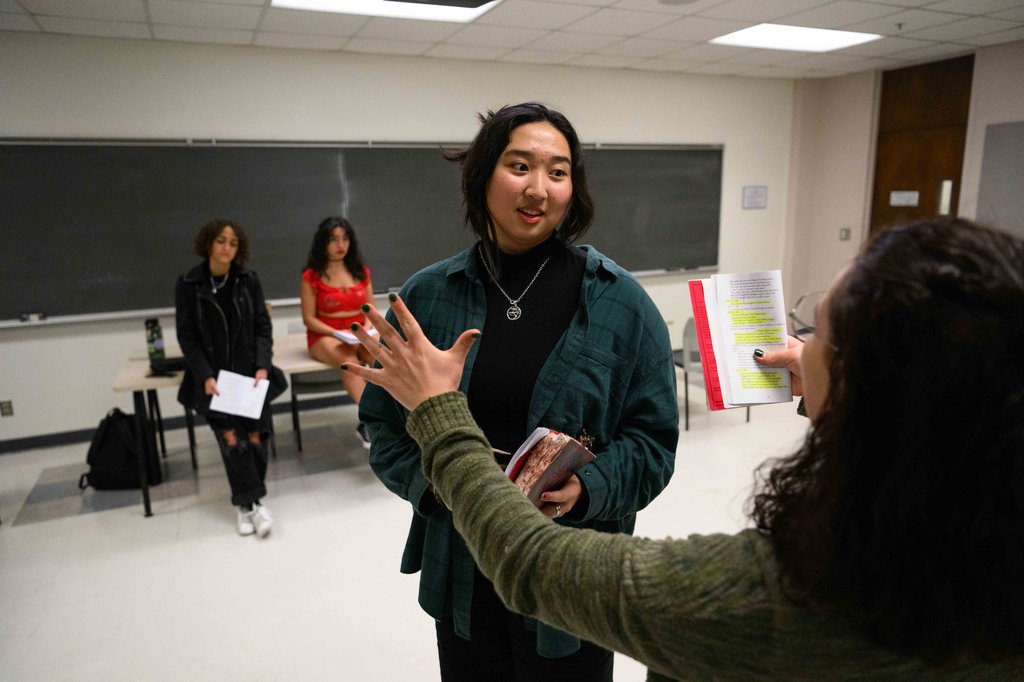
Throughout the play, the main characters, aptly named Students One, Two, Three and Four, faithfully recite Shakespeare’s Old English text. Shakespeare’s language, once so familiar, is transformed as they take on unique personalities suited to the 21st century. A particular recitation of "Sonnet 18: Shall I compare thee to a summer’s day?" was hot-blooded, thrumming with the intensity of restrained adoration rather than its expected tenderness.
Ellie Chun, a first-year psychology student, portrays Student One, the play’s bold protagonist and Romeo figure who encourages her fellow students to sneak out and recite a prohibited copy of "Romeo and Juliet." At this point, the play moves from modern English to the language of the bard. Chun empathizes with her character, who knows that the world doesn’t accept her queerness and uses "Romeo and Juliet" as an outlet for freedom.
"I see her (Student One) very much as someone who's trying to explore and grow but doesn't really know how," Chun said.
Emily Fritz, a third-year English student, plays Student Two, the adaptation’s equivalent of Juliet. In contrast to original performances of "Romeo and Juliet," in which only men were able to perform, "Shakespeare’s R&J" is a nuanced exploration of what love means for women without men present, Fritz said. Through "Shakespeare’s R&J," audiences can analyze the concept of love itself from a female perspective, she added.
"We’re figuring out how to craft it (Shakespeare’s work) in a way that we can still use his words to discuss our modern world," Fritz said.
On the surface, the Shakespeare Company at UCLA’s "Shakespeare’s R&J" seems to live in stark contrast to the Color Box’s "In the Heights"– and cast members in both groups expressed different opinions on the value of tradition in theater.
Between practicing elaborate choreography and workshopping dialogue inflections, De Gongora said updating and diversifying traditional plays is important. However, they added, this work often overshadows newer works created by people of color.
Vega agreed, acknowledging that Shakespeare’s stories continue to influence media today but advising theater companies to focus on works that reflect and champion their local communities instead.
"Take a risk on some new work," Vega said. "Shakespeare is just some dude. Everyone is just some dude."
However, other students continue to find magic and opportunity in centuries-old work. Blaire Battle, a fourth-year theater student and the executive director of the Shakespeare Company at UCLA, said they fell in love with Shakespeare because of the ubiquitous influence of his text. After studying enough Shakespeare, they realized his work, perhaps surprisingly, lends itself to gender bending and fluidity.
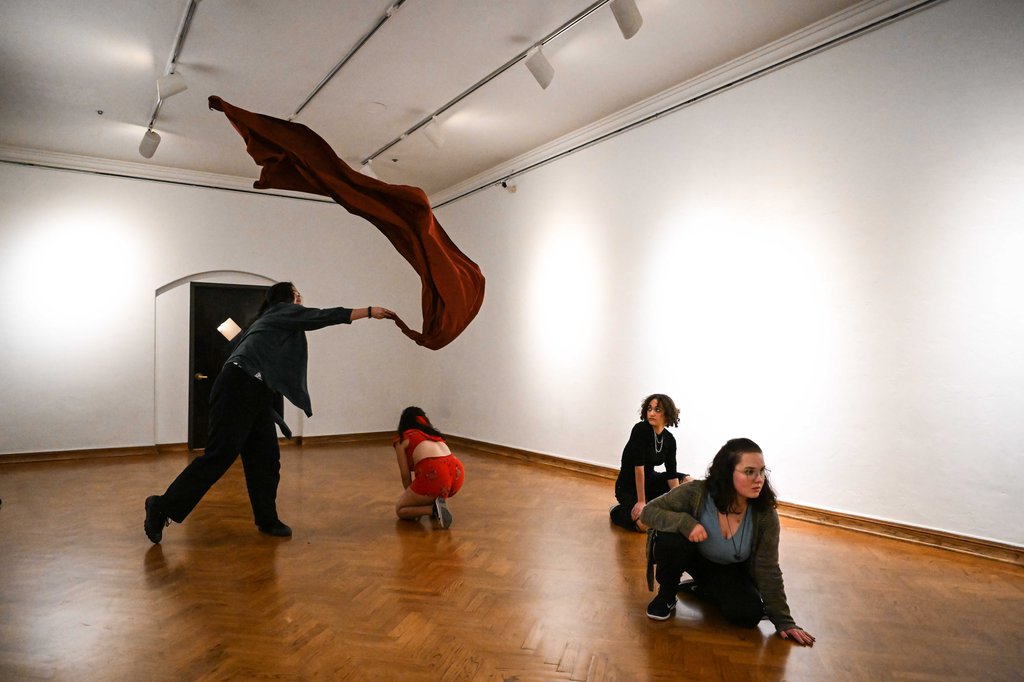
Battle said the reason Shakespeare’s works are so easily reexamined as queer stories is partially because they have always had the potential to be queer. Despite popular notions, queer people have always been around, they said.
"Shakespeare wouldn't have called it this, but I think modern scholars would just call (his productions) camp. There's a fun to it. I find (it) endlessly refreshing," Battle said.
Despite their different choices in the texts they choose to perform, members of both companies strive to assert themselves in an industry that has so often excluded them.
Brooke Lebidine, a second-year theater student and associate director of "In the Heights," said a major focus of the Color Box is ensuring their performances are informed by the actors’ backgrounds and lived experiences. The company’s selection of productions is always deliberate, she added, pointing to last quarter’s performance of "Jane: Abortion and the Underground," which focuses on the history of abortion rights in Chicago and reflects ongoing debates about states’ anti-abortion laws.
De Gongora added that diverse narratives can unite audiences, even if people feel that they can’t personally relate to others’ stories.
"It's the moment you sit in the theater and actually go, that you realize that we are all more like each other than we think," they said.
In a similar vein, Chun said something clicked when she saw "Romeo and Juliet" as a queer allegory. Juliet’s refusal to marry Paris transforms from resistance toward an arranged marriage, something uncommon in the U.S. today, to defiance against compulsive heterosexuality – something the queer community can relate to.
"I'm really excited for them (queer people) to come to see it and for them to experience Shakespeare in the way that I have," Chun said.
According to Battle, there is no good or bad art. There is only art that grips audiences and art that doesn’t, they said. As an art form, theater and its underlying stories continue to be relevant because they can be understood by anyone.
"Theater is an empathy machine," they said. "The best thing we can do is try to allow different people to plug into that machine to generate empathy and keep telling stories that are so important."