
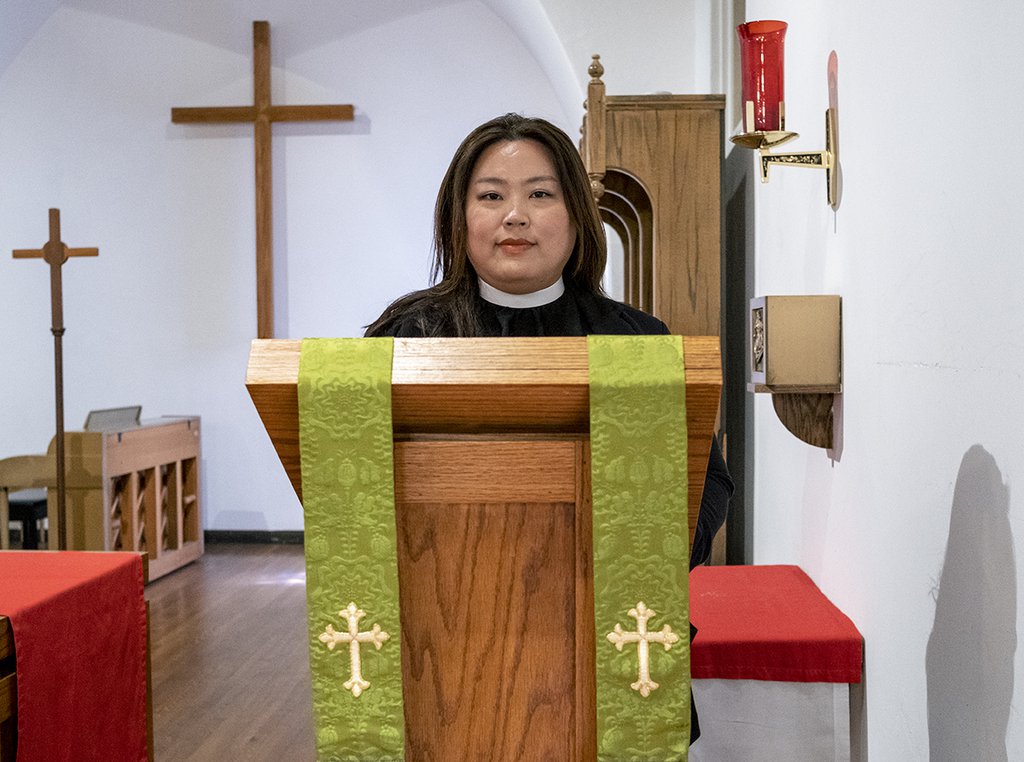
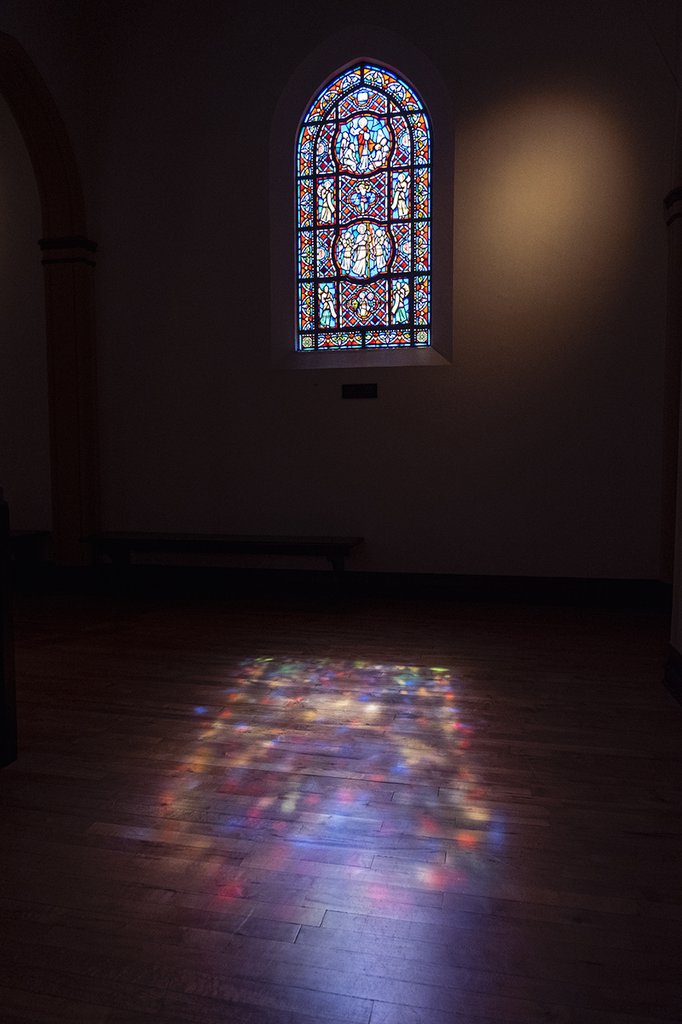
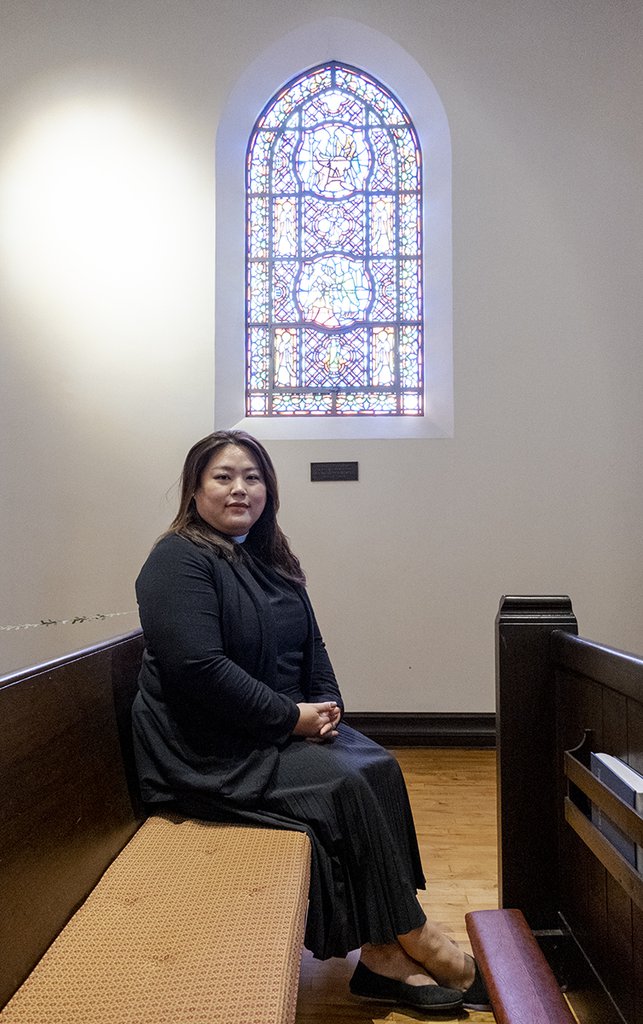
Seated confidently at a grand desk before multicolored stained glass, her white clerical collar peeping through her long black cassock, Rev. Yein E. Kim felt refreshingly normal.
Although she is one of the mere 20% of women in the United States clergy, Kim seemed at home in her office at St. Alban’s Episcopal Church. She is only the second female reverend to serve at St. Alban’s, which was founded in 1931.
The church, nestled between the sorority houses on Hilgard Avenue, is closely connected with UCLA and its students – some of whom Kim preaches to at weekly Sunday services.
Six years after UCLA moved to Westwood, St. Alban’s was purposefully situated near the new campus in order to serve students. Almost a century later, the quaint Westwood church has far from forgotten its close kinship with the university.
At a time of widespread secularization, Kim said St. Alban’s hopes to focus on recruiting college students to join their church community. The reverend believes religious affiliation among college students has decreased because young people feel disillusioned by the more traditionalist culture that dominates Christianity.
According to the annual Cooperative Institutional Research Program Freshman Survey, which tracks the views of incoming college students, the number of students who indicate a lack of religious affiliation has increased from 10% in 1986 to 31% in 2016.
Although some may consider “progressive Christianity” an oxymoron, St. Alban’s congregation characterizes itself as just that.
On Halloween in 2019, St. Alban’s hosted a performance of “Rocky on Halloween: An Act III Horror Cabaret Show,” featuring students from the UCLA School of Theater, Film and Television. Naturally, the show included drag queens.
“The first time I heard it, I literally thought it was a joke when they told us that it was at the church,” said Lauren Stevens, a third-year theater student and performer in the show. “It wasn’t really mentioned until we were at rehearsal and they were like, ‘Oh, we’re doing this at a church by the way.’”
The prospect of performing a show like “Rocky Horror” – known for its vulgarity – at the church came as a welcome shock to many of the show’s performers.
“It is the perfect juxtaposition to have two men grinding on each other right in front of the literal giant cross that hangs in the basement of St. Alban’s,” said fourth-year theater student Isabella Navarro.
Navarro, who performed in “Rocky Horror,” said that she sometimes feels her arts education is not prioritized by UCLA as much as other endeavors, like athletics.
“I love UCLA, but we all know the state of arts and arts education: It will never take priority, it will never be number one,” Navarro said.
St. Alban’s, however, was different. By the time it housed “Rocky Horror,” the church had been a known supporter of UCLA theater productions.
“But then there are places like St. Alban’s that open up their doors and let us have our fun and be creative,” Navarro added.
Struggling to fight back tears, she shakily described how the experience of performing at St. Alban’s struck a chord for her.
“To have rows of queer kids feeling safe in the basement of a church, that is a very special thing,” Navarro said.
According to Kim, the Episcopal Church is known for its tolerance. It remains one of the few denominations that allow the clergy to marry and that support women and members of the LGBTQ+ community joining the clergy, Kim said.
But that’s not to say that there aren’t ongoing debates about how progressive the church should be.
Despite St. Alban’s support of UCLA arts and the queer community, Kim grew noticeably reserved when asked if the church would be willing to host shows like “Rocky Horror” in the future.
“I would be shocked if those shows were held here at this moment with my parishioners being here,” Kim said.
Although she believes the church is meant to serve the whole community, she needs to prioritize her parishioners.
“I was talking to my parishioners about how far can we go. At what point do we say, ‘This is not OK to do in the church?’ and the consensus was rather conservative,” she said.
Formerly a political science student at Korea University, Kim felt a pull toward church leadership as she came to believe that was where she would have the most impact. In 2014, she received her master’s of divinity at the Episcopal Divinity School in Cambridge, Massachusetts. And by June 2020, she was the new rector at St. Alban’s once its first female reverend retired.
As a young child in Korea, Kim never fathomed being a female member of the clergy – even growing up as the daughter of a priest.
“When I was growing up, there were no female priests,” Kim said. “It definitely wasn’t an option.”
As a young woman, the female church leaders Kim saw were often pushed into assistant roles and were certainly not rectors. She wasn’t exposed to many ordained women until she came to the United States, she said.
As she transitioned into her role, Kim was hyper-aware of how few people in church leadership looked like her. She was keen not to take it for granted, and actively worked to represent her community in the hopes of normalizing women of color in church leadership.
“I said yes to everything – like every conference, every talk ... because if I wasn’t there, there would be no Asian female of color,” Kim said. “My goal is that a girl, (an) Asian girl, walks into the church, sees me preach and she doesn’t think that’s special.”
This openness to diversity is what originally drew UCLA alumnus John Hirning to St. Alban’s over two decades ago. Hirning was introduced to St. Alban’s at a Long Beach Pride event during his sophomore year of college, and he has since remained a faithful member of the congregation for the last 23 years.
“One of the things that attracts me to it is nobody is excluded,” Hirning said. “If you want to be a conservative person, you are welcome, if you want to be a liberal person, you are welcome. ... That sort of diversity has always been present at St. Alban’s.”
Back in 2008, Hirning experienced a defining moment during his time at St. Alban’s. At the time, gay rights weighed heavily on the nation’s conscience after California’s passage of Proposition 8. The constitutional amendment narrowly defined marriage as between a man and a woman, rejecting same-sex couples.
As California’s own progressiveness was called into question, St. Alban’s faced inner turmoil as the congregation deliberated over hosting a gay marriage at the church. A teary-eyed Hirning described an especially pivotal discussion he had with Rt. Rev. J. Jon Bruno, former Bishop of the Episcopal Diocese of Los Angeles.
“So we are having this conversation and, at one point, the bishop says something to the effect of, ‘If we’re not going to do gay marriages, if we’re going to tell these people that they are not welcome, ... we shouldn’t be in the business of doing straight marriages either,’” Hirning said.
Asked if there have been more gay weddings held at St. Alban’s since then, Hirning lit up.
“Absolutely, including my own!” he said.
Kim expressed that this is a tradition she intends to uphold as a reverend.
“I know that might not be true in many churches, but definitely this church and this denomination, definitely would not blink an eye in most cases like that, ” she said.
However, Kim acknowledged that, like many other churches, St. Alban’s is always trying to catch up.
“The church should be like 10 years ahead of the society but, in reality, we are like 20 years behind,” she said.
On one hand, St. Alban’s and the Episcopal Church as a whole have made strides in electing more female clergy members – including Kim. Between 1994 and 2017, the percentage of clergywomen in the Episcopal church tripled in size.
On the other hand, notable disparities remain.
For instance, Kim pointed to the gender pay gap that still plagues the church. According to the Church Pension Group, as of 2019, male clergy members in the Episcopal Church were paid $10,000 more on average than female clergy members.
Kim also said that St. Alban’s remains more than 90% caucasian, which doesn’t represent the broader Westwood community, including UCLA. But this disparity is something she hopes to change.
Although St. Alban’s has wavered in its relationship with the UCLA community in recent years, Kim said she has been working hard to turn that around.
“I think it just doesn’t make any sense for us to not engage since we are so close with the students,” Kim said.
Kim acknowledged that young students might feel alienated from the church because they believe that Christianity is in competition with their socially liberal perspectives. She hopes that by stressing the openness of her church, students might feel safe enough to come to St. Alban’s.
Awaiting such students at the entrance to the church is an eye-catching banner celebrating the arrival of Kim as the new priest.
“Welcome! Rev. Yein Esther Kim, St. Alban’s New Rector,” the sign reads.
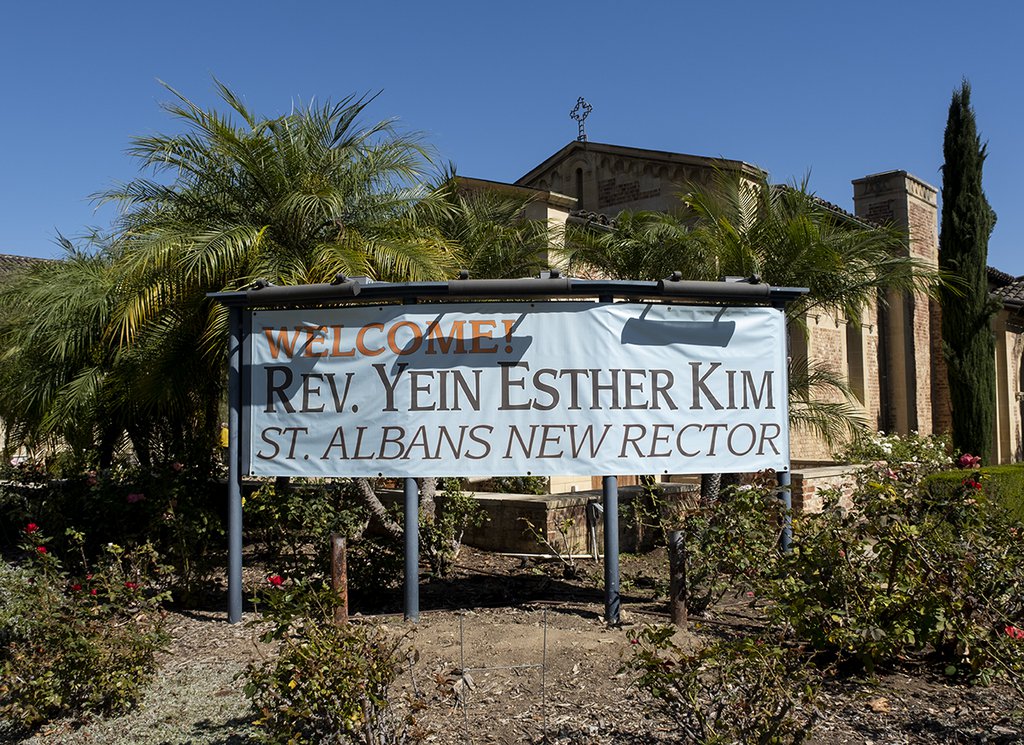
The welcoming hand St. Alban’s has extended toward a young Korean American clergywoman mirrors Kim’s own mission to include the diverse members of the Westwood and UCLA community in her congregation.
“The biggest motto that the Episcopal Church uses is ‘(The) Episcopal Church welcomes you,’ and we really try to mean that,” Kim said.