
Old mattress. Toy pig. Bird scooter. An ex’s clothes. No item is too bizarre for the Roebling fire.
As a resident of Roebling Avenue, I am no stranger to these fires. I sometimes watch them grow from the comfort of my balcony, and I sometimes stand in the crowd where the action happens. Every item thrown in the fire has its own story, all of them burning together to uphold a UCLA tradition.
Each Roebling fire starts as a small blaze in the middle of the street. Before long, swarms of students surround the flames, contributing random items to a large rubbish fire. These fires complement Westwood’s party scene, often serving as spontaneous celebrations of UCLA Athletics’ victories. To some, the fires facilitate a close-knit student culture. But to others, the fires pose danger to gathering students, Roebling residents and their property.
The origins of the tradition are unclear. According to a statement from UCPD spokesperson Lt. James Echols, fire activity on Roebling Avenue dates back approximately five years. Roebling residents know that the times and the dates of the fires are sporadic, with no official way to anticipate a coming fire. The only commonality among the fires is their connection to Roebling Avenue.
People get creative to spread the word about these spur-of-the-moment fires. Several sources told me announcements about the fires are conveyed by word-of-mouth. One student reported hearing about the fires through a written note on her Duffl delivery. I usually rely on a Roebling residents’ GroupMe chat for fire announcements. Someone always sends a heads-up through the chat, allowing me and my roommates to move our cars to safety.
No person or group openly claims responsibility for the fires. Some students suspect that the person who starts the fire is different every time.
One alumnus, who requested anonymity because of legal concerns, described their experience starting the fire as an impulsive decision. During a night out in Westwood, one of their friends informed them that the Roebling fire would be starting soon. But once they arrived at Roebling Avenue and found no fire, they decided to take matters into their own hands.
"Usually, I’m not the type to take charge and start a fire," the student said. "But I had a couple of drinks in me and saw there was literally a couch on the side of the street untouched."
The student dragged the couch into the middle of the street, where they used a friend’s lighter to start the flame. Another acquaintance brought some lighter fluid and drizzled it around the couch. Before long, people began crowding around and piling debris onto the blaze just like any other Roebling fire.
While it was only the student’s second time attending the fire, they said they were unafraid to light the flame themselves. They believed the fire’s status as a UCLA tradition served as a form of protection from legal consequences.
After someone starts the Roebling fire, the entire crowd works to keep it alive. With each person’s contribution, the fire grows, attracting the attention of passing students and inviting more and more people to join, said third-year microbiology, immunology and molecular genetics student and Roebling resident Mrudula Akkinepally. The crowds of people help hide the perpetrator.
"I don’t really know if it's one specific group of people," Akkinepally said. "I think it’s just students."
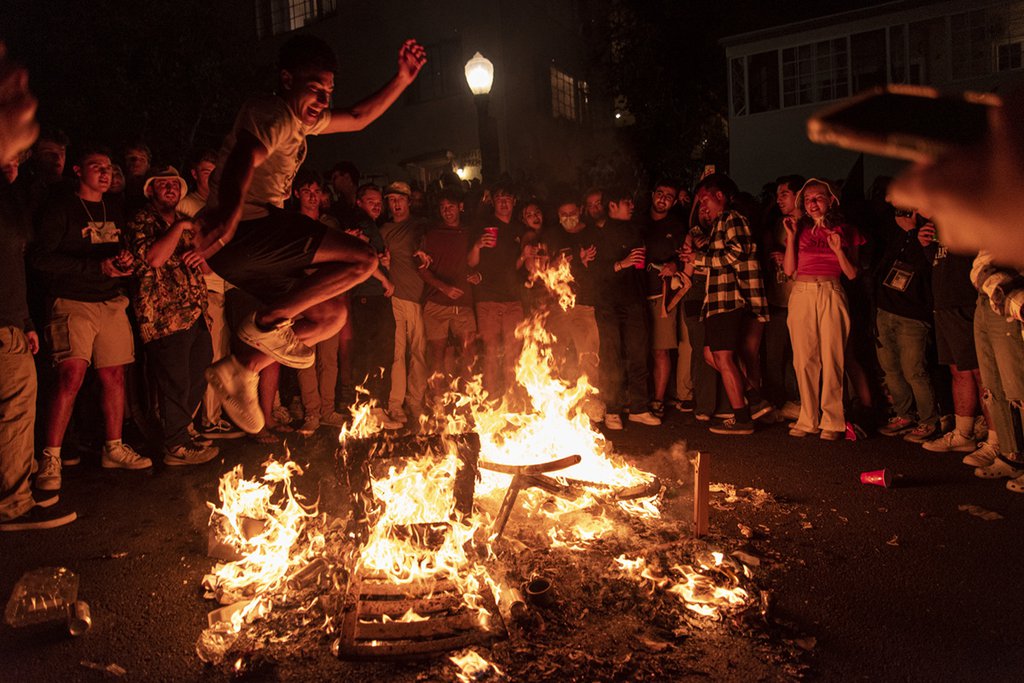
Despite the mystery surrounding the fires, many students find value in the tradition. Third-year human biology and society student and Roebling resident Maya Johnson said the Roebling fires encourage greater interest in UCLA sports games and boost the morale of the teams, enticing Bruins to show up to big events.
Third-year molecular, cell and developmental biology student and Roebling resident Faith St. Amant explained how the fires contribute to the pride of being a Bruin.
"It's a super crazy, wild, fun thing," St. Amant said. "It's one of those traditions like the Undie Run that needs to happen."
Although I have only lived on Roebling this past year, the fires have been a central part of my UCLA experience. I will never forget my first time witnessing the event. Standing within a massive crowd, I watched my fellow classmates chanting together, throwing trash into the captivating blaze. As a freshman, I initially struggled to find my place within UCLA and felt uncertain that I would fit in. But celebrating the fires with other students made me feel connected to UCLA and my peers.
Regardless of the commemoration associated with these fires, they do pose a risk of danger. In March, St. Amant witnessed a car melting due to a Roebling fire. St. Amant sympathized with the owner of the car and said others echoed this feeling, which was evident through a GoFundMe page created to help take care of the damages, she said.
I have heard stories similar to St. Amant’s and seen GroupMe messages announcing that the fires will proceed regardless of whether cars are moved. These warnings have stoked my fear. I remember running to the buses at the Rose Bowl following a football victory this fall, hoping to beat the mass of people heading back to Westwood so that I could move my car. Luckily, I made it home just in time, with the fire starting a mere 15 minutes later.
During another fire this fall quarter, I witnessed the battery of a Bird scooter explode after being thrown into the blaze. While nobody got hurt, that blast spread the fire closer to my apartment, a poignant reminder of the fire’s possibility for destruction.
A Roebling fire usually burns until the arrival of the Los Angeles Fire Department and UCPD, which work in tandem to diffuse the fire and the surrounding crowd. This process can take four or five hours and cost up to $60,000, said LAFD Capt. Brian Russell. He added that the LAFD’s time and equipment used to combat these fires could contribute to the dissatisfaction of the surrounding Westwood area residents.
"You’re taking an emergency resource out of service to put out a rubbish fire that someone lit intentionally," Russell said. "That is where I think the students don't really see the big picture."
When asked about the Roebling fire tradition, Echols affirmed the dangers associated with rubbish fires.
"This activity is illegal and poses a significantly unsafe environment for students and our Westwood Village community," Echols said in a written statement. "We highly encourage students to use good judgement and consider the safety of others with the activities they engage in."
Despite his concerns, Russell expressed some sympathy toward the tradition, describing it as a way to build school spirit and unify the student body.
"They're not setting these fires inside the buildings, they're not setting them next to cars, they’re not setting them intentionally next to something that can catch fire," Russell said. "They're actually putting them out in the middle of the street. They’re trying to celebrate a tradition I guess that's been going on for many years at UCLA."
Even during his very first experience with the Roebling fire, Russell understood this celebratory dynamic. As he prepared to fight the blaze, he navigated his truck through a crowd of 400 to 500 students. Suddenly, a student climbed into the firetruck and began messing with Russell’s firefighting gear. Having never witnessed such behavior in his 25 years of experience, Russell felt this crossed a line and reprimanded the student. But Russell quickly determined there was no malice behind the student’s actions. Rather than handing him over for arrest, Russell hugged him and let him go. The attendees cheered for the heartfelt moment.
Second-year economics student Justin Dargo echoed Russell’s sentiments, noting that the Roebling fires are not ill-intentioned but instead serve as an example of student culture.
"For the kids who don’t want to join the whole fraternity, sorority or party scene, it gives them a time to be able to join everyone else," Dargo said. "It’s more of just an open thing for the entire UCLA community."
I remember watching a group of girls at a Roebling fire distribute an armful of clothing among themselves. Together, they ran up to the blaze and tossed the garments into the flames as a team. Whether I am throwing in a ripped-up couch pillow or an old basketball from my job, the fires create an opportunity to relieve clutter in a sentimental way. Yet, as a resident of Roebling this year, I cannot ignore my fear for my car and my home should the fire department not make it in time.
St. Amant said the Roebling fires create lasting memories of her time at college. As a student who never got to live on the Hill, St. Amant feels that the fires help facilitate that missing unity.
"The pros definitely outweigh the cons because student tradition is such a huge part of what it means to be an undergrad and be a Bruin," she said. "Stuff like the fires bring us all together."
Contributing reports from Mallory Cooper, PRIME contributor.