
Crossing Trader Joe’s at golden hour, I watch as students take on grocery shopping in pairs, parties and alone. As the clock nears 4 p.m., parents and children start to fill the store. Three women gaze intently into the yogurt aisle as Hawaiian shirt-clad staff bustle around. I smile at the sight of a shopper – basket in one hand, not-so-small dog under the other.
A Trader Joe’s employee recognizes me after my third pass around the store with a different student – I worry at first, but am quickly reassured by his smile and chuckle. Forging ahead, I spark up conversation with the next available basket-laden Bruin.
Armed with grocery bags and coupons, UCLA students learn to bear the added weight of budgeting, meal planning and caring for themselves away from home. Students from beyond the West Los Angeles region navigate additional changes, such as accessibility and managing finances. Curious about their attitudes and strategies during this transition, we set out to find answers among the aisles of Westwood’s grocery stores.
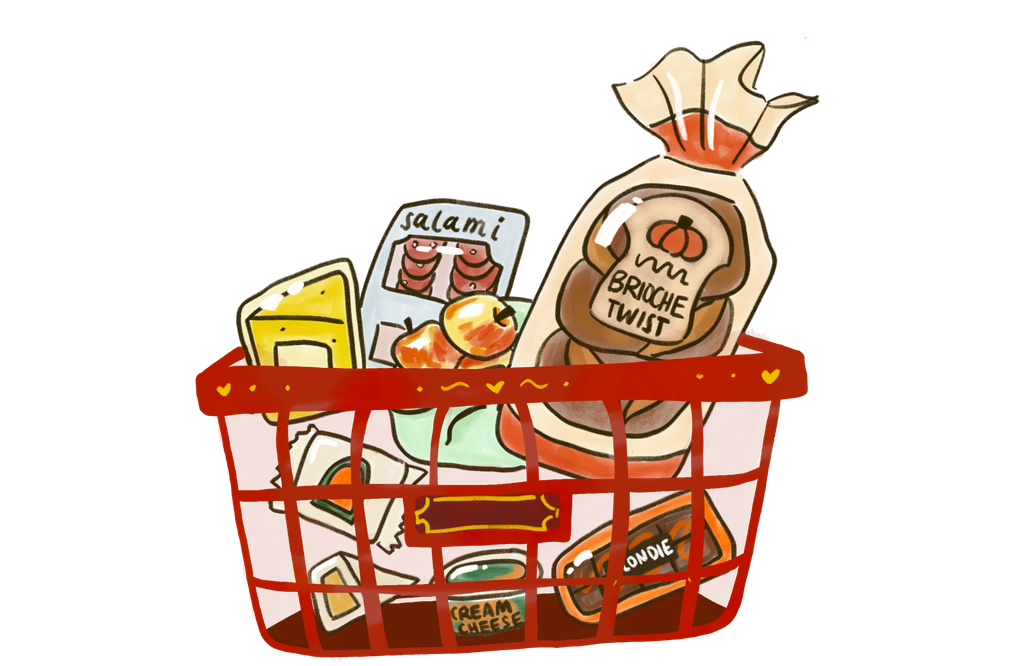
Amid colorful signs and a cacophony of voices, I spot two students conversing across the Trader Joe’s produce aisle. Preparing for a housewarming charcuterie party, Kalani Emde and Shonan Chiang deliberate goat cheese’s popularity and warmly recount their recipe-creation adventures.
The pair bonded over attempting TikTok recipes in the Saxon Suites. But in their current off-campus apartment, Trader Joe’s fuels some of their midnight creations. Most recently, Chiang said they fashioned a tower out of pumpkin brioche, pumpkin butter and cream cheese to accompany their late-night show.
The shift from living on the Hill to an off-campus apartment has also come with a need for greater economic awareness, said Emde, a fourth-year molecular, cell and developmental biology student. Among the grocery stores in Westwood, she said Trader Joe’s offers the most variety and affordability — not to mention its seasonal treats and produce.
"Be grateful to still have B Plate," Emde chimed in.
Chiang, a fourth-year human biology and society student, also mitigates costs by purchasing essentials in bulk from Costco – such as Greek yogurt, steak, deli turkey, pretzels and cottage cheese – which her parents pick up during their visits from San Diego. While the bulk portion sizes can mean temporarily repetitive diets as they battle spoilage, the students still opt to shop for essentials there.
Kayla Diep browses Trader Joe’s for its unique snacks and frozen meals when food on the Hill gets repetitive. The second-year biology student added that Trader Joe’s is the most affordable among Westwood’s grocery stores, though it is still marginally more expensive than her hometown’s location in the Inland Empire. While it may not be essential, Diep said she finds joy in grocery shopping.
"It’s a nice escape," Diep said. "I feel like I’m exiting the simulation of school."
Diep isn’t the only student who shops for leisure.
Although Stella Lau has finished her grocery shopping for the week, her lackadaisical walk to Whole Foods Market reflects her typical grocery shopping style. A Ralphs frequenter otherwise, the second-year psychology student enters without a grocery list and relaxes while shopping, using the trip as a relaxing break. She and her travel companion, second-year mathematics student Carlos Martin, enter the higher-end store around 9:30 p.m. for a leisurely late-night stroll to browse for snacks. As she scans the wall of assorted carbonated drinks, Lau reminisces on life at home – where grocery shopping was more labor-intensive than relaxing.
"Shopping for a family is a lot," Lau said. "Someone’s got to help them with the grocery bags. Also, I don’t want my mom to feel lonely. I feel bad, (so) I’ll just be like, ‘I’ll come with you Mom!’"
In the Trader Joe’s flower section, I find Julieanna Li. She meanders around the grocery store she visits as a go-to for snacks. The shift from being fed by parents to feeding oneself can be a challenge, explains the third-year data theory student from Indiana. Living independently made her better understand her parents’ strong aversion to wasting food. She still prefers, however, apartment living to the dorms because she has more freedom over everyday choices.
Nearby, in the drink aisle, I spot Amelia Jeffs on the phone deliberating the best lemonade flavor to purchase. Hailing from northern California, the third-year psychology student said her hometown grocery stores are similar to Westwood’s – making shopping decisions familiar and easy. She said she typically purchases produce from Whole Foods for its longevity and opts to buy frozen meals from Trader Joe’s. In their off-campus apartment, she and her roommates typically share a few essentials such as milk, condiments and spices, but their differing schedules mean they primarily shop for themselves.

For Li, the lower cost of living informed her choice to live off the Hill. On the Hill, Li recalls several instances where her peers wasted food, either from not eating to-go order leftovers or missing meal periods on a Regular plan. In the off-campus apartments, Li can make all the food she wants and save leftovers for another day. Apartment living also allows for the bartering of responsibilities, such as Li’s roommates occasionally cooking in exchange for her doing the dishes.
Carpooling from their off-campus apartment, roommates Sharon Park and Kendall Gomes shop to accompany each other and split their Trader Joe’s bill. Park, a fourth-year sociology student, said living in the apartment has made her cook more frequently, because eating out every day is unsustainable. On the other hand, leaving the Hill brought money to the forefront of Gomes’ mind.
"Living on the Hill, you get all the food through a swipe, so it doesn’t feel like real money," the third-year economics student said. "So now it’s like, ‘I have to pay for this.’"
Peering over the pair’s moderately full grocery cart, I ask how they divide the cost of groceries. Since the roommates were close friends prior to living together, Park said they often share common goods such as cream cheese and bread. For instance, she doesn’t mind footing the ketchup bill for the group, since her roommates would do the same.
I emerge from Target’s toilet paper aisle to find another set of roommates discussing canned goods. As an alternative to dining hall breakfasts, Caryn Dea said she opts to make grab-and-go items such as overnight oats in her dorm. The first-year human biology and society student’s decision is a product of having a 14P meal plan and limited time before early classes. First-year political science student Skyler Dang said Westwood’s Target prices are higher compared to the Foods Co. and Safeway the pair frequent in San Francisco – enough even to merit checking Amazon for cheaper products.
Discussing the feeling of "adulting," Dea adds that Dang is awaiting the results of her Electronic Benefits Transfer interview, which she had earlier in the day. Although most students with meal plans do not receive approval, Dang said she is hoping for the additional financial support.
The recent government shutdown led to a temporary loss of benefits for recipients of California’s Supplemental Nutrition Assistance Program, CalFresh — including EBT or Food Stamps. While it has since reopened, repercussions for students are expected to continue. On an emergency grocery run to Whole Foods, Vicky Gao notices price increases and expressed concerns over losing EBT access if she decides to move back home post-graduation. In the meantime, the fourth-year psychology student utilizes resources such as the Wednesday free grocery distributions at the Tipuana University Apartments.
I encounter Romy Billard and Joshua Coenraads in Ralphs, two second-year business students in UCLA Extension, debating the freshness of the store’s beef. Billard said she feels more reassured going to Trader Joe’s because more students go there, but found herself at Ralphs because of its late hours.
Billard also mentions her fears around getting sick from California’s differently regulated products, such as eggs not vaccinated for salmonella. Billard also said she finds foods significantly sweeter in the United States than in her home country of France, but is embracing the new default sugar content during her year in the U.S. Compared to shopping at home, shopping as independent adults in Westwood made her buy less frequently.
Justin Dixon strategically comes to Ralphs with an empty backpack and a cooling bag. The fourth-year economics student usually visits only one grocery store Sunday mornings before it gets crowded. As Dixon walked around the fresh produce and meat aisles, he explains that he tries not to let price limit his food choices.

Equipped with a mask, cap and grocery list, Sky Kaufman pushes a Ralphs shopping cart with a foldable, fabric grocery cart nestled inside. Too many trips carrying two bags and a backpack left them with marks on their shoulders, prompting them to use the cart they received for their birthday instead. While examining vegetables for plastic film, the third-year design media arts student notes the difference in taste between organic and non-organic bell peppers.
Worries about rising prices initially led Kaufman to prioritize how far they could stretch their food, but they soon recognized this difficulty – especially when considering expiration dates and making balanced meals. All in all, they enjoy their time in the grocery store, using it as an opportunity to call their family and pick up a bag of sea creature-themed chicken nuggets.
A quarter before 10 p.m., patio chairs block the Whole Foods entrance, and an announcement on the speakers cordially informs shoppers to wrap up and leave. As if the announcement fell on deaf ears, there is no visible urgency in the grocery store patrons – but cashiers gain newfound excitement as closing draws near. The metropolis sky darkens with light pollution, marking the young bustling of a college town Saturday night.
Behind a bag-and-skateboard-wielding student, I, too, exit the grocery store.