
It’s 8:15 a.m., and I’ve beat the morning traffic. I have just enough time before my Chem 14D lecture to apply eyeliner. The result is shaky, as I have only the car’s rear view mirror and the dim overhead bulb as a light source.
For about a year, this was my daily routine. I spent my freshman and sophomore years as a commuter student, enduring countless hours navigating Interstate 405 and Interstate 5 freeways to arrive on time for class every day.
After several quarters of taking the bus, I received a coveted parking pass to my preferred lot: Parking Structure 7. I did not take this parking spot for granted. Near Bruin Walk and a short walk from South Campus, Lot 7 was the perfect choice for a student like me: a STEM student who often left campus late due to club events – or to avoid rush hour.
According to UCLA Transportation, my spot was just one of about 22,000 parking spaces in UCLA’s 21 major parking areas. Every member of the UCLA community – faculty, students, hospital staff, visitors and more – use these lots. Thousands of cars flow in and out every day – they might be the most popular buildings on campus.
Now, having lived in a Westwood apartment for the last year, those commuting days feel like they were long ago. Yet, I still get a nostalgic feeling whenever I walk past a parking lot and see a dance team practicing or students hurrying to class. The parking lot became an important space within my time here at UCLA, and I was curious about what you could learn from the people who frequent this space, as I did.
Teaming up with Julian – a fellow PRIME writer and frequenter of Parking Structure 2 – we set out to visit Lots 2 and 7 on three different days to hear the stories of the people who shared these spaces with us.
You could smell the thick anticipation in the air. Children frolicked around their parents, all parties decked out in blue and gold. The camp of students that had waited in line for the better part of a day now bustled with life. It was Feb. 24, 2024 – the day of the UCLA vs. USC men’s basketball game.
The mouth of Lot 7 spat out people from all walks of life. They ascended from the seemingly infinite dimness of the parking lot onto bright Bruin Walk, buzzing with excitement.
Among this commotion, we met Stephen Farrington as he laughed with his friends on the stone benches outside Pauley Pavilion. Farrington, class of ‘71 and ‘73, had come to cheer on the Bruins. While majoring in Slavic languages as an undergraduate, he paid his way through UCLA by working in parking service, he said with a smile. His early morning shifts often entailed counting parking tickets and fixing gate arms.
"Now, they don’t even have the gate arms ... restricting the entrance to the parking buildings and everything," he said. "I don’t know how I would have paid my way through school now."
Farrington’s connection to UCLA spans beyond just the years he spent obtaining his degrees. His father was the Associate Dean of the College of Letters and Science for 25 years. And he still goes to the Bruins’ sports games with his friend Mary Petersen, class of 1957.
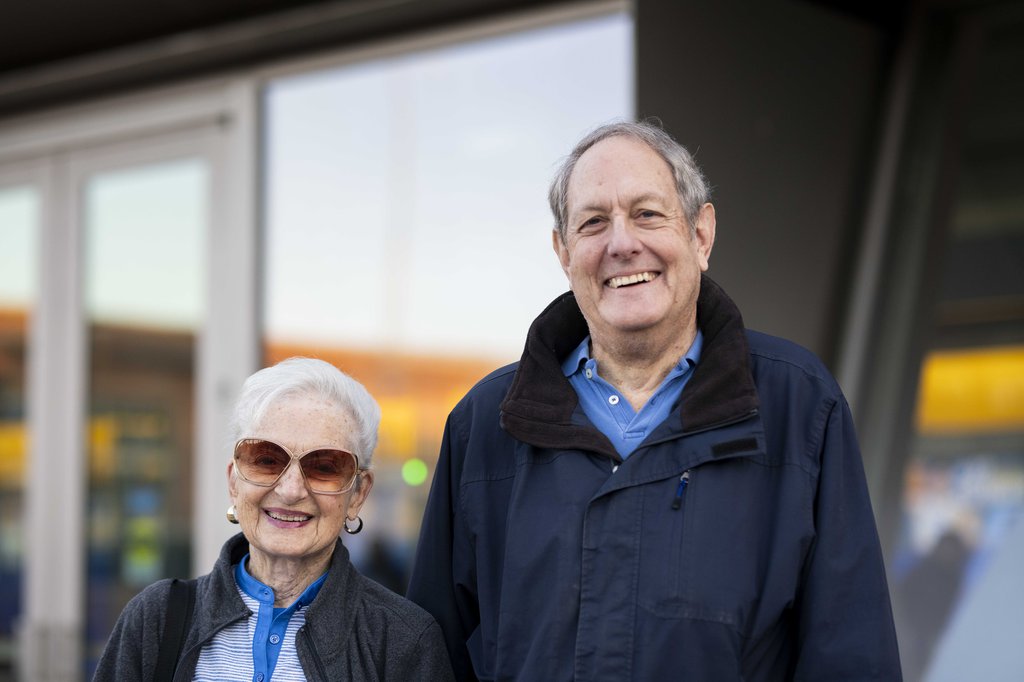
Farrington and Petersen’s 30-year friendship began at the UCLA Anderson School of Management, while Farrington was studying for his MBA. Petersen worked on the administrative side, eventually becoming special assistant to the senior associate dean during her 40-year tenure. Now, she is on the board of the UCLA Retirees Association.
Both Petersen and Farrington remain committed to UCLA sports, attending baseball, basketball and gymnastics games, they said.
"UCLA is a wonderful place with very high academic standards," Farrington added. "It’s a great community, and ... everybody works hard to work together. It’s really a joy to watch."
After our conversation, Petersen and Farrington headed into Pauley to grab their seats before the game. As stragglers rushed toward Pauley’s thick doors, we managed to intercept a couple of attendees making a beeline up the wide Lot 7 steps.
Nancy and Peter Lumsden, Class of 1969 and 1970, respectively, met as counselors in UniCamp – a nonprofit summer camp that links UCLA students with Los Angeles youth. After graduating, Peter moved on to graduate school, while Nancy found a job with UCLA Housing and soon began working for a vice chancellor. She was placed in Murphy Hall, where she spent 25 years, before retiring in 2011. She said it was ironic that she worked in Murphy Hall, the same building she sat in to protest the Vietnam War.
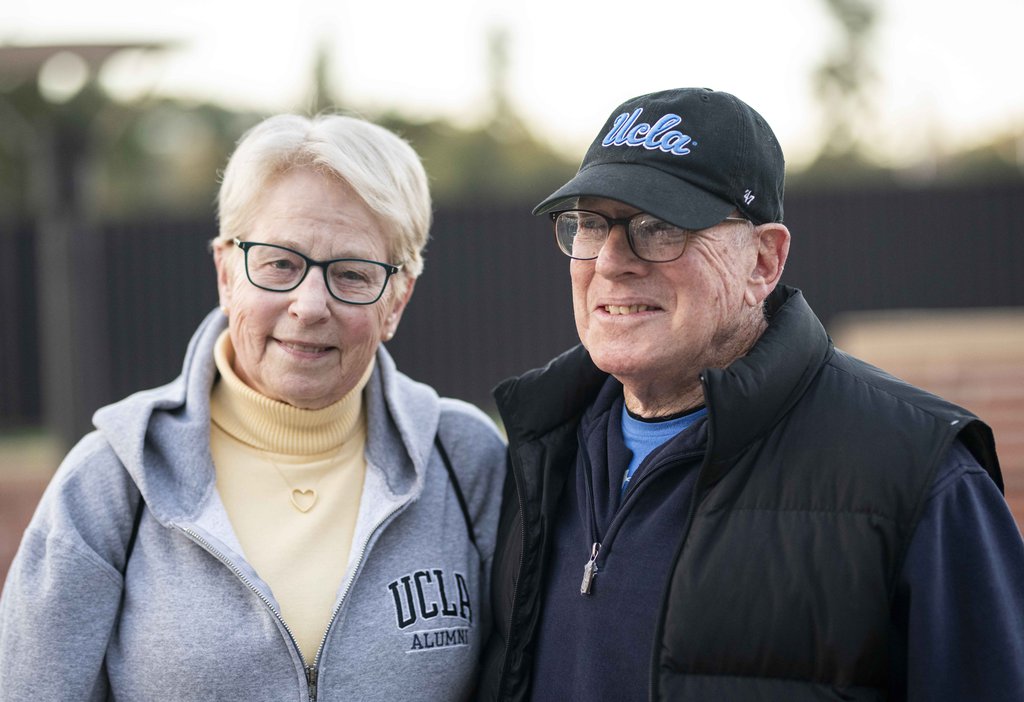
In addition to participating in the protests denouncing the Vietnam War, Lumsden also reminisced about attending a rally in support of Angela Davis when Chancellor Young was being pressured to fire her by the UC Regents and then-Governor Ronald Reagan. As Lumsden later went on to recount students protesting against South African apartheid, we listened with rapt attention, amazed as she described events we had only read about in our textbooks.
By now the crowd was thinning. Lot 7, which only a few minutes ago had been a makeshift alumni reunion space, now returned to its usual levels of activity. Graciously, Lumsden stayed with us for a few more minutes, sharing with us more anecdotes of her time at UCLA and what the campus and community meant to her.
"There’s a feeling about this place, that for all of its ups and downs and sideways, it’s a marvelous place to be," Lumsden said.
If you’ve ever heard loud, brassy noises coming from Parking Structure 2 in the morning, odds are it was me. When the sky is clear and the music practice rooms are full, I relocate from Schoenberg Hall to a middle floor of the parking garage to play my French horn. It isn’t the most comfortable place, but I find it comforting to hear the horn’s mellow sound bounce off the concrete.
Other Bruins seem to find it comforting, too. Every once in a while, a passerby will come up to me and strike up a conversation. I’ve had a stranger ask me about how metronomes work, an amateur photographer ask if they could take candids and even a very kind medical student who stopped to reminisce about her horn-playing days.
I bring my horn to the lots during the odd hours between 11 a.m. and 2 p.m., avoiding the morning and evening when the parking lots are busiest. Everyone from commuter students to alumni flock to these hubs for UCLA life, forming their own routines and traditions among the rows of cars. With each horn practice session, I have become more curious to learn if other lotgoers are finding unlikely communities beneath the dingy overhangs. Perhaps now I could be the one asking questions to the people here.
We approached the tan obelisk of Parking Structure 2 on a day when the cloudy sky melded into the dullness of the concrete.
We waited near an entrance to see who we would find. Medical students poured by us like grains of sand in an hourglass desperately trying to land in their classes on time. It seemed that no one would be able to take time to speak to us in their rush to begin their day.
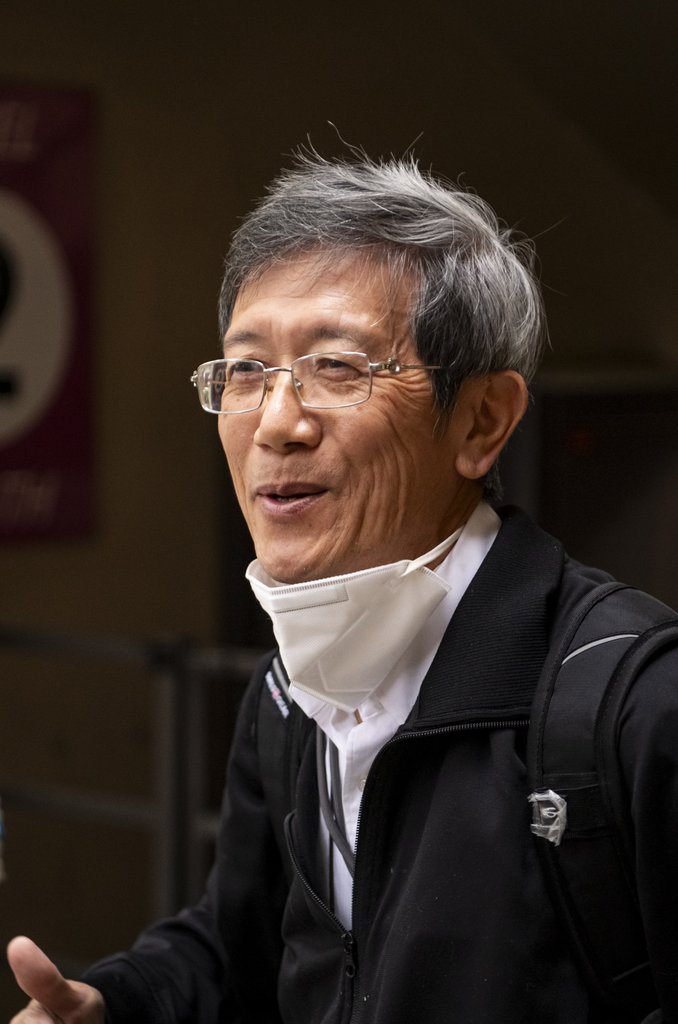
However, we soon met Dr. Kenneth C. Kung, class of ‘78, and ‘84. He does not appear in the parking structure often, as he only comes to campus once a week to teach his systems engineering course at the Samueli School of Engineering. It’s a long drive for him, ranging from 45 minutes to three hours, but he said he thought it was important to meet with the students once in a while to get a sense of how they are doing.
Kung had spent years navigating UCLA’s esoteric parking system, earning points on his pass. During his Ph.D. program, he earned the right to park in Lot 9, which was easiest for him as an engineering student, he said. Now, it’s a different story.
"Since I only teach one class (in person) a week, I just park in the visitor parking," Kung said. "It’s much simpler."
We left as the wind started to gust in. The gray skies would open up at around noon, leading to a steady shower of rain for the rest of the day.
We return to Lot 7 around 5 p.m. on a warm Thursday evening. A stream of UCLA professors, students and staff alike filed down the Lot 7 stairs to their waiting cars. Within a few minutes, we saw a group of friends descending down the steps.
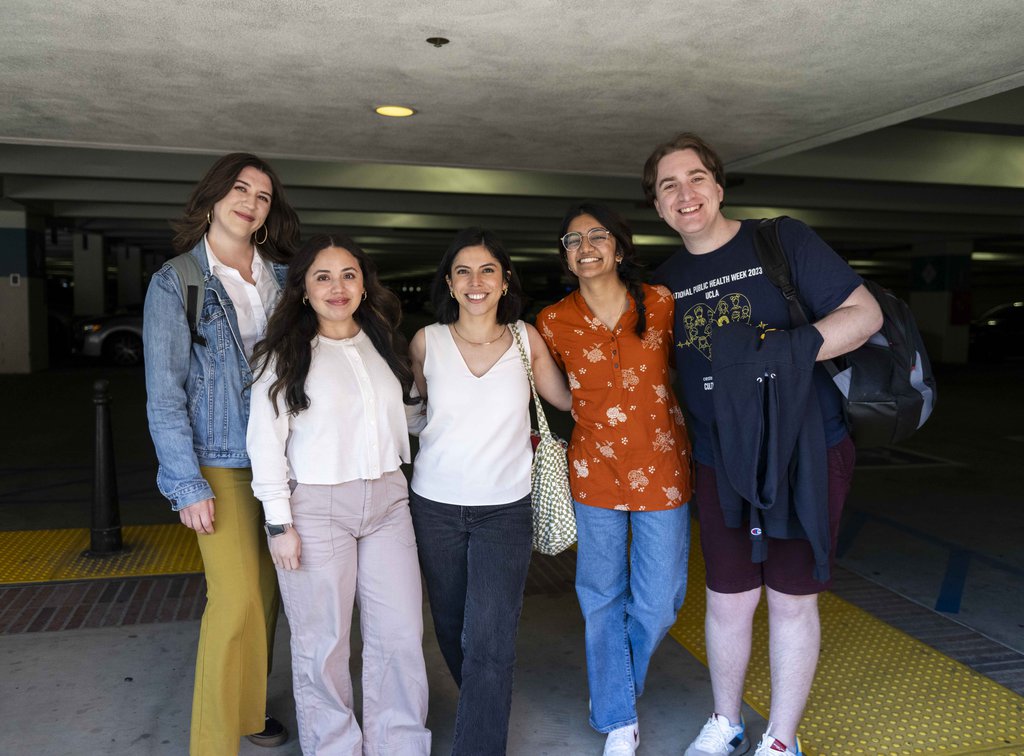
Emylze Garcia, Maria Rivas Reyes, Varsha Nair, Jarrod Erdman and Gillian Stucki, all current Master of Public Health students, had just come from their last class of the day. Garcia, Erdman and Stucki were heading home, while Rivas Reyes and Nair had a more exciting endeavor in mind.
"I convinced three of my friends to watch ‘Shrek 2’ with me," Rivas Reyes said with a laugh.
She explained that she normally does not drive to campus but was carpooling with others that day to catch the movie.
The friends soon revealed Rivas Reyes as a connector within the group. Rivas Reyes recounted meeting Garcia at their admit day and later meeting Nair at the same event. She then met Erdman before he decided to commit to the Master of Public Health program as his buddy and mentor. She later met Stucki through a book club.
"Maria is, without a doubt, the star," Garcia said.
"She’s the people’s princess," Nair added.
While Lot 7 served simply as a space to park for most of the group, it held a bigger role for Nair.
"Varsha is a parking lot rock star," Stucki said. "She does her K-Pop dances right here."
Nair took a beginner K-pop dance class at John Wooden Center with UCLA Recreation. She sometimes rehearsed in the parking structure, and she told us about the pivotal role the lot played to many K-Pop dance groups as a space for activities.
"I was told through the lore of this campus that apparently everybody films stuff and does stuff in Lot 7," Nair said. "So I guess this just really is the place to be."
As we watched the group walk to their cars, the sounds of engines, talking students and screeching scooters from Bruin Walk melded together. Redirecting our attention to the entrance steps, we saw a family walking through.
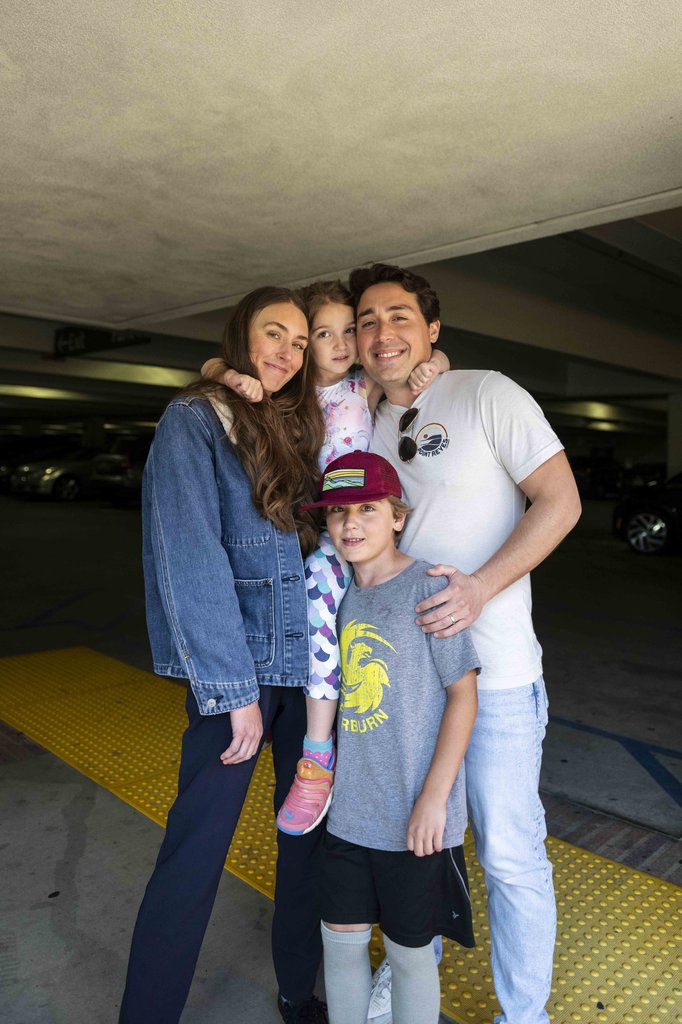
Ronit and Sean O’Reilly were heading home with their two young children Kai and Quinn, who enthusiastically interjected throughout our conversation with the family. Ronit and Sean graduated from UCLA in 2011. Today, they work in entertainment and still live very close to campus.
Moments into our conversation, Ronit referred to Lot 7 as the family’s second home. She was a commuter during her time at UCLA and often parked within Lot 7. A decade later, they return to UCLA for athletic programs, such as summer soccer camp and weekly gymnastics classes. Today was no different.
As the conversation came to a close and the number of the cars in the parking lot dwindled, the O’Reillys headed out. The sun had come closer to the horizon, making dramatic shadows on the steps. Silence now echoed over the concrete, where only an hour prior it had been the sounds of lively conversation and engines running. Almost everybody had gone home for the day.
Now, as we stand among the barren parking spots after hours of interviews, I feel a sense of deja vu from the distinct silence of Lot 7. I am reminded of the days of sprinting to my car, the sounds of my footsteps echoing in the structure, desperate to get back home after a long day of classes and club meetings. I viewed the lots as simply a liminal space that I passed through every day.
But now, Julian and I have witnessed these lots as a meeting space, a second home and a launching pad for gameday. Everyone has a parking lot story – these spaces hold meaning for so many UCLA community members. And no matter how much indifference I felt toward them during my commutes, the same is true for me.
Perhaps Mary Lumsden put it best:
"For all of its ups and downs and sideways, it’s a marvelous place to be."