
The band’s cover of "Billie Jean" throbs against Jack’s eardrums as he clears another plate, heavy with half-eaten hot wings. He is bussing tables, sweat gathering beneath his T-shirt, when his manager tells him another clogged toilet needs his attention. He will not have a chance to rest until his shift ends after 2 a.m., when Rocco’s Tavern closes for the night.
Between the heavy lifting that comes with being a barback and his full-grown beard, Jack’s coworkers never guessed that he’s only 19 years old. He is not old enough to order from the bar – but he is old enough to work it.
Jack McCool, a rising second-year philosophy and psychology student, entered his role as a barback at Rocco’s Tavern only a month before fall quarter of 2023. Although he did not always picture himself as the only sober guy holding a plunger in a bar, he now works three days a week serving food, cleaning after customers and ensuring the bar is stocked with drinks and accouterments.
McCool is not the only student who balances classes, club meetings and nighttime shifts. Jobs in local nightclubs and bars are opportunities for Bruins to make some extra cash or even pay off tuition fees – much like any other student job. Students enjoy the vibrant energy and convenient hours, but face challenges such as being unable to find time to rest when both their days and nights are accounted for.
Los Angeles is home to a thriving nightlife industry where promoters, performers, service workers and others find work. In Westwood, Rocco’s Tavern, Barney’s Beanery and Broxton Brewery & Public House – Westwood Village’s only bars – have become staples for students who drink and those who don’t. Students looking for a study break might head here for a drink, a themed trivia night or a karaoke session.
The students who work at these establishments enjoy their short commute from campus. The perk of proximity is even appealing enough for past Bruins to stay in the area following graduation. Originally from St. Louis, Missouri, UCLA alumnus Conor Driscoll started working at Broxton Brewery as a student. Driscoll said the short commute to Broxton Brewery was a large reason for him remaining in the Westwood area.
Other Bruins, such as UCLA alumnus Sam Freeman, have branched out into other parts of nightlife. Freeman found the traffic-riddled trips to Downtown LA to be worth it since he was able to catapult his job as a club promoter into a career as a founding member of three nightlife businesses: The Flair Collective, The Entertainment Group LA and MTRNM.
"I really, really learned a lot from it (club promoting), built a lot of connections, and that’s where that ultimately propelled my personal career," he said.
Freeman said he gravitated toward the nightlife industry because of its inherent social aspect. Unsatisfied with the prospect of a traditional desk job, he decided to give club promoting a try through companies such as The h.wood Group and Tao Group Hospitality. As a promoter, Freeman would chaperone young women to various clubs in Los Angeles, such as Poppy, Bootsy Bellows and The Highlight Room in order to advertise tables.
Afterward, Freeman transitioned to another form of club promotion by selling tables at clubs for 10-15% commission. At this point, he said that most of his clientele were well-off entrepreneurs, offering him the opportunity to even network with CEOs of marketing companies.
Driscoll especially enjoyed socializing with customers, whether that be his friends or strangers. From chatting with his regulars to yachting with them in Marina del Rey, Driscoll said connecting with customers came naturally, so bartending was a job that just made sense for him.
"You get pretty involved in other people's lives because they come in and talk about what they're going through and what they've done that day," Driscoll said.
McCool said this job also allowed him to balance social commitments and school thanks to the nontraditional work hours. By reserving about half of the week for his barback shifts, McCool fits in weekly visits to church, soccer practices and coursework.
External and internal pressure to maximize one’s academic and social opportunities while working can create a pretty tight schedule for these Bruins. Janna Shadduck-Hernández, a professor of labor studies and a researcher on the UCLA Labor Center’s 2020 "Unseen Costs" study, which focused on how LA county students navigate simultaneously working and learning, said a large appeal of working in the nightlife industry as students is the convenience.
"Because schools are generally not offering evening classes, this is often an opportunity to take the night shift – to do the restaurant shift at night, to work in a club – because these are the hours when they're able to work and attend school at the same time," Shadduck-Hernández said.
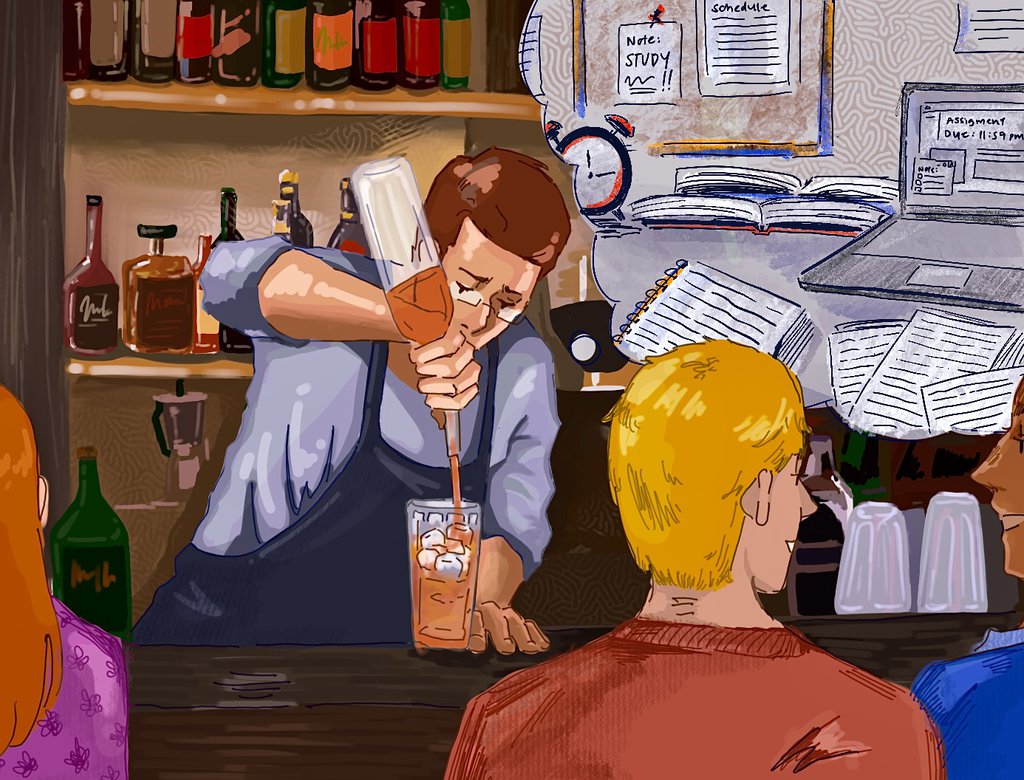
But sometimes the nightlife industry makes it difficult for workers to maintain their personal relationships outside of work. Driscoll said it can be tough for him to find time to go out with his own friends when he is already spending his Friday and Saturday nights behind the bar.
"Truthfully, on my off days I don't really do a whole lot," Driscoll said. "I could be on my feet for eight to 12 hours. So on my days off, I pretty much want to rest."
Shifts don’t just get in the way of hanging out. Driscoll said he has to catch up on rest from the late nights on his off-days. According to "Unseen Costs," it is common for student workers to cast aside balanced meals and healthy meals. The study also reported that at least 69% of the interviewed student workers missed assignments, portions of classes or other academic obligations because of their work schedules.
Nightlife student workers not only sacrifice their sleep but may also face more frequent labor law violations than other industries because of their evening shifts, Shadduck-Hernández said.
"Labor violations include not getting a break, being asked to work past your eight hours and not getting overtime, being required to pay for your equipment or your uniforms – which is actually against the law in California."
For UCLA alumnus Tula Ramos-Jussen, her passion for performing and organizing shows had to be put on the backburner at times in order to prioritize her day job and academics. When she’s not attending classes, Ramos-Jussen is a guitarist in a dream rock band named "Bitch Star," as well as the organizer for an independent alternative music festival, "Juicefest."
"It definitely is difficult juggling it (work and academics) and there were some times when I struggled," Ramos-Jussen said. "I think that goes for anyone, whether they’re doing something in the creative sphere, or just working to put themselves through school."
On Fridays and Saturdays, bars such as Broxton Brewery do not close until midnight, causing students, such as Driscoll, to not go home until the early hours of the morning. Driscoll said working late nights and having to walk home afterwards makes him feel uneasy at times, especially when he stays later than he was intending due to the nature of the food service industry. His solution for avoiding the cold and any potential danger is renting an electric Bird scooter, despite the short walk back to his apartment.
Inside the bar, Driscoll also has to be cautious of potential reactions by drunk customers. He recalled a busy shift at Broxton Brewery where he was tasked with closing out a guest’s tab. The customer, who Driscoll did not serve, was already flustered with the bustling atmosphere inside the brewery and was dissatisfied at how long the food took to arrive. When he learned that the establishment does not accept cash, he continued to berate Driscoll.
Safety and comfort are also a foundational part of Ramos-Jussen’s nightlife ethos, especially after experiencing multiple sides of the industry as a concertgoer, musician and organizer.

Throughout the past seven years as a musician and show promoter, Ramos-Jussen found that transparent communication has been the key to combating some of the dangers of nightlife. When organizing concerts, Ramos-Jussen is concerned about concertgoers feeling safe in those spaces – making sure to minimize the amount of dangerous crowds, drug-related harm or other unsafe behavior.
"A big part of it is just communication, just having that line with audiences and performers," Ramos-Jussen said. "Letting people know at every possible point, like, ‘Hey, if something's wrong, you can tell someone and you know we're going to listen to you.’"
With these issues in mind, students such as Freeman and Ramos-Jussen have sought to increase safety within nightlife spaces. After a year and a half in the industry, Freeman realized that being a promoter was an opportunity for him to encourage safety within the nightlife scene, monitoring his tables and preventing the possibility of contaminated drinks.
As a student, Freeman said he created a safer, more comfortable experience because he knew his clients as friends and classmates first. Following his lead, he said fellow Bruins began to promote in clubs as well.
Ramos-Jussen said she also faces obstacles in the nightlife industry as a woman. In high school, while performing with a male-dominated band named "Cohort," she said she frequently encountered misogynistic comments and male peers who frequently questioned her talent.
"People unfortunately don’t always take you very seriously when you’re young and a woman," Ramos-Jussen said. "There’s always going to unfortunately be this kind of element of the scene that can be very misogynistic and wanting to downplay your achievements and not really give you credit where credit is due."
Ramos-Jussen also works to ensure that artists – especially those who are young and new to the music scene – feel supported as performers. After performing many years as a minor, Ramos-Jussen aims to create a safe space for creative youth.
She added that introducing children to creative arts allows them to have a community where they feel seen and supported, while also giving them the skills to enter the professional workforce when they’re older.
Nightlife Bruins have found the community and energy in their workplaces to be invigorating. For Freeman, he cites his early days of club promotion as the major building blocks of his current career, while other students such as McCool see his job as backseat partier. Since he is listening to the same music as the customers and is experiencing Rocco’s alongside them, albeit indirectly, the barback gig isn’t too shabby for him.
"I feel like it's an interesting job to have. It's like getting paid to go to a party because, at the end of the day, you are in the party," McCool said.
Whether they choose to stay in this industry or are simply enjoying being behind the bar for a few years, these Bruins have found their comfort zone within the strobe lights and DJ sets.
"What brings me back to it is the community. I have never worked a job where I feel like such a part of the community, with my co-workers, with the customers," Driscoll said. "I think that's really neat and I love being a part of it."