
Michael Schneider spent much of his Los Angeles childhood in a car. He and his family drove almost everywhere, including to his school. The distance of the journey? Three blocks.
"I essentially was told from a very young age – whether it’s through movies or TV shows or just personal experience – that you have to use a car to get around Los Angeles," said Schneider, who now serves as CEO of Streets For All, a transportation-focused political action committee.
While this automobile-centric vision of LA is a reality for many, the city boasts a multilayered patchwork of transit agencies, operating at the countywide to citywide level. Despite complaints about crime on public transportation in the media and at recent town hall events, LA’s public transit is crucial to many residents. According to LA Metro, the agency saw more than 250 million passenger boardings last year alone. And the system is continuing to grow, with the Purple (D Line) Extension Transit Project connecting downtown LA to Westwood set to open in 2027.
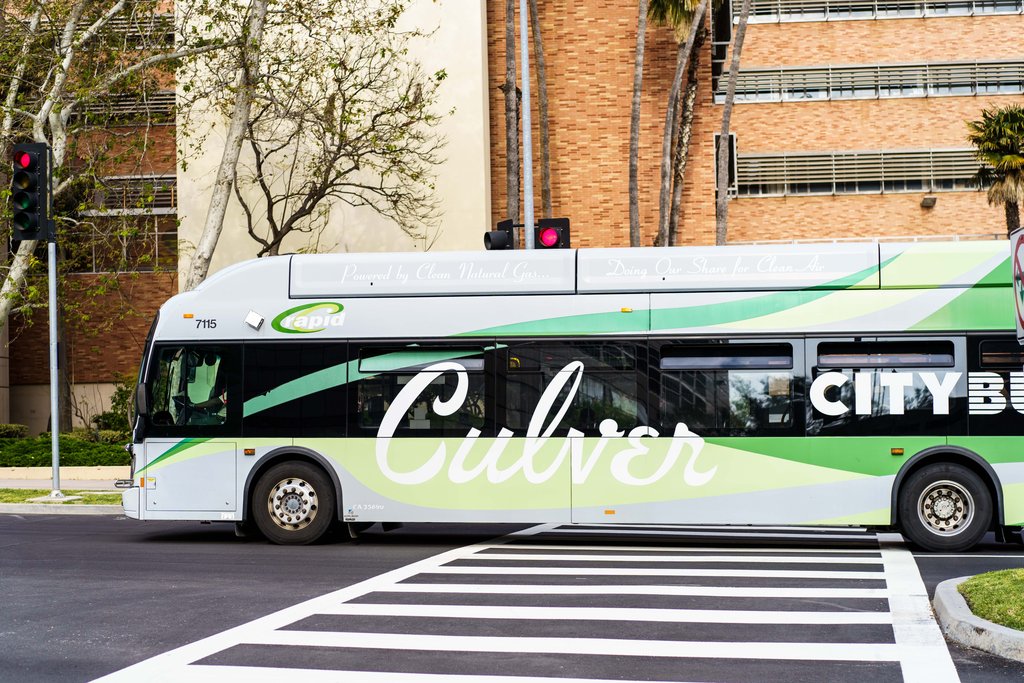
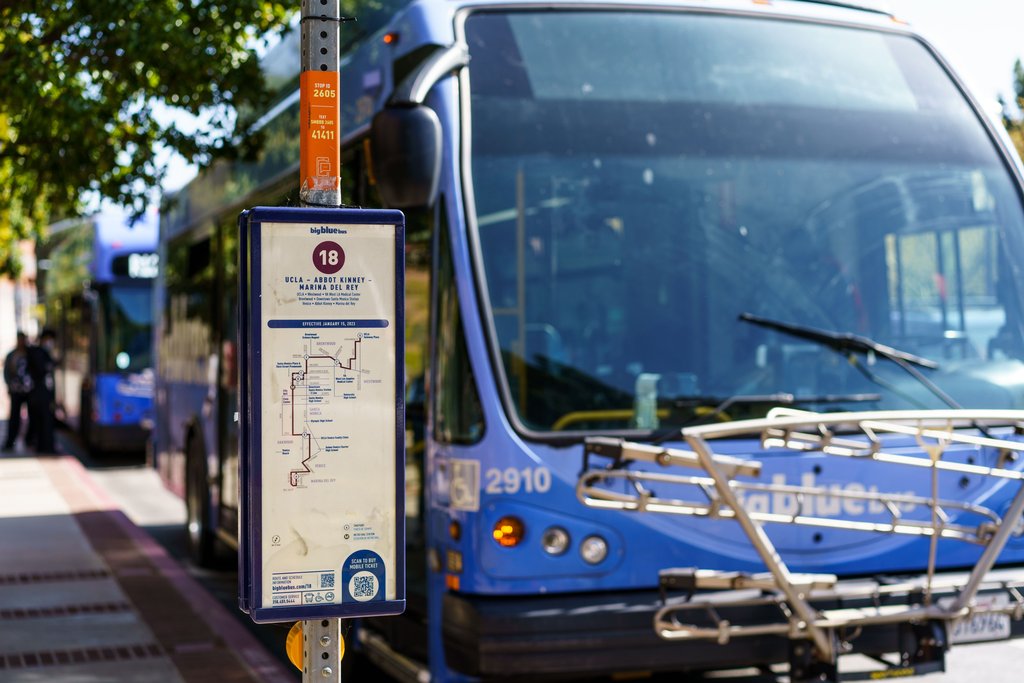
More than a dozen bus routes currently serve UCLA, acting as a throughline between Westwood and the rest of LA. Signs list the routes available to transit takers, flashing between the Culver CityBus Line 6 or the Santa Monica Big Blue Bus Rapid 12. These are just some of the routes available to UCLA community members, including the 22% of commuter students who use public transportation to reach campus according to recent data.
But that number may grow in coming years. With the recently approved Undergraduate Students Association Council election referendum, undergraduate students will soon be able to ride fare-free on LA’s main transit systems for a small quarterly fee.
Students aren’t the only ones drawn to the convenience and low costs of LA's public transit systems, however. Nurses, doctors, researchers and workers wait at Westwood’s bus stops to commute all over LA, with commutes ranging from 15 minutes to an hour and a half.
Hsin-Hui Lin had to wait at the UCLA Gateway Plaza stop three or four times a week to take the Big Blue Bus or Culver CityBus home. Lin, a visiting graduate researcher from National Chengchi University in Taipei, Taiwan, lived in LA from September to April and traveled 20 to 30 minutes to get to campus.

Reluctant to buy a car for a short stay, Lin relied mainly on LA’s bus system to get around. While she said public transportation was a convenient option, the car-centric nature of the city made the experience of taking the bus feel isolating. When Lin first moved to the United States in 2022, she found herself waiting at bus stops amid the city’s record-breaking summer heat wave.
"Standing at a bus stop and waiting for the bus, which you don't know when it’s going to come in or when it will appear – it's unbearable," Lin said.
Lin also noted the differences between Taipei’s and LA’s public transportation. Buses often run late in LA, she said, but her main issue was the infrequent service. When the bus route schedule was reduced at night, she said that waiting at stops felt unsafe.
Some of these differences stem from the sometimes dismissive perspective on public transportation in LA, Lin said. In cities such as Taipei or New York, buses or trains are the norm. But in LA, she added, public transportation is often seen as a backup option for those who don’t have the resources to buy a car.
"The ways of transportation in LA is very hierarchical," Lin said. "In New York, everyone is taking public transportation. ... People ranging from the super rich to the poor, from every class, every race, every gender – they all take public transportation."
While New York is famous for its subway system now, Schneider said LA was once renowned for its public transportation. In the 1920s, Southern California had the Pacific Electric railway, a system of streetcars and buses. While the system was privately owned, he added, it was used extensively by the public.
"We're the only major city in the world that had such an extensive rail system where you didn't need a car to get around," Schneider said. "We snatched defeat from the jaws of victory. We dismantled that space. We gave it over to cars."
In the present day, however, LA transportation policies only cater to automobiles, Schneider said. Painting more bus-only lanes would greatly increase the efficiency of transit service in the city, allowing buses to become untethered from the daily slog of LA traffic. While this decision may increase ridership, he said policymakers have not prioritized this proposal because it would take away lanes currently used by cars.
"Every decision that’s made in Los Angeles is viewed with a specific lens: Is this going to delay someone in a car?" Schneider added.
Multiple transit takers in Westwood expressed the same frustrations with LA’s public transportation: infrequent service, long routes and delays. Jimmy Tu, a graduate student in engineering who commutes between UCLA and his university apartment in Sawtelle, said his frustrations boiled down to one main reason: "A lot of wasted time."
But materials science and engineering graduate student Blair Huang said her daily bus commute allows her to avoid paying the university’s costly parking fees. Because her apartment is located near a major transit line, the bus takes her from the front steps of her building to UCLA in under 20 minutes. And with her Bruin Grad Pass, she never has to pay the bus fare when she climbs aboard.
The pass, funded by a $25 quarterly fee imposed on graduate students, allows them to take public transportation anywhere and anytime in LA without paying a fare. But Lin, who was not a registered UCLA student while completing her research, was disheartened to learn she did not qualify for a transit pass like most of her fellow graduate students. Other transit takers in Westwood, such as employees, do not currently have universal access either.
The Bruin Grad Pass came into being after a 2020 referendum passed by the Graduate Student Association. However, it was scheduled to sunset in 2023 and was not on this year’s ballot, leaving the fate of riders like Huang uncertain.
But with the passage of the Universal Access Transit Pass referendum by USAC last month, undergraduate Bruins will also have unlimited access to LA’s public transit system starting in the next academic year. The $3.30 quarterly fee represents the cost of one round-trip fare on a Metro bus, said former USAC Facilities Commissioner Phoebe Chiu, whose office was in charge of the referendum. Nearly 94% of voters in the 2023 USAC election were in favor of the pass.
"It’s really a public good. It’s a public service," said Madeline Brozen, deputy director of the UCLA Lewis Center for Regional Policy Studies. "It’s a way that you can contribute to making sure everyone at the campus has access to affordable transportation."
Prior to the referendum’s success, UCLA was the last UC school without a zero-fare transit pass for undergraduate students, said urban planning professor Donald Shoup. However, this pass is not the first of its kind at UCLA.
Between 2000 and 2003, the BruinGO! transit program gave all UCLA students and staff fare-free access to the Big Blue Bus. Unlike the current referendum, the university covered the full cost of the program during those three years. The program caused substantial changes in campus culture almost overnight, Shoup said. Data showed Big Blue Bus ridership rose dramatically, and single-driver commutes went down correspondingly. Entire dorm floors would take trips to Santa Monica together, Shoup added.
But beyond offering cost-effective access to weekend activities, Shoup said BruinGO! motivated students who live farther from UCLA to commute by bus and avoid paying high campus parking fees. Shoup said these daily savings added up.
"A lot of students made the case that this was an important part of their financial aid at UCLA," Shoup said. "That it saves them enough money to be able to eat or to buy textbooks."
Brozen said public transportation first and foremost functions as a social safety net – it supports people who can’t afford cars, as well as those who are too young to drive or who have a physical disability that prevents them from driving. Oftentimes, college students fall under one or more of these categories.
While access to LA’s public transportation will soon become easier for some Bruins, the system has a ways to go in terms of improvements.
According to Brozen, riders may feel unsafe because of insufficient lighting at bus stops and infrequent service. Brozen said increasing bus frequency is one way to mitigate these feelings of discomfort while simultaneously providing riders with a greater sense of reliability.
Christina Godinez, an administrative specialist with UCLA’s Semel Institute for Neuroscience, said in an emailed statement that she would appreciate increased frequency of Big Blue Bus routes, which she often takes to get to her home in West LA. Her commute, which mainly uses buses and occasionally the rail, takes anywhere between 30 minutes to an hour. Godinez has noticed heavy overcrowding on her route, leading to drivers bypassing stops and leaving passengers without a ride. She said she believes overcrowding would be solved with more frequent service.
With the Purple Line only a few years away from opening in Westwood, Brozen said Bruins will have more opportunities to live in less-expensive neighborhoods outside of West LA while benefiting from more consistent travel times to campus on the rail. This shift, she added, will require infrastructure changes in Westwood Village, such as widening sidewalks for increased foot traffic and expanding the bike share system, so those arriving by rail can get around easier.
Growing up in LA, Schneider spent a lot of time in Westwood Village, but the evolving neighborhood will look a lot different than the one he and his family used to visit. While the Westwood of his childhood was always a car ride away, he feels a more accessible city is now closer in sight.
"In the next few decades," Schneider said, "LA will be dramatically different in public transportation."