
The corner of Weyburn and Broxton avenues in Westwood is home to a business of incredible cultural significance, one where visitors can be entertained, terrified and even have their hearts touched by the stories they watch unfold while drinking beverages most agree are more expensive than they ought to be. And next door, there’s also a movie theater.
I’m speaking, of course, of Starbucks.
I met a man I’m fairly sure was in the mob at thatv Starbucks once. Nice guy. One time I overheard two men in sweaters meet and bond over sobriety and – minutes later – heard them threaten to call 911 on each other. I’ve even become acquainted with a regular who refuses to tell me her name but always has something to offer about the history of the Village.
Whenever I tell my friends these stories, I’m continually met with one question: “Why does the wildest stuff always happen to you at Starbucks?”
It’s a good question. So in April, I set out to find the answer.
For three weeks, I made that Starbucks my home. Breaking a fair few social norms, I people-watched and interviewed patrons at all hours of the day, from the store’s 4:30 a.m. opening to its 10 p.m. closing. I even stuck around the patio to write with the store closed for Passover. I met men and women, lifelong Angelenos and transplants, people who shared my sweet tooth and plain coffee devotees. To save you the same trouble, here I present the humans of the Westwood Starbucks.
On April 7, the first official day of interviewing, I met Judit Csotsits on the patio. She had a wood-plated fork and was grazing on a salad she’d brought from home, being kept halfway out of the glaring sun by the table’s umbrella. She’s a visual arts educator at the nearby Geffen Academy, a UCLA-affiliated school for sixth through 12th graders. Csotsits came to Los Angeles at age 9, she told me, her parents fleeing political persecution in Hungary. She practices Kundalini yoga and hikes four hours with the Santa Monica Hiking Club every Sunday. Her Starbucks order is a large iced Americano with cold foam.
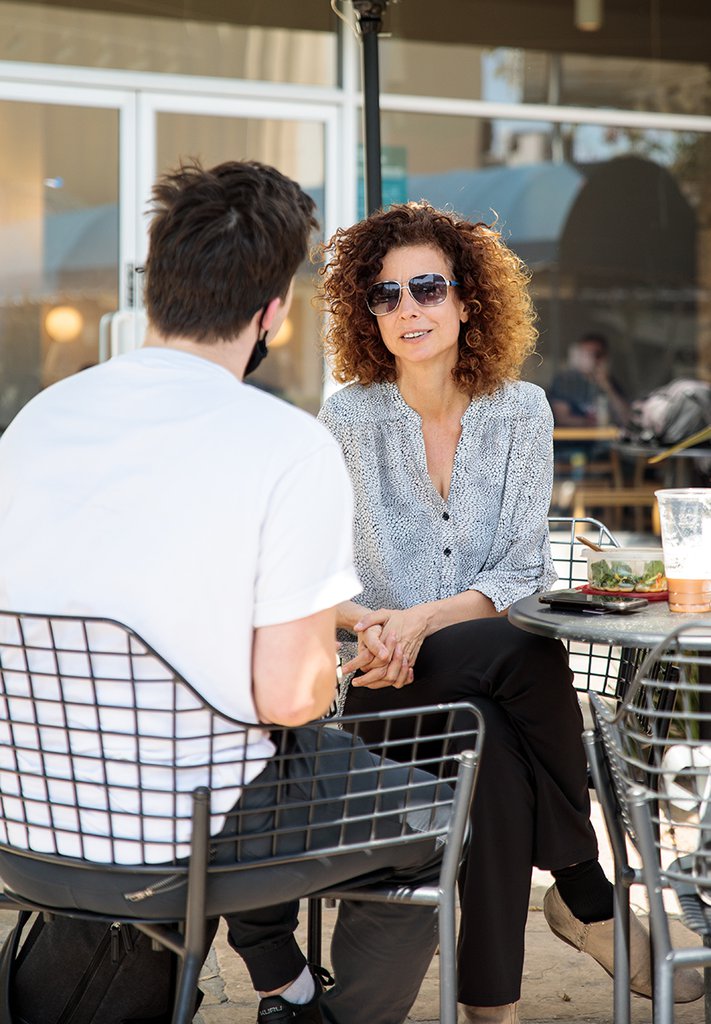
We had been talking about meditation for 70 seconds before I asked her to lead me in a breathing exercise. It must have been something about the energy of the patio that convinced me this was not an odd conversational move to make.
“Well, there’s the Om chant,” she said without skipping a beat. “I don’t know if you’re familiar with that.” I was, but only from ill-formed caricatures of Zen monks and Woodstock attendees – not in the context of real meditation or its practitioners.
We really should have been sitting in the lotus position, she told me, but the gridded iron arms on our chairs didn’t quite permit it. Straight spines and feet firmly planted on the ground would have to do.
“This is called the Gyan Mudra, where you attach the index finger to the thumb,” she said, demonstrating for me. I dutifully mimicked her, my hands held flat towards the sky, each index finger and thumb touched together into little rings.
“The thumb represents the ego, so you’re trying to bring the ego under control,” Csotsits told me. She’d talked earlier about the culture shock of LA individualism as a young Hungarian immigrant. The ego is, I suppose, less controlled in this town than in most.
“And then you just breathe in deeply,” she instructed. I did.
“You close your eyes,” she added. I did.
“You look into your third eye, which is right here in between the eyebrows,” she said. I tried to. I imagine she must’ve tapped the space between her brows then, but two of my eyes were closed and I wasn’t in tune enough with the third to catch it.
“And then you just do a – Ommmmm,” she said, relaxing into the chant.
I’ll admit what I did was more of a low hum than a full articulation, but it was something – something genuinely calming and centering. I think of this moment often now. My speech therapist tells me that when I catch my voice drifting higher than I’d like it, I should touch my hand to my chest and say “Mm-hm” to reset my pitch. “Mm-hm” works, but ever since meeting Csotsits, I’ve preferred to hum.
I remember humming before approaching Dimitri Magganas a week later. It was about 6:40 a.m. I’d been at Starbucks two hours already. I wasn’t on the patio this time, as skateboarding over from the dorms in the early morning dark taught me by the time I arrived that 55 degrees was too cold to justify outdoor seating.
I ordered the day’s first drink, a grande cinnamon dolce latte with soy milk, and then spent the two hours sitting in comfortable quiet with Ashley Kenney, a recent UCLA graduate and the photographer who volunteered for the article that involved a pre-dawn Starbucks trip. At around 6:40 a.m., when she’d made it through 100 pages of her book and I’d treated my Notes app to a 2,500 word play-by-play of the morning, I prepared my voice with a hum and approached Magganas.
Magganas is a commercial real estate property manager born in Athens, Greece, and raised near the Acropolis. Although he lives in Oakland, he was two weeks into a Westwood trip that morning, staying in an apartment a block away while visiting his son at UCLA. The Starbucks is very conveniently located, he told me, so he starts his days here, drinking regular coffee with half-and-half.
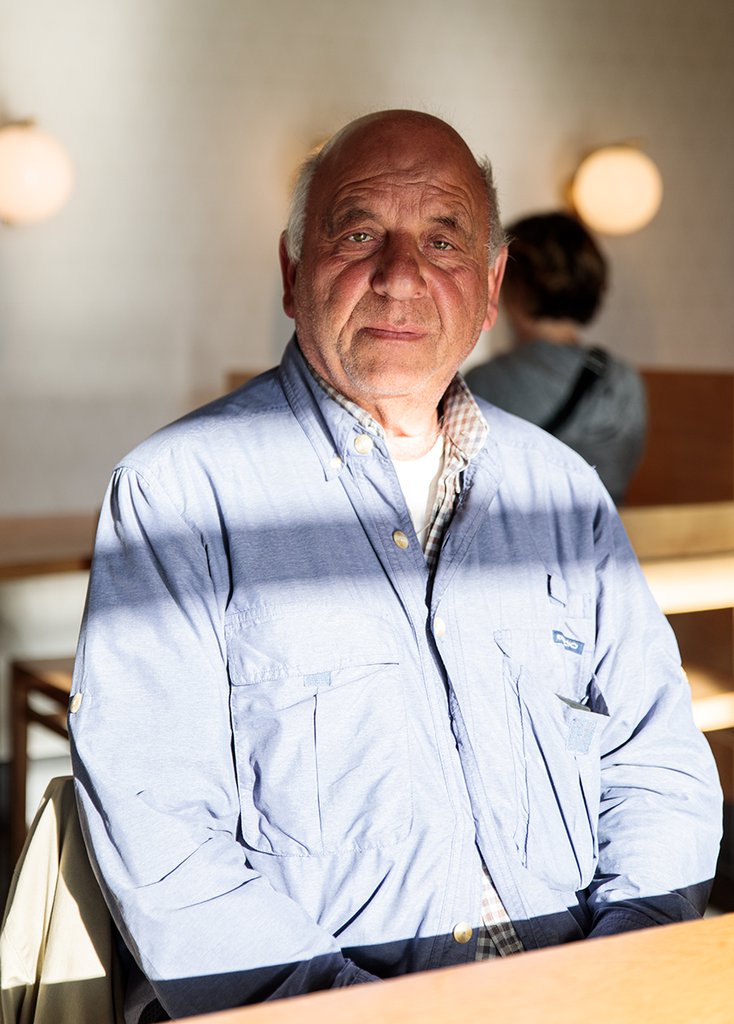
Most people I approach at Starbucks are not interested in talking, and those who speak often do so with great caution initially. Magganas held no such reservations.
“Can you talk a little bit about your relationship with your family?” I asked. I was curious. I’d never met or even heard of a parent visiting a child at school for weeks at a time, especially when that child is a doctoral student. “If it’s not too personal – you don’t have to share anything you aren’t comfortable with.”
“Nothing is too personal for me,” he interrupted. “I always ask personal questions. Those who don’t want to answer, they don’t answer, or they evade.”
I feel a need to make some things about Magganas quite explicit. He is a UC Berkeley-trained economist and one of the most analytical, intelligent people I’ve ever met. Each answer he gave thus wandered quickly and inevitably into a lengthy economic treatise. A full five minutes passed after I asked the question before I actually learned anything about his family.
About 15 years ago, he told me, he took several steps back from professional life when his sons were 10 and 12.
“I was working, but I would not pursue any new projects, no new investments,” he said. “I would overlook business opportunities in order to pay quality, undivided attention to them.”
He quickly clarified.
“That does not mean babysitting or a short leash,” he said. “That means traveling, going to consulates, embassies, Washington D.C., city halls, lectures.” I doubt he was exaggerating about the embassies and consulates. He told me he had worked with Gov. Gavin Newsom during his early days as mayor of San Francisco and met President Joe Biden during Biden’s time in the Senate.
He wandered back into the land of policy and economy. I tugged us once more towards family. Magganas had so far missed no opportunity to inform me that the world is all but doomed if we don’t tear down our current political systems and rebuild them anew. This paradigm shift, he said, is 20 years overdue and still nowhere in sight. How does it feel, I wondered, to see so little hope in the future his sons now march towards? What role does emotion play in that world?
“We all have emotions,” he carefully stated. “And you should not deny that.”
But they can be blinding, he told me, and ought to have no role in geopolitical decision-making – or his sons’ lives.
“I always would counsel them to strike out (extreme emotions) as totally unacceptable. Hatred or love,” Magganas said. He caught me off guard with that last bit, and he seemed to know it.
“They’re the two sides of the same coin,” he explained. “They could both be very destructive.”
I took up the challenge he’d laid out half an hour ago; nothing is too personal.
“When you say love, it can mean many things,” I said.
He agreed, reminding me that his native tongue, Greek, has seven different verbs for love. Without thinking, I asked a question I never thought I would pose to a near-stranger in Starbucks as the sun rose outside.
“Do you tell your family you love them?” I asked.
“No, I have never told my family,” he said. “You hear, many times, parents or others say ‘I love you.’ No. I can never use that verb.”
The English-speaking world is too liberal with the word, he said, too ready to apply it in too many situations that are too undeserving of such a serious concept.
“Respect is a lot more useful and cerebral and logical,” he told me. “Love is not based on anything. Respect is based.”
Love can blind, he explained. Love for a person can persist despite their terrible behavior, their despicable values. We let it remain, unearned, long after respect is lost.
“Have you told your spouse, your children, that you respect them?” I couldn’t resist asking. From the way he talked about his family, whatever he felt about them is something I’d call love.
“No,” he said firmly. “You need to do this by deeds and acts and actions and lack of actions – not verbally.”
I thought of Magganas choosing his sons over advancing his career and of the weeks he spends here visiting. When I look at his words now – when I think of them in the abstract – they sound so harsh. Maybe they are. But English words, as he told me multiple times, are often not quite up to the task of communicating his reality.
Magganas is a father who does not tell his family he loves them, yes. He’s also a father who gave me glowing accounts of his sons and their accomplishments minutes after we met, and one who emailed me the next day to remind me that I should not include their names in this article, lest the press bother them.
He’s more than just a family man, too. He’s a savvy political mind with grand notions of how to better the world.
“Huge, huge changes are needed,” he said. “At the very, very local level.”
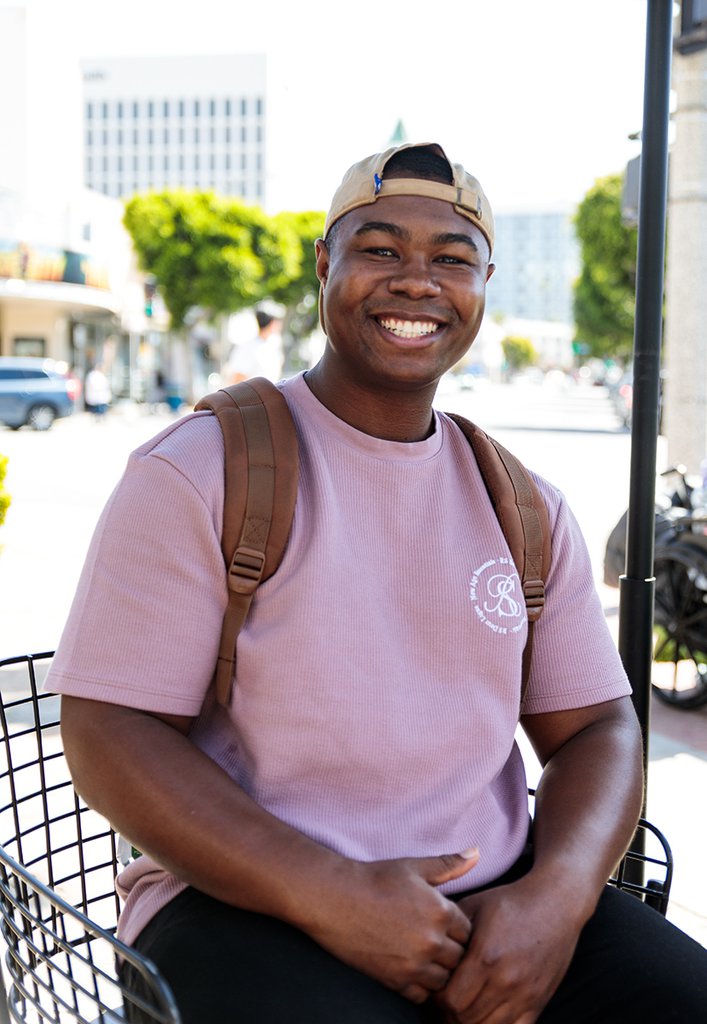
Among those fighting for such changes is London Taylor – a man with an infectious smile. I met him on a sunny morning in early April.
I could be convinced that this Starbucks is an annex of the Ronald Reagan UCLA Medical Center, especially in the mornings. It’s not, but going purely off the number of customers in scrubs and black vests emblazoned with the UCLA Health logo, it could be. Even some street-clothed patrons are here for a pick-me-up before reporting to work at the hospital. There’s really no way to know if you’re the only customer present who won’t be breathing stale hospital air today without asking strangers about their jobs.
Asking strangers about their jobs is in fact how I know the hospital’s inhabitants extend beyond the uniformed. I never expected to talk to anyone from the medical center. They tended to flit in and out with such efficiency that I didn’t dare disrupt the ritual. But when I first saw Taylor, he was sitting on his phone at the counter by the window. He seemed relaxed – just the kind of person who might have a moment to chat.
I invited him outside – almost everything interesting happens on the patio – and we talked for a brief 10 minutes before life beckoned him away. As a union organizer at the hospital and member of the American Federation of State, County and Municipal Employees, he told me his days never look quite the same.
Taylor was by far the most joyous and smiley stranger I approached at Starbucks. He was drinking a shaken almond milk espresso, though he said he’d have preferred it to be a Snickers Frappuccino.
He’s from Sacramento, he told me, and came to LA in 2016 as part of a big life change – an exciting escape from his hometown’s sleepiness and a bolder, riskier move than anyone at home realized.
“I came out here for a six-week internship,” he told me. “I didn’t tell anyone, like, this is not a guaranteed job.”
He grinned.
“I really bet on myself in that moment,” he said.
He had never worked in labor organizing before taking that position with Service Employees International Union – not even as an activist.
“I just knew I liked helping people,” he said. “And it was just so eye-opening.”
He’s been working in labor ever since, coming to Westwood for AFSCME Local 3299 in 2018.
“I wouldn’t say it’s all roses and daisies,” he admitted, voice cheery as ever despite the subject matter. “There are moments, as an organizer, I’ve gotten in my car and been in tears.”
I can imagine. During a three-year contract dispute, he helped lead six strikes at the hospital, he told me. Convincing workers to lose wages for a strike is, as he explained, a difficult feat. To do it six times is more difficult still.
“But when I’m speaking to a worker and they feel empowered to fight for themselves, it makes it all worth it,” he added with a smile.
Taylor is, like Csotsits, a hiker. One of his favorite hikes is the Los Leones Trail in Pacific Palisades. Csotsits, I’ll remind you, is a member of the Santa Monica Hiking Club – a club that will host a potluck at the same trail in July.
Csotsits and Taylor do not know each other, as far as I’m aware. But with this upcoming event, there exists the smallest possibility that the two may meet. They may share with each other what they both told me: that they find happiness on hikes and that these moments in nature stay with them.
To my knowledge, Csotsits does not know Magganas, either, and they will in all likelihood never meet. If they ever did strike up a conversation, though, they might find themselves on common ground rather quickly. They are both European immigrants and UC grads who espoused the importance of education, of children pursuing their passion and of individuals taking action to create the world they want.
Talking to strangers is not part of Starbucks’ social etiquette. Speaking from experience, most people won’t indulge attempts to do so. They’re focused on themselves, and at Starbucks, why shouldn’t they be? Meeting random people is not the reason anyone goes there.
I’m still glad I made it my reason.
A fantastical amount of human experience coalesces each day within this coffee shop. That is itself a marvel that often goes unappreciated. More marvelous, perhaps, is the terribly short distance between it all. I can make a six-minute trip from my bed and learn from a stranger how to access my third eye or fix the U.S. economy.
I did not know when I met Csotsits that she was an artist. She did not know when she met me that I used to consider myself one, too, or that I once submitted art portfolios with my college applications. But she is, and I did, and when I asked the thematic focus of her work, her response felt like some little nod from fate.
“A depiction of a connection of humanity,” she said. “Really learning to respect the environment and other people as if they were part of us.”
We are tied to the world we inhabit, she explained, as separate as the two may seem.
“We’re so connected in every possible way,” Csotsits said.