
In August, Casper Hsu found the trek to campus from his dorm more difficult than usual. The distance to class and the number of stairways he had to climb were not the only obstacles the fourth-year economics student faced.
There was heat. Extreme heat.
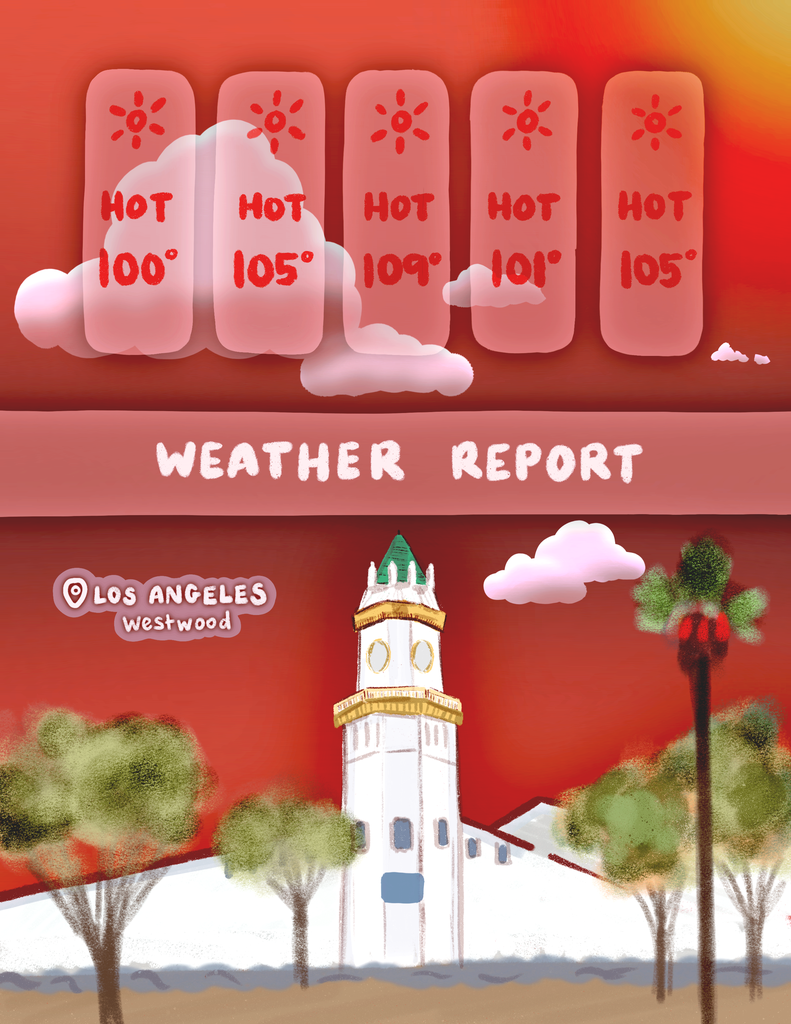
Extreme heat is one of the deadliest extreme weather events, leading to the most fatalities of any weather emergency each year. According to the Los Angeles Times, the 2022 LA summer heat wave was possibly the worst September heat wave on record, with temperatures consistently trending upward of 100 degrees Fahrenheit. The City of LA issued an excessive heat warning from Aug. 31 to Sept. 9, alerting residents to the grave health risks posed by the temperatures.
The effects of the heat extended to campus and beyond. From overwhelming UCLA’s hospital with patients to exacerbating socioeconomic disparities, the heat wave exposed the dangers of an unprepared and unaware community. Now, six months later, the true toll of the disaster on both UCLA and LA is still being revealed.
On Sept. 5, UCLA shut down air conditioning and access to 34 buildings across campus. Martin Lee, a professor in the biostatistics department, taught Biostatistics 100A: "Introduction to Biostatistics" during summer session C. He said that he and other faculty members received notifications from UCLA asking them to be aware of the risks of the heat, especially if their class involved outdoor activities. Lee added that, while his lecture took place earlier in the morning and in a classroom where the conditions were bearable, he noticed that attendance dropped as the temperatures rose.
"Let's face it, August in LA is never a cool period of time," Lee said. "But ... I can still remember summers going way back being a lot easier to deal with than certainly the last decade or so."
Heat and dryness are typical features of California’s weather. However, climate change has intensified these events, said Daniel Swain, a climate scientist at the UCLA Institute of the Environment and Sustainability.
"One of the things to realize is that climate change most prominently exacerbates existing physical hazards," he said. "Often it's not creating new physical events out of the ether, but it's amplifying them."
But, Swain said, residents may not realize the danger of these high-intensity climate events.
Anna Jackanich, an emergency medicine resident physician at UCLA, explained that heat can cause health conditions such as fatigue, dehydration and headaches. Heat exhaustion sends many patients to the hospital when temperatures rise, she said. The effects, however, can quickly manifest into a more severe condition: heat stroke, which occurs when the body can no longer regulate its temperature.
"The symptoms of heat stroke can actually be pretty dangerous," she said. "It can lead to death."
Many patients came to the emergency room exhibiting signs of heat exhaustion and heat stroke during the heat wave: nausea, confusion and even seizures, Jackanich said. However, the heat can also exacerbate existing conditions because of dehydration or lead to physical injury because of fatigue. Many other patients came with kidney stones, injuries caused by collapse or other conditions, she added.
"It's just crazy to think that someone could be so sick from heat exposure," she said.
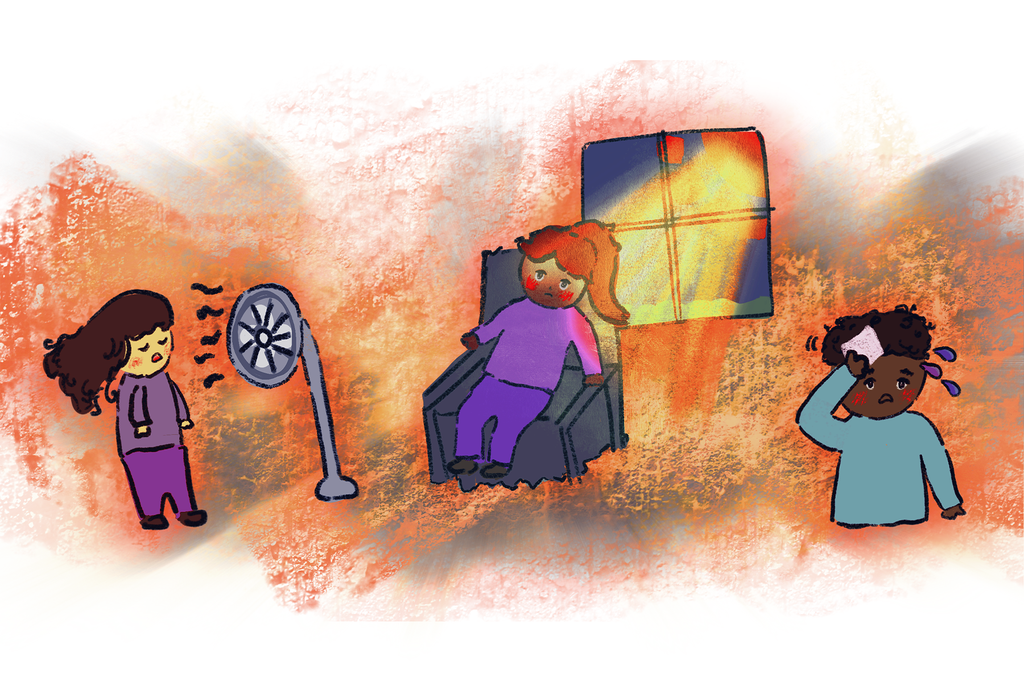
Students on campus over the summer were no strangers to the symptoms of heat exposure Jackanich described. Ruochen Li, a fourth-year biochemistry student, took Biostatistics 100A over the summer. During this time, Li lived in Saxon Suites without air conditioning. Even with the ice packs he made using campus ice machines, Li said he still struggled to fall asleep at night. Eventually, that lack of sleep affected his studies.
"I found (it) hard to keep focused at the lecture," he said.
For Sarah Huang, a third-year human biology and society student, the symptoms went beyond disrupted sleep patterns. The heat, coupled with the demands of her academics and extracurriculars, led to a sudden fever.
"I think I got sick just due to extreme exhaustion and fatigue," Huang said. "My body shut down."
Later in the summer, Huang participated in band camp with the UCLA Bruin Marching Band. While the camp occurred in September, after the peak of the heat wave, the 12-hour outdoor practices took a toll on Huang and her peers. She added that the band’s efforts to mitigate the effects of the heat, such as taking mandatory water breaks and cooling down in air-conditioned rooms, did not fix their situation.
Angelique Campen, a clinical professor of emergency medicine, explained that heat can affect anyone, including young individuals like Li and Huang. At the Ronald Reagan UCLA Medical Center, the ER was overrun with struggling patients of all ages.
This increase in the number of patients led to a strain on hospital resources. Both Campen and Jackanich described the scramble as they sought out fans, looked for ice and prepared cooling blankets. These overwhelmed systems within hospitals only reflected the realities of outside communities.
David Eisenman, a professor at the David Geffen School of Medicine and the Fielding School of Public Health, tracked the effects of the heat wave on entire communities. His research quantified the effects of the heat on Southern California by mapping excess ER visits – calculated by comparing ER visits on days with extreme heat versus non-heat days – on both the county and ZIP code levels. His studies found that, for every day of extreme heat, there are eight additional deaths within LA County. The more days of extreme heat there are, the more the number of fatalities increases.
Eisenman and his colleagues also found that not every community experiences extreme heat the same way. During the heat wave, ZIP code 90210, which covers parts of Beverly Hills, had two excess ER visits daily. The neighboring ZIP code 90024, which covers UCLA, had three. On the other hand, ZIP code 90037, covering parts of South LA, had 17. As Eisenman explained, these disparities reflect long histories of discriminatory policies and structures.
"Why is this one neighborhood so much more affected than the other?" he said. "This almost always comes down to issues of equity, fairness in housing, historical racism in the form of redlining, access to health care."
Despite the risks of heat, there has been a lack of data transparency in the immediate aftermath of a heat wave, Eisenman said. He added that, while LA County does keep records of the effects of the heat, they are not made public. Public health authorities are not adequately informing communities about the dangers posed by heat waves, he explained.
While months have passed since the heat wave, the repercussions still persist. Often, relentless rain can be linked to the extreme temperatures of the summer, Swain explained. He said that higher temperatures increase the atmosphere’s capacity to hold water. Eventually, that water must return to land as rain.
Like the summer heat wave, January’s winter storms had devastating impacts on unprepared residents. According to the LA Times, the storms resulted in at least 22 fatalities. NPR reported that 2.6 million homes using Pacific Gas and Electric – California’s largest electricity provider – experienced power outages. Many freeways, including the Pacific Coast Highway and Interstate 5, were partially blocked because of mudslides or flooding.
According to the LA Times, this particular storm was not the result of global warming. Patterns of heat followed by precipitation are normal to California’s climate. However, climate change will only exacerbate this cycle, Swain said. The solution to this problem is difficult and complex: stopping climate change.
"We can't directly do anything about the extreme weather events except to the extent to which we mitigate and eventually halt climate change," he said.
However, that does not mean individuals are hopeless when it comes to mitigating these conditions. Lee said that UCLA needs infrastructure changes on campus in order to combat the effects of heat. He explained that older buildings, such as Moore Hall, tend to become unbearably hot in comparison to their newer counterparts.
"What certainly needs to be done, if it's not already underway, is to ensure safe environmental conditions in the older (buildings)," he said. "Because our campus is well over 100 years old now."
On a communitywide scale, Eisenman said counties such as LA should release data on the effects of heat.
"They (LA County) need to educate them (residents) going forward about heat, and how to prevent their own sicknesses and how to stay cool," he said.
But one of the most important steps needed is a collective acknowledgment of how dangerous the heat can truly be, Eisenman said.
"Extreme heat is, on average each year, the No. 1 weather-related emergency for deaths across the nation, more than any other kind of weather-related event," he said. "But if you look at the news, what do you see from pictures? You see pictures of people going to the beach."