
There was no good solution to her situation.
It was spring quarter of 2023, and a third-year physiological science student was shut out of upper division courses. The one thing standing in her way? A completely full Physics 5C class, an essential prerequisite for her major. Student A turned to her department advisor for help and learned she would need to wait another year to enroll in the upper division courses she needed.
Student A felt she could not afford to wait that long. She worried about falling behind and preparing for the MCAT. But just before giving up hope, Student A summoned a solution right out of her back pocket: her wallet. She bought a Physics 5C spot off another student for $50.
"I don’t think it’s fair. I paid a lot of money just to get a class," Student A said. "I felt like I was at risk of not graduating."
Student A is not alone – the competitive nature of course enrollment at UCLA has spawned a black market for buying and selling classes. The UCLA Registrar’s Office said departments have to set seat limits on major preparation courses, leaving students and professors with few sanctioned options for ensuring that students secure the classes they need. Buying a class can help some Bruins snag a spot in full sections. However, many students feel torn over the practice’s financial and ethical costs.
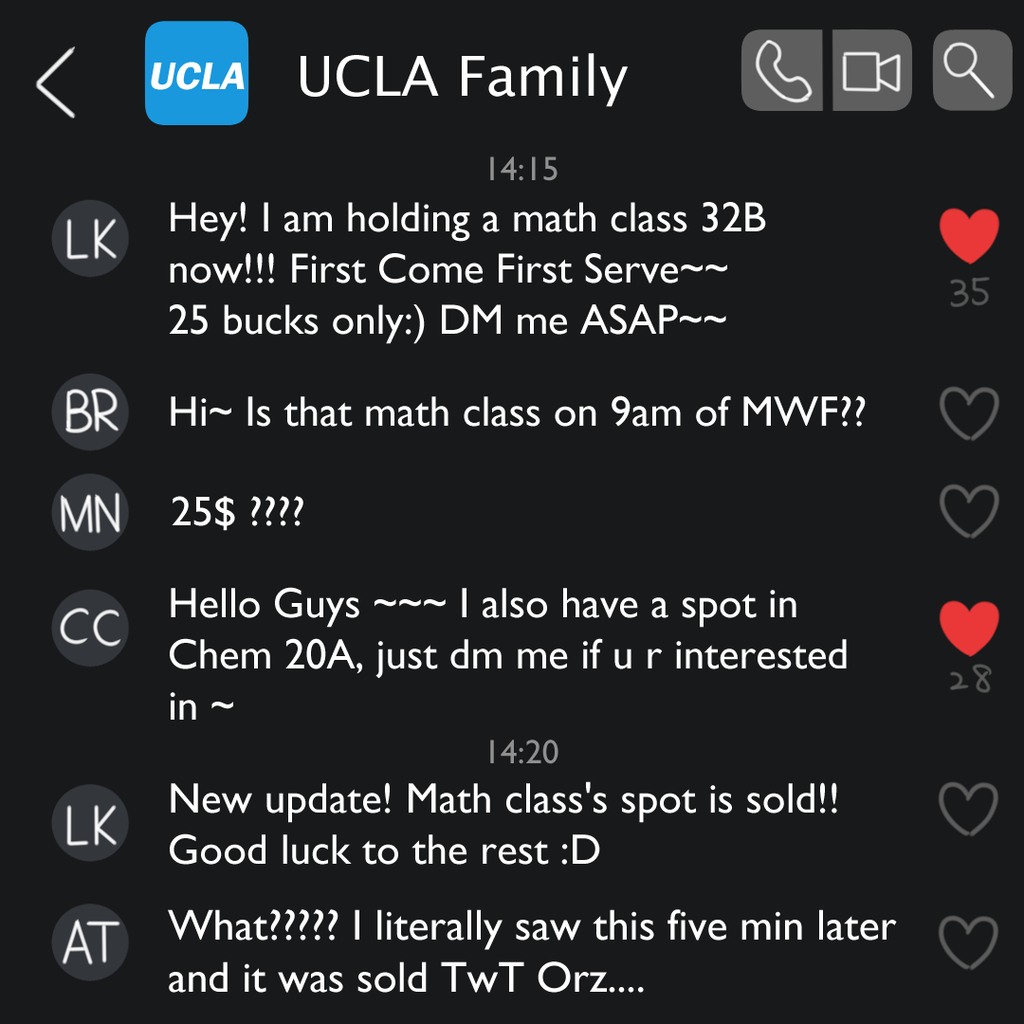
Bruins face a variety of pressures to secure seats in competitive classes. Between staying on track with her major requirements and getting professors that would actually help her succeed, third-year physiological science major Student B said she knew how important it was to get into a Life Science 23L course last fall. But her enrollment window was so late that the class was completely filled. So, just as she would ask for MCAT advice or internship opportunities, Student B turned to her peers in the UCLA pre-med GroupMe to buy a coveted seat in the class. This was not the first time Student B used GroupMe to purchase a class. In fact, she said she had already spent around $200 buying classes for prior quarters on top of tuition.
GroupMe is just one way students find others willing to cash out their class spots. Classwide Snapchat stories, r/UCLA on Reddit and Facebook groups serve as other popular enrollment marketplaces. Student B said that holding a class, the practice of enrolling in a class on behalf of someone else, usually costs around $30, with an actual class purchase often having a cost between $150 and $200. Student A added that although these prices may seem high to outsiders, students in desperate need for specific classes view them as a necessary cost.
"It’s kind of brutal," Student A said.
This financial incentive of selling classes opens the door for scammers to cash in on stressed students, Student B added. She explained that some non-UCLA students put up fraudulent ads selling classes, and students fall prey to these hoaxes because they are desperate to find seats.
According to a written statement from the Student Conduct Office, buying and selling classes goes against UCLA’s Student Conduct Code. If caught, students can be referred to the dean or even put on probation.
But few students experience these punitive measures. According to a statement from UCLA Media Relations Director Ricardo Vazquez, over the course of the entire 2022-2023 school year, the Student Conduct Office handled four reports of buying and selling class spots.
One of the many students selling classes without intervention from the Student Conduct Office is student "KB," who requested anonymity out of fear of future disciplinary action. KB started selling classes last year after discovering an enrollment loophole while studying abroad. The fourth-year molecular, cell and developmental biology student said she was able to enroll in more units despite already having all the classes she needed through her UC Education Abroad Program. Even though KB said she enjoyed earning the extra $250 in spending money, she expressed some guilt about selling these 10 to 15 classes.
"I know it’s kind of unethical. … I have some moral qualms about it," KB said. "But in another way, I’m like Robin Hood. If you have the money to pay $50 for a class, you probably have money."
Although students frustrated by this ethically murky business might think enrollment is up to their professors, instructors are often equally powerless to increase seats. Life science professor Julie Ko teaches Life Science 7A: "Cell and Molecular Biology," a popular prerequisite for many upper division science courses and medical school. She said professors have no control over class sizes, which are determined by their departments prior to each quarter. However, Ko said she has heard that the students who need her classes are guaranteed spots.
"I’m told that if they actually need it for their major that they should have had access to enrollment before the general enrollment," Ko said. "I don’t know if that’s strictly true."
Select students do have priority enrollment – the ability to enroll in their preferred classes before the rest of the undergraduate population. According to a written statement from the Registrar’s Office, priority enrollment groups include Regents Scholars, athletes in NCAA sports, veterans, Guardian Scholars Program foster youth, homeless youth, students with dependents and students served by the Center for Accessible Education. The Registrar’s Office wrote that these combined enrollment groups account for less than 10% of undergraduate enrollment.
Students ineligible for priority enrollment can turn to Permission to Enroll numbers, or PTE numbers, as another above board way to get into full classes. The Registrar’s Office wrote that PTE numbers are issued at the instructor’s or department’s discretion, or if the student has a compelling reason to override the grade level or major restrictions.
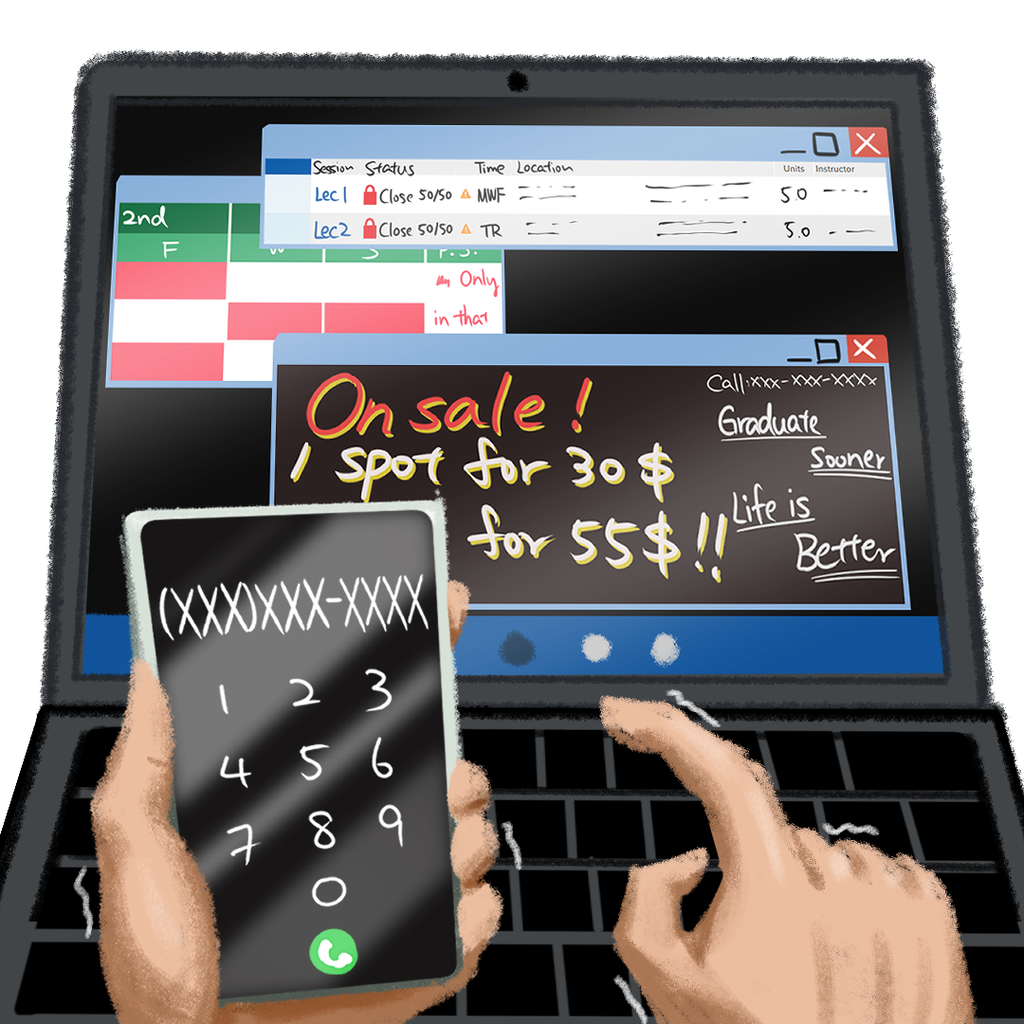
However, these decisions are more often at the department’s discretion than the instructors’. As such, some professors feel as if they can do relatively little to assist students trying to get into their classes, Ko said.
"Once general enrollment opened up, there were very few spots left in the class (LS 7A)," Ko said. "I started getting a bunch of emails from students that needed a spot in the class but couldn’t get in, and there’s no waitlist."
Departments control the enrollment capacities for their classes, according to the Registrar’s Office. Linguistics department chair Megha Sundara said that instructor and teaching assistant availability, as well as room capacity, are the two main factors that go into this decision.
"Each TA is already handling a lot of students, so to add extra students onto their roster is not right," Sundara said.
In the eyes of many students, Linguistics 1: "Introduction to Study of Language" is an investment worth fighting for. The course covers multiple GE requirements and fulfills necessary lower division courses for even several non-linguistics majors.
Sundara said the department moved the class online a few years ago because there were no physical rooms large enough to accommodate all the eager students. Since moving online, the class size has slowly increased over time, with 491 spots in the fall 2022 and 500 spots the fall 2023. If a class is full but the student absolutely needs it, the department chair will talk to the TAs individually to see if they are willing to shoulder that extra burden, she said.
But with the scarcity of PTE numbers, many students are left feeling as if enrollment pits them against one another and creates a breeding ground for buying classes. Third-year human biology and society student Logan Chin said the class-picking process can force students to view their potential classmates as competitors.
"We are all against each other when it comes down to enrollment," Chin said.
Even in spite of opportunities to capitalize off of the competition and sell his spot in popular classes for extra cash, Chin said he has never considered selling a class. He explained that he cannot focus on acquiring classes others may need when he has his own list of courses to enroll in. Chin added that the buying and selling system adds a competitive layer to an otherwise collaborative school culture at UCLA.
"The existence of this competitiveness and every-man-for-himself mindset when it comes down to the actual classes themselves is a little bit sad," Chin said.
Limited class space not only makes some students feel they lack control over their enrollment, but it can leave professors like Ko feeling powerless as well.
"What I’ve been responding is basically the same thing: that I straight up have no control over enrollment," Ko said. "They have to watch the schedule of classes and hopefully someone will drop."
Acknowledging these frustrations, the Student Conduct Office is taking steps to address the stress of enrollment. The office said in a written statement that it recently created the Degree Attainment and Student Success Task Force to respond to such concerns over the competitive nature of enrollment. Created in 2019, this committee seeks to increase graduation rates by creating initiatives for low-income, first generation and underrepresented students to get the classes they need, thus eliminating graduation rate disparities among these students by 2030.
In the meantime, the class black market continues to fill in the gaps left behind by priority enrollment and the PTE shortage. From begging older sorority members to hold classes to bidding $1,000 for Physics 5A on Snapchat, many students note the buying and selling practice still is thriving at UCLA this fall. To Bruins like Student A, the process of shelling out hundreds of extra dollars to enroll in classes now feels like an overly normalized part of school culture.
"I hope that admin sees within the next couple of years that there's been an issue with enrollment and do something about it," Student A said.
Contributing reports from Rachel Rothschild, PRIME contributor.