
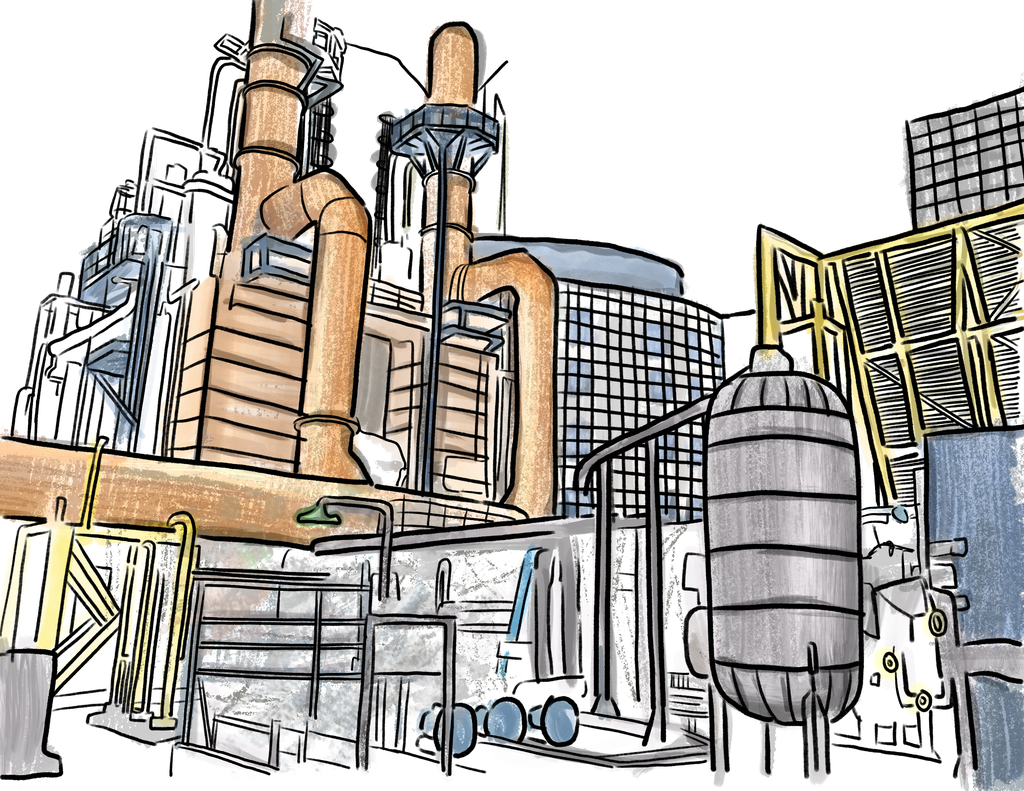
Upon first arriving at UCLA, the towering, steam-shrouded building near the Ronald Reagan UCLA Medical Center invited much speculation among my friends and I, particularly because of the ever-present clouds of steam or smoke that hung over it.
Was it a factory of some sort? An incinerator? The world’s largest hot tub?
It would prove to be none of those. The 200,000 square foot building houses a variety of UCLA Facilities Management operations – including the UCLA cogeneration plant. Formally known as the Energy System Facility, the plant produces heat and power simultaneously through the process of cogeneration, said Lewis Rosman, the director of energy services, in an emailed statement. The electricity created serves many of UCLA’s facilities.
Inside, it’s hot. It’s loud. And with good reason:
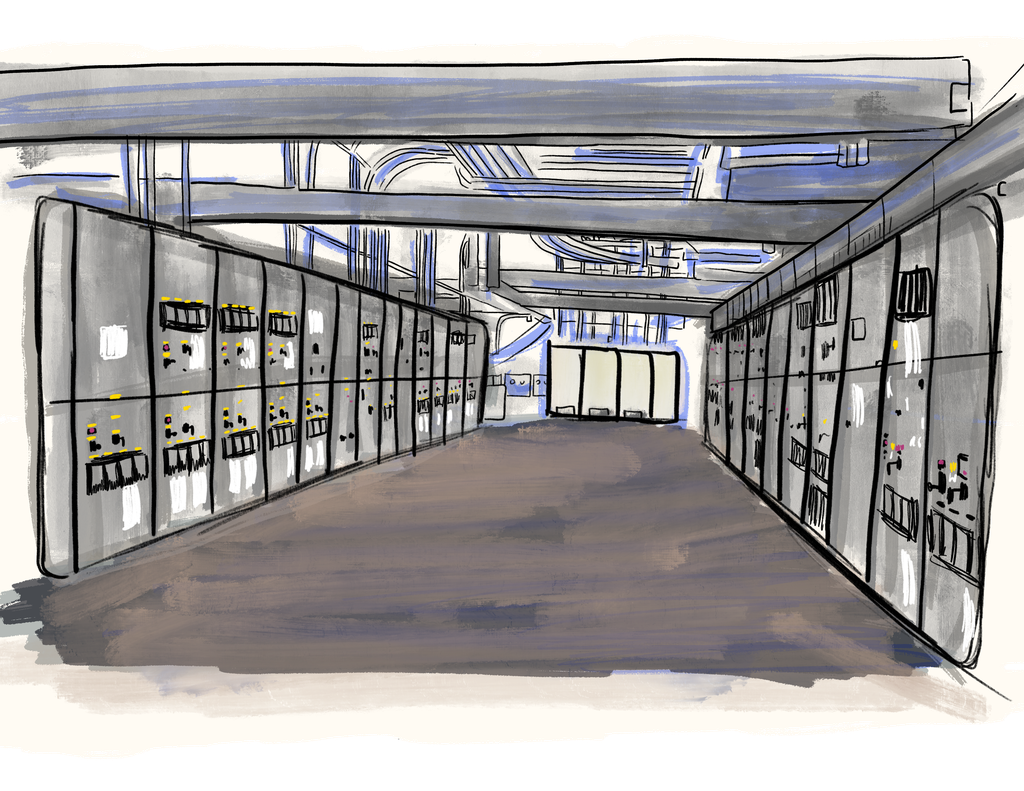
“You’re basically operating a large jet engine that has been strapped to the ground,” explained Eric Fournier, research director at the California Center for Sustainable Communities within the UCLA Institute of the Environment & Sustainability. An impressive number and diversity of pipes – a description also courtesy of Fournier – line the inside of the facility, as do support structures for seismic stability.
From the outside, an enigma. From the inside, pipes, and lots of them. The question remains: What exactly is the UCLA cogeneration plant?
The plant has its origins in the 1980s. At the time, the campus’ aging utilities infrastructure necessitated frequent repairs, which interrupted teaching and research, and stricter air quality standards demanded a change in the inefficient existing machinery. As operational costs rose and the campus planned to grow, a more efficient system became necessary, according to articles provided by UCLA. The new plant’s purpose was to provide reliable power, heating and cooling to UCLA with an increase in efficiency and a reduction in cost and emissions, Rosman said.
Documents show the site was prepared in 1991, and after about 2 1/2 years of construction, the plant began operating in January 1994. But its construction encountered difficulties. Pipeline and concrete progress was postponed by extreme rainfall, while a crane was required to lift the heat-recovery steam generator in seven pieces – each weighing 100,000 pounds – before the rest of the plant was built around it. Still, the plant demonstrated its dependability by continuing to provide power during the Northridge Earthquake in January 1994, even though it was incomplete at the time.
Architects described the building as being designed not to conceal its purpose, despite being situated unusually in an urban area – a technique called “boss design” by its architect Wes Jones. Westwood homeowners, who denounced the plant as an “ugly monstrosity,” were shocked to see it win several architectural honors, according to the Los Angeles Times.
“Boss design” aside, the technological processes the plant performed were even more complex.
“The cogen plant is really very, very, very advanced in terms of its ability to extract useful energy from the fuel that it’s burning,” Fournier said. “Not necessarily the most advanced – you could argue that there are other things that could be done. But certainly for 1994, at the time it was built, it’s definitely really cutting edge.”

Three things immediately stood out to Luke Elissiry when he first toured the cogeneration plant: the thundering jet engines, the rooms packed with steam-generating devices and the steam shrouding the cooling towers on the roof in an omnipresent fog.
Elissiry, a UCLA alumnus who studied chemistry, toured the plant as a former officer of the Student Members of the American Chemical Society to study environmentally friendly electricity production through the more energy-efficient process of cogeneration. While the outside of the plant was relatively quiet, the inside was surprisingly noisy, Elissiry said.
“It was really loud in the facility. We had headphones and earplugs, and I think we were wearing hard hats,” Elissiry said.
“Oh yeah,” he later remembered, “We had glasses too.”
According to Rosman, two engines produce electricity by burning natural gas. This process creates an excess of heat energy, which is directed to devices that use the energy to create steam with water. After the steam is formed, it can be used for one of three purposes: producing more electricity, heating campus or making cooled water.
All together, the plant can generate 42 megawatts of electricity, 26,000 tons of chilled water and 180,000 pounds of steam per hour, Rosman said. Furthermore, in addition to reducing emissions – which Rosman said would be more than 60% higher using only electricity purchased from the LA power grid – the cogeneration plant lowers operating costs by approximately $50 million each year.
“What surprised me is the scale,” Elissiry said. “I thought, ‘Oh, it’s like one turbine inside that makes a little bit of steam,’ but it’s a really large scale operation.”
A web of underground pipes carries chilled water and steam across campus grounds, Rosman said. When air blows over the steam pipes, it collects heat and is used to warm university buildings. Chilled water pipes absorb heat from the air, which cools the buildings, before the now-warm water is diverted back to the plant to be chilled again.
“UCLA is able to run a very advanced and efficient plant because they have total control over the integration of that plant with the buildings,” Fournier said. “UCLA, because it has total control of all of that, is able to build a plant that is far more advanced than you would see just out in the world.”
Originally, the plant could fulfill the energy needs of the entire UCLA campus, said Nurit Katz, chief sustainability officer at UCLA, in an emailed statement. However, as the campus has grown, the plant has struggled to meet the increase in demand. According to the UCLA Facilities Management website, the plant can now only provide enough electrical power for 85% of UCLA’s needs. The rest of the power demand is met by energy purchased from the LA Department of Water and Power.
The plant is struggling to keep up with campus energy requirements, raising questions about its sustainability.
“The cogeneration plant has been both the single largest contributor to reducing UCLA’s emissions, and at the same remains the largest source of direct emissions,” Katz said.
Presently, the cogeneration plant runs on fossil fuels. Although UCLA’s cogeneration plant can use renewable natural gas – also known as biogas – as its fuel source, Katz said the plant currently uses non-renewable natural gas because of biogas supply shortages.
According to Fournier, nonrenewable natural gas is not totally clean. It still produces significant quantities of pollutants, such as nitrogen oxides, carbon dioxide and fine particulate matter – which can lead to adverse health outcomes, including death, for sensitive populations.
“Moving forward, biogas remains challenging to source and expensive, and an alternative to the cogeneration plant that would meet the needs of the campus has not yet been developed,” Katz said. “An alternative will be highly complex and will require enormous investment.”
Despite the emissions produced by natural gas, the plant is prized for its efficiency.
According to Rosman, UCLA’s cogeneration plant is actually a trigeneration plant because it produces both steam and chilled water in addition to electricity. UCLA’s plant is twice as efficient as most power plants, Katz said.
“In sustainable systems, waste equals food,” Katz added. “That is, the waste from one process is fuel for another. Cogeneration is more sustainable than traditional power production because it uses this principle of taking the waste heat from one process and putting it to use.”
So how sustainable is the cogeneration plant really?
Fournier’s answer: “It depends what you’re comparing it to.”
The benefit of a cogeneration plant over a conventional natural gas plant, he said, is that it is more efficient; it converts 85% to 90% of the gas it starts with to useful work.
“That’s a very high system level efficiency,” Fournier said.
Sociology professor Rebecca Jean Emigh disagreed. Instead, she calls this justification in the name of efficiency “greenwashing.”
“We don’t need a glossy sustainability report,” Emigh said. “We need real, real solutions, and also just to stop the greenwashing and just to admit where something really is not sustainable.”
Emigh helped organize Earth Day protests with the organization Climate Action Now, UCLA! on April 22, in which participants marched down Westwood Plaza to protest in front of the cogeneration plant.
The plant, she said, symbolizes sustainability problems more broadly, particularly because of its high carbon emissions. Emigh said she worries that if sufficient action is not taken, global temperatures will rise beyond a point where climate change can be reversed.
“If we go beyond that, there’s a point of no return,” she said. “A lot of the looping processes will kick in, and the damage will really be quite unrepairable.”
Shutting down the cogeneration plant is a matter of climate justice, Emigh said. Because energy infrastructure is often located in low-income communities and communities of color, the gas emissions harm these groups in particular. Consequently, high rates of asthma can result amongst these groups.
“That sort of cost-benefit analysis is completely ignoring all of the cost to our planet, to our health, to our poor communities of color,” she said. “Where are those things valued?”
Additionally, as other energy sources are modernized, the cogeneration plant falls behind in sustainability.
“As the grid transitions to 100% renewables, the plant as it currently operates will no longer be lower in carbon emissions than other energy sources,” Katz said.
Ultimately, there isn’t a straightforward answer. The campus needs power to operate, and power production inevitably creates emissions.
“It becomes a question of, what is the least environmentally impactful way of solving the problem that we have to solve?” Fournier said.
As the University of California pursues plans for carbon neutrality by 2025, there is still progress to be made.
Fournier admitted that fully renewable technologies, such as solar and wind, are ideally preferred over the cogeneration plant. Yet these renewable technologies are not without difficulty as well.
“There’s a lot of challenges associated with implementing that type of solution within the context of a campus and the energy needs of a campus like UCLA,” he added.
If UCLA were to produce power using solar panels, problems would immediately arise, Fournier said. There is not enough physical space on campus to place the number of solar panels required to power the entire property. Alternative sources of energy also must maintain the reliability and quality of the current energy system; otherwise, sensitive research equipment or valuable samples that depend on constant refrigeration may be ruined.
“The campus falls into a high intentionality (intensity) energy use category that makes it particularly difficult to do things 100% with renewables,” said Fournier. “And that’s just a physical reality.”
However, not all hope is lost for the cogeneration plant and renewable energy.
“Currently, the strategy is to transition the fuel to biogas,” Katz said, mentioning a goal also outlined in the April 2022 UCLA Sustainability Plan. She added that later down the line, the cogeneration plant may be reduced to a smaller part of UCLA’s energy production.
Emigh had different ideas.
“What the sustainability office needs to be doing is sitting down and developing serious plans to get rid of that cogeneration plant,” she said.
Still, if UCLA hopes to achieve the greater sustainability goals it set out, it has a ways to go.
Fournier emphasized the importance of UCLA community members’ role as consumers of that energy in making change.
“We’re part of that (conversation),” he said. “We have to be a part of that solution as well, as the users of energy.”
Contributing reports from Rachel Rothschild, PRIME contributor.