
Here’s a fun fact: There are bees on the roof.
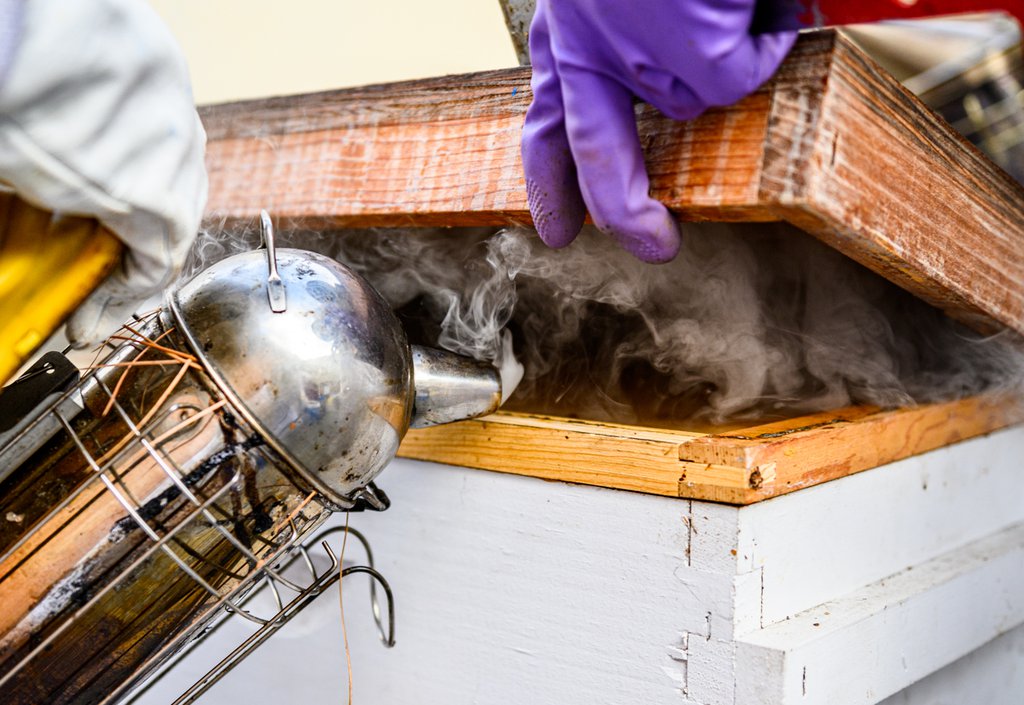
I’m standing on the rooftop of the Life Sciences Building amid two active beehives, watching a few errant honeybees lazily drift from the box Rey Soto has just opened.
"This used to be used for bird research," said Soto, a data manager in the UCLA Department of Epidemiology and director of operations for Bruin Beekeepers at UCLA. He gestured to the cages on the rooftop. "Now we're going from birds to bees."
Most UCLA students haven’t seen the hives before. They’re unassuming – just wooden boxes with vertically stacked frames of honeycomb. A couple of boxes sit in metal chicken-wire cages between the thundering air conditioning units on the rooftop. Signs above the entryways warn visitors of nearby active hives.
This setup is all well and good, but there is a slight problem. I am scared of bees.
I tell Soto this truthfully.
His response? "Just close your eyes."
So I do. But I open them soon after. There is a box of bees in front of me, and I don’t want to miss a thing.
Bruin Beekeepers leads campus sustainability efforts with its emphasis on bee conservation, education and research. The club is also a satellite branch of the California Master Beekeeper Program, a statewide education program that certifies beekeepers.
Jonathan Fox, an alumnus and founder of Bruin Beekeepers, was inspired to create the club in 2018 after listening to a talk by a local beekeeper, who accompanied his presentation with a box of bees. The talk, alongside Fox’s passion for conservation, led him to incorporate beekeeping into the club as a way to actively engage students with sustainability issues.
"No one at UCLA had been keeping bees," he said. "And so I just thought, ‘Well then why not? Why don't I do it?’"
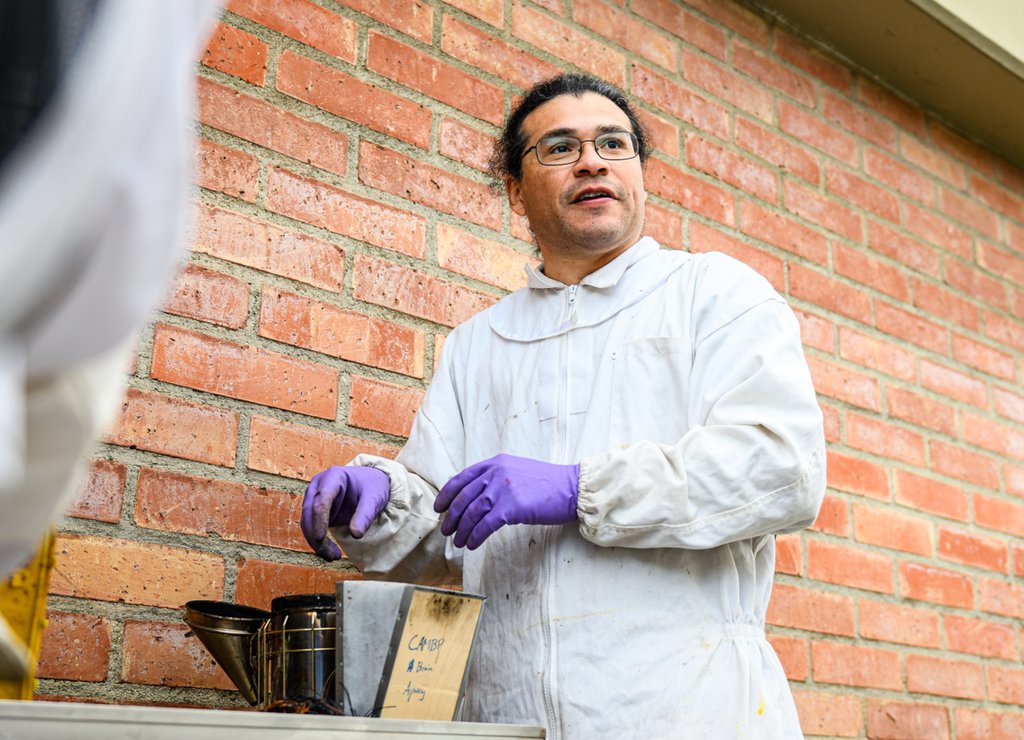
Although having hives was a goal at the outset for Fox, the expensive equipment required for honey-beekeeping prevented the new club from establishing hives immediately. But little did Fox know, another student group at UCLA also had their sights set on beehives.
It all began with an unexplained candle on a table in 2019. Members of Bruin Home Solutions, a club dedicated to student-led sustainability projects, were sitting around the table brainstorming project ideas when Kian Nikzad was inspired by the candle’s mysterious presence. Nikzad, an alumnus and former executive director of Bruin Home Solutions, envisioned a local economy project in which candles could be sustainably produced within the Westwood region. But this meant they needed beeswax.
To kick-start the process, Nikzad created Bruin Apiary as a project under Bruin Home Solutions. The Bruin Apiary team then reached out to Bruin Beekeepers and UCLA administration to pitch their idea of keeping bees on campus. This partnership created the current Bruin Beekeepers club in 2021.
The merger has enabled the club to combine both the educational and practical aspects of beekeeping into one setting, said Angela Tang, a co-director of Bruin Beekeepers and fourth-year geography/environmental studies and mathematics student.
Tang joined Fox’s Bruin Beekeepers in her freshman year while looking for a sustainability-focused club. While she didn’t know much about bees before joining, her passion for the insect soon grew.
"What really hooked me was learning that there's this whole other world of bees that most people don't really think about or know about," she said.
Back on the roof of the Life Sciences Building, I’m able to step into the world Tang has grown to love. According to Isabel Zabryanskiy, a co-director of Bruin Beekeepers and fourth-year civil engineering student, the stars of the rooftop are the two honeybee hives. She added that the club owns four additional hives at a ranch in Santa Paula, California, that also house honeybees. But even though Bruin Beekeepers only keeps honeybee hives, it dedicates its education and conservation efforts to native bees. As I soon learned, the distinction between native bees and honeybees is essential for focusing conservation efforts.
Native bees are incredibly effective at pollinating and sustaining native plants, said Hollis Woodard, an associate professor of entomology at the University of California, Riverside. In contrast, honeybees were brought to the United States in the 17th century via colonization, and their beeswax was used to make candles. Although honeybees are used for crop pollination, some native bees are more effective pollinators than honeybees, according to research from UC Berkeley. This effect is particularly noticeable in local plants, Woodard added.
Nikzad noted another important benefit of native bees: They increase an ecosystem’s biodiversity and provide unique ecological services. For example, some native bees only pollinate certain plants, and many native bees aerate the soil by living in the ground.
"There's beauty in these relationships," Nikzad concluded. "There's this spiritual aspect of it, of caring for these things."
Woodard also emphasized the ethical importance of minimizing harm and supporting native bees beyond the practical purpose of pollinating native plants.
"Equally important is the ethics of conservation, regardless of what they (native bees) do for us or for the ecosystem," Woodard said. "They deserve protection."
But pesticides, climate change and limited food resources – among other factors – have disrupted native bees’ habitats, leading to a decline in their population, Woodard said. This habitat destruction, coupled with the importance of native bees in sustaining local plants, has driven Bruin Beekeepers’ advocacy for native bees, said Zabryanskiy.
The club’s first native bee project began in 2019 in the Mildred E. Mathias Botanical Garden. What was affectionately named "the bee hotel" was assembled from stacks of chopped bamboo in a box of recycled and reclaimed wood. It encouraged native bee conservation by providing safe habitats for native bees, who tend not to live in hives. It later went on to win the sustainability project of the year award at UCLA’s Green Gala.
While honeybees might have been the more expected choice for the project, Fox and his co-founders chose to focus on native bees because of the risks they face compared to honeybees.
"We really wanted to, at least in the beginning, hammer home the whole conservation aspect," he said.
However, Zabryanskiy and her peers recently found there were more effective ways to support native bees on campus. They decided to retire the original native bee hotel project to focus on these other methods.
"We looked more into research and found that the native bees of Southern California don't really live in hotels like that close together," Zabryanskiy explained. "So we came up with a solution."
The solution in question? On the rooftop, Soto pulls out a chunk of a log attached to a long pole of rebar with holes drilled in the log. To me, it looks like an aerated marshmallow on a stick, a la s’mores. But to native bees, it looks like home.
"These holes are now nests for native bees," Soto said.
He explained that some native bees will lay their eggs in the holes. The homes will then be placed around campus, displaying scannable QR codes with more information on native bees to educate students.
Bee education is a central part of the club’s mission, Tang said. At general meetings, the club presents on topics such as the differences between native bees and honeybees – Tang’s favorite topic – and explores bees around the world. Bruin Beekeepers also educates members about the relationship between flowers and bees for Valentine’s Day, in what Tang calls "the blooms and the bees."
Bruin Beekeepers also offers and subsidizes the California Master Beekeeper course, a class for any California bee enthusiast to become a registered California Beekeeper. The course features lectures, self-guided notes, a practical exam and a written test, Zabryanskiy explained.
"Everyone at UCLA passes (the course) because we do put a lot of emphasis on it," Zabryanskiy said.

But the hives aren’t just for beekeepers – they’re also open for research. Bruin Beekeepers encourages bee research, a field Soto said is understudied at UCLA and currently lacks resources.
While on the roof talking to Soto, I’m able to witness the first use of the hives for research. Kayla Law, a third-year biology student and member of Bruin Beekeepers, arrived with a small group of fellow students to study the bees’ memory in an experiment for a class.
Zabryanskiy hopes that researchers can use the club’s hives to study honeybees as well as native bees. And bee research is important.
"We don't really know the effects of urban life on native bees in Southern California," Zabryanskiy said. "We don't have that much research on it now."
Bruin Beekeepers’ projects, including its original bee hotels, helped UCLA achieve its Bee Campus USA certification in 2020. The Bee Campus USA certification encourages universities to create habitats that support pollinators and discourage pesticides while also educating students about bee conservation, said Laura Rost, the Bee City USA and Bee Campus USA coordinator.
As UCLA reaffirms its commitment to bee conservation, there’s a lot of buzz around Bruin Beekeepers’ plans for the future. The club’s rooftop hives aren’t currently ready for honey production, but that could change soon.
"The goal is in a few years to have all the honey in the dining halls be sourced from here," Zabryanskiy said. "Maybe eventually we'll sell it."
Soto envisioned the honey stocking the Community Programs Office Food Closet, which provides free food to all students.
The second time I make it to the rooftop for a tour of the hives, I’m still wary but not as scared. The wind is higher today; it kicks at the back of my coat, and Zabryanskiy and I have to raise our voices to be heard over it. Yet the clunky machinery on the rooftop feels oddly navigable, and the bright red signs warning me about live bees on the roof are less foreboding than before.
A bee follows me around the rooftop as we move from the hives to the storage shed like an odd welcoming committee. But when I hear its telltale buzzing circling my head, I stay still.
I don’t close my eyes.