
There are a lot of things Serena Kim knows. She knows how to write an algorithm, how to construct software and how to make a website. She also knows that 600 is the typical number of job applications most students send to companies – only to get a single offer back.
For Kim, a second-year linguistics and computer science student, this rejection was something she had to learn over the course of her time at UCLA. She said many computer science students feel like they're not good enough after being turned down hundreds of times. If she, and students like her, knew that getting job opportunities was more of a numbers game than about her individual worth as an engineer, she and other students would feel more confident in themselves.
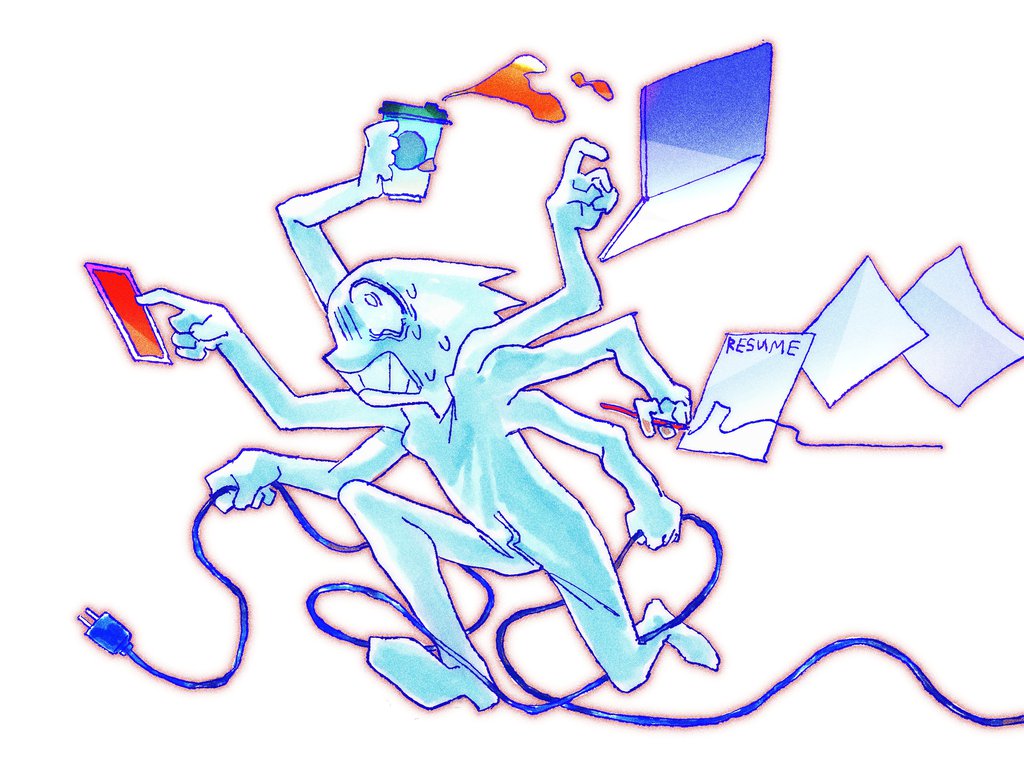
Still, the job market’s dark cloud hangs over many computer science students' heads. They see it as competitive, random, saturated, ridiculous.
"It’s a grind," Kim said.
With an increasingly saturated job market, computer science students are finding it more difficult to secure jobs or internships. Students and professors at UCLA are trying to adapt to this changing, unstable environment. Whether it’s an inward reflection on how to improve course structure or outward changes in where and how to look for jobs, the UCLA computer science community is trying to find a way to weather this storm together.
After much of the world went online after the pandemic, tech companies hired and expanded wildly. Everyone needed computers, organizations needed video call services, and people shopped online. But as the harshest days of the pandemic receded, the online economy slowed – leading to the shedding of jobs. With a limited number of jobs and increasing numbers of students enthralled by the computer science dream, the situation has become one of saturation.
In short – too few jobs, too many people.
In this new paradigm, Peter Nguyen, a third-year computer science student, said getting a job in the industry is often about random chance. He has heard of computer science students sending out thousands of applications to jobs just to get a few callbacks. Because of this desolate market, over the course of his sophomore year, he sent around 600 job applications.
"I do think about how it's definitely a lot more saturated and a lot harder to get a job nowadays," Nguyen said.
Iris Li, a first-year linguistics and computer science student, has also heard about the market’s increased competitiveness compared to a few years ago. She added that people in the job market have to have more experience, at least compared to a few years ago.
Fourth-year computer science student Jackson Steele said that during his first year at UCLA, it felt as though the job market was tanking.
"Since then, these situations have improved. It does, anecdotally, seem to be like we're at a slightly better spot than we were before," he said. "It definitely does still feel extremely competitive. There's tons of people applying for a lot of these jobs, and it's a very rigorous interviewing process."
Some students, such as Li, said they wished courses were more practical to better equip students with tangible skills needed for the industry. Instead of learning those skills in the classroom, they instead find themselves learning them at the job site.
"I know the UCLA CS program – it’s really theoretical," she said. "So if the school can help us in terms of more practical things, … it will be helpful."
The faculty of the department are aware of this criticism. Todd Millstein, chair of the computer science department, said the curriculum seeks a balancing act between courses focused on fundamentals and courses that teach modern workplace skills.
"Trying to get that balance right is something that we're often playing with and getting feedback from our students and from alumni, etc., to try to figure out how we can best prepare students for their careers," he said. "The technologies that a lot of people are using right now didn’t even exist five years ago."
Millstein said the criticism was fair in the sense that practical skills are needed, but he said fundamentals are still the main focus of the program. Many new technologies at their core have the same basic principles that govern their operation, limits and tradeoffs.
These are the principles Millstein said the department is trying to teach students.
"We are preparing you for an internship this summer," he said. "But in addition to that, we're also preparing you for the next 40 years of your career."
Not every professor is as diplomatic to criticism of being too theoretical.
Paul Eggert, a teaching professor and vice chair of industrial relations in the computer science department, said that even as one of the least theoretical department members, he broadly doesn’t agree with the critique.
Eggert, who said he’s a big fan of practical skills, is true to his word. One of the classes he teaches, Computer Science 35L: "Software Construction," is seen as very applicable to the job market by students such as Kim and Steele. Eggert also helps run the UCLA Computer Science Affiliates Program, which links companies to students, and he has spent years in the industry, even co-founding a startup.
However, he did say that course requirements may include too many outside-of-department courses, such as the full year of physics required for the major.
"Change sometimes happens slowly – it used to be you had to take a course in chemistry to get a CS degree," Eggert said. "I expect us to make further changes."
Students' reactions to this approach to education vary.
Nguyen said there is value in exploring and exposing students to a variety of topics, practical or otherwise. For example, he wouldn’t have found his niche interests in computer science without taking courses for the major, including some others view as nonpractical.
Steele said he felt well-served by aspects of the major – particularly how the classes have given him good design practices, analytical problem-solving skills and a theoretical understanding.
But even with these strong academic fundamentals, Steele felt it can still be difficult to get a foothold in the industry.
"The tech job market is rough. Especially starting out, when you don't have any relevant experience, it can be really hard to get that first experience," Steele said.
But what happens after you get the first experience?
For some students, such as Steele, return offers can eliminate the need to delve as deeply into the job market in later years of school.
"The way it tends to go is, once you get that first internship – that first shot – you can pretty reliably get a return offer," he said.
Now, Steele is excitedly heading to work for Google after he finishes the year.
Saadia Gabriel, an assistant professor of computer science, entered the field in a more unconventional way. She didn’t start coding until a seminar in her undergraduate program where she worked on a solar-powered jacket.
"That's really where I saw how many different directions you can go with computer science, and how could I make it intersect with the other interests I had," Gabriel said.
Now, Gabriel conducts research on how AI can be used to detect hate speech, securing her a partnership with Microsoft and a Forbes 30 Under 30 award in the process.
Others stumble into jobs in unusual places. Over the summer, Nguyen contributed to a coding project on GitHub, a site where everyday people post their coding products or projects for anyone to use as open-source software. One day, a company was so impressed that he was offered an internship.
While Nguyen wouldn’t say his experience is a guide, he did say learning to work with existing code is an important skill.
"There's very much a skill of finding how you still contribute meaningfully to massive code bases that weren't written by you," Nguyen said. "And that's largely what getting involved in the open-source community helped me with."
But not everyone sees reasons to despair over the job market. In fact, despite the negative press, occupations related to computer science are projected to grow over the next decade – including a projected 26% growth in computer and information research scientists from 2023 to 2033, according to the United States Bureau of Labor Statistics.
Eggert said that the notion of a job shortage may be about the industry’s skewed historical metrics.
"People got used to and heard stories about people graduating with a bachelor's and getting internships at Google or Amazon," Eggert said. "If you're used to a white-hot market, then an ordinary market doesn't look very good."
For Eggert, the past also offers reasons why not to worry.
When Eggert was an undergraduate at Rice University, there was no computer science major. When he went to graduate school at UCLA for computer science in 1975, the job market was not very good. But when he graduated in the 1980s, the job market was plentiful.
To Eggert, this cycle happens over and over again – such as during the dot-com bubble.
"If you graduate at the right time, the market's great – other times, not so good," he said.
Additionally, professors encourage students to redefine what the tech industry is, just because so many things use technology and software.
"Tech means more than just the big five, six companies that get a lot of attention, and they get a lot of attention – rightly so – because they are very important and influential," Millstein said. "But there's so much more to the tech industry."
From the student side of things, Steele said that he thinks it would be helpful if students were exposed to pathways outside traditional computer science ones. Gabriel added that students with internships should make connections with as many people as they can and to do side projects.

"You either want to come out of it with a paper, or you want to come out of it with really strong connections with the people that you were working with," she said.
For some students such as Kim, that connection can come from on-campus organizations. When Kim needed help with her resumes, her fellow club members aided her. When she needed mentorship, alumni supported her. And when she was on the hunt for another internship, an outside organization helped her achieve that goal.
While the tech world may be competitive, it's also filled with people who want students to succeed at UCLA or otherwise. Professors who want to teach fundamentals that will support a decades-long career. Organizations that connect students with prospective employers. Clubs that give students community and invaluable skills and experience.
Kim said that at UCLA, students have these tools – and more – to have a gateway into the job market.
"Reach out to those resources because they are there for a reason," Kim said. "You don't have to go through this journey alone.